
Penn Hills, Allegheny County
Trimming that holds its shape
Most of the trimming we do in Penn Hills is on maples that were planted in the fifties and have never had a proper cut. Done right, a reduction and a deadwood pass buys a tree another decade and takes the weight off your roof. Done wrong, it makes the tree more dangerous than it was.
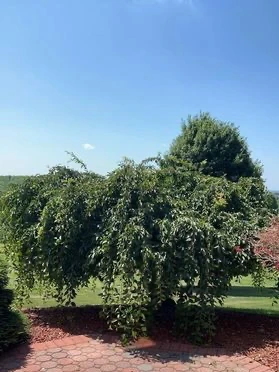
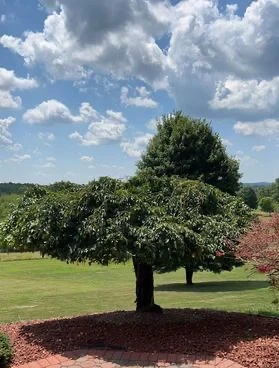
We do not top trees
Topping is cutting the main stems back to stubs to make a tree shorter. It is still the most common thing homeowners ask for by name, usually because a previous outfit sold it to them, and we will not do it. Not as an upsell position, as a straight refusal.
Here is what actually happens. A topped tree panics and throws out a mass of fast, weak shoots below every cut, called water sprouts. Within three or four years the tree is taller than it was, denser than it was, and every one of those new stems is attached to nothing but a thin collar of new wood at a stub that is already rotting. The regrowth is structurally worse than what you removed. Meanwhile the open stubs cannot seal, so decay walks straight down into the trunk.
So you pay to make the tree taller, weaker, uglier, and eventually into a removal. We would rather reduce it properly once and have you call us in eight years for a touch-up than take your money now and create a hazard you will pay to take down later.
What we do instead
Reduction cuts back to a lateral branch big enough to take over as the new leader, so the tree keeps a natural outline and the wound can seal.
The result is a smaller, lighter, better-balanced crown that still looks like a tree, and it holds that shape for years rather than exploding into sprouts.
If a tree genuinely cannot be brought down to a safe size without wrecking it, we will tell you it is a removal instead of pretending a trim will fix it.
The trimming work that comes out of this township
Different streets need different cuts. These are the ones we are booked for most in Penn Hills.
Crown reduction
The big one here. A sixty-five-year-old plan maple with its crown out over the roof gets brought in and down, cut by cut, back to laterals that can carry the lead. Takes the end weight off the limbs that overhang the house, which is what actually fails in a wind event, and lets more light onto the lawn underneath.
Deadwood removal
Clearing out everything dead in the canopy. On an older maple that has never been touched this alone can be most of a day, and it is the single highest-value cut for safety, because dead limbs are what come out of a tree in the first hard front of the season and land on the drive.
Clearance work
Lifting the canopy off a roofline, a gutter, a drive, or the mail truck’s path down the street. Branches resting on shingles hold moisture and wear the roof; branches over a drive get torn off by a delivery truck eventually and take a chunk of the tree with them.
Structural pruning on young trees
Cheapest work we do and the most useful over a lifetime. Taking out a competing leader on a fifteen-year-old tree is one cut now instead of a co-dominant union failing over your car in thirty years. Nobody calls us for this and everybody should.
Thinning, done carefully
Selective removal of some interior growth so wind passes through instead of pushing the whole crown like a sail. Overdone, it strips a tree of the foliage it needs and produces a lion’s tail with all the weight at the ends, which is worse. We take a light hand with this one.
When to cut, and when to wait
Timing matters more than people expect, and for a couple of species around here it matters a great deal.
Dormant season, roughly November to March
The best window for most of what we do. No leaves means we can actually see the structure, cuts seal fast once spring growth starts, and the ground is often firm enough to work without marking the lawn. Most of our Penn Hills reduction work is booked in this window.
Oaks, April through October, avoid
Oak wilt is the reason. Fresh cuts on an oak during the growing season attract the beetles that spread it, and this is real in western Pennsylvania rather than theoretical. We schedule oak work for the cold months unless it is a genuine hazard, in which case we treat the wound.
Summer, for a light touch
Fine for deadwood, clearance, and taking out anything that has become an obvious problem. We would not do a heavy reduction on a stressed tree in August, especially in a dry spell, because the tree is already working hard enough.
Anytime, if it is a hazard
A cracked limb over the porch does not wait for the right season. Safety beats timing every time, and we make the cut and deal with the consequences rather than leave it hanging.
What a trim day looks like at your house
Chris walks it with you first and points at what he intends to cut before anyone goes up. If you disagree with a cut, that is the moment to say so. There is no version of this where you come home to a tree you do not recognize.
Then it is climbed, not spiked. Spikes are for removals, because they wound the trunk, and putting them on a tree you intend to keep is a mark of an outfit that does not care. Cuts are made at the collar so the tree can seal them.
Brush goes through the chipper as we work rather than piling up, so the yard is walkable when we leave. Everything gets raked. If you want the chips left for mulch, say so and we will drop a pile; otherwise it all goes.
If while we are up there we find something that changes the picture, decay in a union, a crack you cannot see from the ground, you hear about it that day with photos rather than at some later point. Sometimes that conversation turns into a removal, and sometimes it is a case for cabling the union and keeping the tree.
We trim right across Penn Hills, from the plan streets off Frankstown Road out to the bigger lots near the Plum line, and through Allegheny County generally. Work in progress and finished jobs are in the gallery.
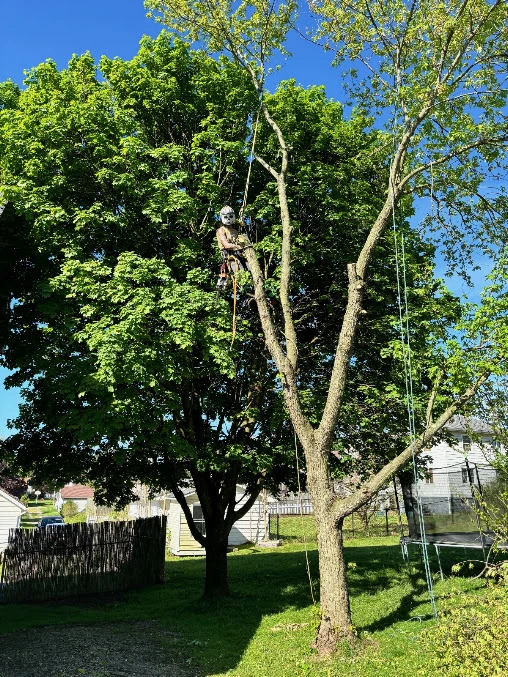
Penn Hills, Allegheny County. Sixty-five-year-old street trees, block after block.
Trimming questions from around Penn Hills
Mostly asked standing in the front yard looking up.
How often does a mature tree need this?
For a healthy mature shade tree in a yard, roughly every three to five years for deadwood and a light tidy, and a real reduction maybe every eight to ten. A tree that has never been touched needs more work the first time and then settles into that rhythm. Younger trees benefit from a structural look every two or three years while the cuts are still small.
Can you just take the branches over my roof and leave the rest?
Yes, and it is one of our most common jobs here. The only thing to watch is balance. If we take everything on the house side and nothing elsewhere, the tree is left lopsided and leaning away, which is its own problem in a wind. Usually we do the clearance you asked for plus a light pass on the opposite side so the crown stays even.
Will trimming fix my tree dropping limbs on the drive?
Usually, because the limbs coming down are almost always deadwood, and a deadwood pass takes exactly that out. What trimming will not fix is a tree dropping live limbs, which points at something else going on, and that is worth an arborist looking at rather than more cutting.
My tree is right up against the house. Is it too late to save it?
Rarely too late. A tree close to the structure can usually be reduced and lifted so it clears the roof and the gutters and stays healthy. The question is what the roots have been doing under the foundation and the walk, and whether the trunk is far enough off the wall to keep growing. Chris will give you a straight answer, including if that answer is that the tree is in the wrong place and always will be.
Do you haul the brush or do I deal with it?
We take it. It goes through the chipper as we work and leaves on the truck. Nothing gets left in a pile at the curb unless you have asked us to leave chips for mulch, which plenty of people do.
The last company topped my tree. Can it be fixed?
Partly, and it is worth doing. It is called restoration pruning: over a few visits we select the strongest of the water sprouts to keep as new leaders and remove the rest, so the tree slowly rebuilds a defensible structure. It never goes back to what it was, and the old stub wounds keep decaying, but it can be made a lot safer and a lot better looking. We will tell you honestly whether yours is worth restoring or too far gone.
Book a trim in Penn Hills
Send a photo of the tree from far enough back to show the whole crown and where it sits relative to the house. Chris will tell you what it needs, what it does not need, and what it costs before anyone climbs anything.