
The last piece
Stump grinding that finishes the job, Pittsburgh
A stump is the part of the tree everybody forgets to plan for. It dulls the mower, sprouts suckers all summer, and turns into a bug hotel in about two seasons. We bring the grinder, take it down past grade, and hand you back flat ground instead of a monument.

What the machine is doing down there
A stump grinder is a rotating wheel studded with carbide teeth, swung side to side across the stump a bite at a time. It doesn’t dig or pry. It chews the wood into coarse chips and keeps going until the whole thing is below the surface, usually six to twelve inches down, deeper if you tell us you want to plant something on that spot. The wheel takes the flare and the big surface roots on the way out too, since those are what push up through a lawn and catch a mower blade.
Depth is a real decision, not a default. Six inches is plenty if you just want grass. If a new tree, a fence post, a patio footer, or a raised bed is going in there, say so during the walk-around and we set the machine deeper and pull the roots wider. It costs us time, not a second trip, and it saves you from finding out later that there’s a dinner-plate of old oak eight inches under your new sod.
Before the wheel spins, the utility side gets handled. Every grind on our schedule gets a PA One Call ticket at 811, because gas, water, cable, and irrigation lines run shallow in older Pittsburgh yards and a carbide wheel does not care what it hits. Locates get marked, we grind around the paint, and if a line sits close enough to make the job stupid, we tell you that instead of gambling with your yard.
People ask why we grind instead of pulling stumps out with a machine. Pulling works, and on a wide-open lot with nothing to protect it can be quick. The problem is what it leaves. Yanking a root plate out of the ground opens a hole the size of a small car, drags a mess of dirt and torn root across the lawn, and takes a loader heavy enough to rut everything it drives over. You end up needing fill dirt, a grading pass, and probably new grass. A grinder works from the top down and never breaks the surrounding turf, so the only disturbed ground is the circle where the stump stood. On a normal Pittsburgh lot with a fence, a walk, and a neighbor forty feet away, that difference is the whole argument.
Why an old stump is worse company than a new one
Leave a stump alone and it starts working against you. A maple or a locust will throw suckers off the root collar every spring, and you’ll be mowing a small forest for years unless somebody kills it back. The dead wood underneath is exactly what carpenter ants want for a nest, and a nest twenty feet from your foundation is a nest looking for a better address. Then there’s honey fungus, which colonizes rotting stumps and roots and can spread to living trees and shrubs nearby through the soil.
Old, weathered stumps are still worth grinding. People assume a stump that’s been sitting since 2011 has rotted enough to just tip out. Usually it hasn’t. The top goes punky and the core stays hard, so it breaks up unevenly under a shovel and leaves a crater. Grinding handles rotten and hard wood the same way, and honestly the old ones are often the faster job. If you’ve got a couple of them scattered around the property from previous owners, we knock them out on one visit, and multiple stumps on one trip come in better per stump than doing them one at a time. Ask and we’ll put the number in writing before anything starts.
Grinding, plainly
Carbide wheel below grade, roots and flare included, 811 locates first, chips backfilled or hauled, hole raked and left ready for seed.
Insured, military discount. Chris runs the machine himself on most jobs.
See finished ground in the gallery. Pair it with tree removal or a full land clearing job and it all happens on one visit.
“Chris was wonderful to deal with, beginning to end. He was excellent at communicating what he was going to do.”
Kellie Walker, Google reviewSplitting up the work
Your list is four items long. Ours is the rest of it.
Your part
Point out every stump you want gone, including the ones hiding in the ivy. Tell us what’s going on that spot afterward: grass, a new tree, a shed pad, nothing. Mention any private lines you know about, like an irrigation run or a dog fence, since 811 only marks public utilities. Then decide whether you want the chips left or gone.
After that you can go to work. Nobody needs to be home once we know where the gate is.
Our part
File the 811 ticket and wait out the locates. Clear the stump face of rock and dirt so the teeth aren’t eating gravel. Grind it down past grade, chase the surface roots, then do a second pass at depth when something’s getting planted. Backfill with the chips or load them out, rake the area flat, and blow the drive and walk clean.
Anything the grinder can’t reach on foot gets discussed first, never improvised. Need the whole tree handled? Removal and the grind get scheduled together.
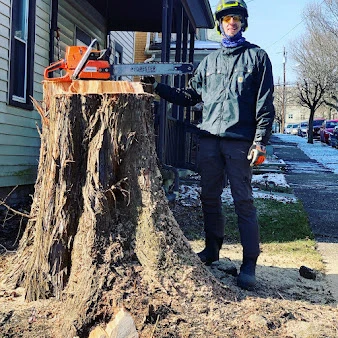

Our crew, our jobs. That stump on the left came out of an Allegheny County backyard.
Chips, dirt, and what grows back
Grinding makes a surprising volume of chips, more than the stump looks like it should hold, because the wood fluffs up as it breaks apart. You get a choice. We can rake the pile back into the hole, tamp it, and crown it slightly so it settles level over the next few months, which is the free option and works fine if grass is the plan. Or the chips ride out on the truck and we bring in topsoil for the hole instead, which is what you want if you’re seeding right away. Fresh chips tie up nitrogen while they break down, so grass planted straight into raw chips comes in thin and yellow.
Replanting on the same spot is doable with a little planning. Grind deep, pull the chips, backfill with clean soil, and set the new tree a few feet off the old center if there’s room, because the remaining root mass takes years to give up. That’s the routine on the hillside lots in Ross Township, the tight side yards in West View, and the bigger properties up in McCandless where people are usually replacing a dying ash with something that’ll outlive them. Our clay soil compacts hard around an old root plate, so loosening the backfill matters more here than it would in sandier ground.
Stump questions, answered straight
The same six come up in every driveway conversation.
How deep do you grind?
Six to twelve inches below grade on a standard grind, plus the surface roots running out from the flare. Tell us you’re planting a tree, pouring a footer, or setting a post there and we go deeper and wider. It’s a conversation at the walk-around, not an upsell later.
Do you call 811 before grinding?
Every time. A PA One Call ticket goes in ahead of the work and we wait for the locates to be marked. That covers gas, water, electric, and telecom. Private lines like sprinkler heads, invisible dog fence, or a run out to a garage are not covered by 811, so tell us where those are and we’ll work around them.
What happens to all the wood chips?
Your call. We can backfill the hole with them, tamp it, and mound it a little to allow for settling, or we load them out and leave the spot ready for topsoil. Some people want the chips kept aside for mulch beds, which is fine too. Just say which one before we start grinding so we’re raking in the right direction.
Can I plant a new tree in the same place?
Yes, with the right prep. Deep grind, chips removed, hole filled with clean soil rather than chip debris, and ideally the new tree offset a couple feet from the old center. Old roots keep decomposing underground for years and they steal nitrogen while they do it, so a fresh sapling planted straight into that mess struggles.
Is it worth grinding a stump that’s been there for years?
Usually, yes. Old stumps look rotten on top and stay solid in the middle, so they don’t pull out cleanly and they keep feeding carpenter ants and honey fungus in the meantime. Grinding an old one is often quicker than a fresh one. If you’ve got several around the property, one visit handles them all and the per-stump number drops.
What does stump grinding run in Pittsburgh?
It comes down to diameter, how many, how close the machine can get, and whether the chips stay. Nobody can answer that honestly over the phone without seeing it. Chris looks at the stumps, measures across the widest point, checks the access, and gives you an up-front number in writing. Set up a visit and you’ll have it fast.
Get the last of it out of your yard
One visit, one machine, one flat patch of ground where the stump used to be. No craters, no suckers next spring, no second contractor. In sawdust we trust.