
This is the home zip
Shaler’s tree crew already lives on your side of the line
Triple T Tree Care runs out of 15223, and 15223 sits right on Shaler’s edge. Not a service area we drive out to. The township line is a few streets from where the chipper parks overnight, so Shaler gets the shortest response we are physically capable of giving anybody.
Removals, pruning, trimming, stump grinding, storm work at whatever hour it happens. Insured, military discount, and one and done every time. Chris gives you the number up front and the crew finishes what it starts.
We know which Shaler streets flood at the bottom, which ones stand on a slope steep enough to change how a tree has to come down, and which plans went up with the same maple in every third yard. That is the difference between a crew that services the township and a crew that lives at the edge of it.
What we do in Shaler Township
Every service on the truck runs here weekly. The links go deep on each one.
Removal
Large tree removal · Tree removal · 24/7 emergency response · Storm damage cleanup
Care
Tree pruning · Tree trimming · Cabling · Bracing
Health
Tree health · Disease treatment · Arborist services
Groundwork
Land clearing · Lot clearing · Brush clearing · Forestry mulching · Stump grinding · Stump removal
Commercial
Two townships, one hill, very different trees
Shaler is not one kind of property, and anybody who has worked here a while can tell you which half of it they are driving into before they check the address. Down along the Route 8 corridor the ground is Pine Creek bottom, flat and generous and wet more often than the deeds admit. Up off the flats the land stands on end. Whole streets sit on the hillside with mature oak and tulip poplar leaning out over the back deck, roots gripping a slope that keeps sliding a little every wet spring. Same township, two entirely separate conversations about what a tree is doing.
The valley trees fail from the bottom up. Saturated bank, loose root plate, a gusty front off the creek, and a healthy-looking silver maple lies down in one piece with the sod still attached. We see it after every stretch of heavy rain along the creek streets, and the tell is almost never in the canopy. It’s the soil heaving at the base and the trunk sitting a degree or two off from where it stood last year. If the ground around your trunk has cracked open on one side, call before the next front rather than after it, because a leaner over a creek-side yard rarely improves on its own. That’s the kind of call that turns into an overnight run when it waits too long.
The hillside properties fail from the top down, and they scare people more. A big oak fifty feet upslope of your kitchen window has leverage on its side, and the neighborhoods backing onto the Fall Run gorge are full of exactly that geometry: house tucked at the base, steep wooded ground climbing away behind it, deer having chewed the understory down to bare dirt so nothing holds the surface anymore. When those slopes shed, they shed fast. Half our hillside work here is honest slope triage, walking the ground above a house and sorting the trees that need to go from the ones that need weight taken off the long side and nothing more.
Housing stock tells the rest of the story. The plans built out through the fifties, sixties and seventies got their shade trees planted at the same time, all of them the same age, all of them hitting the end of their useful crown at once. Those trees are full-grown now with sixty-plus years of untouched deadwood stacked up inside them, and a plan street where nobody has pruned since the original owner will drop something in every serious wind. The older places out at the Glenshaw valley edge came with trees that were already standing before the house went up, which is a different problem: bigger trunks, closer to the foundation, roots under the walk, and a canopy that has been keeping one side of a roof damp for a decade without anybody connecting the two.
Access is the other thing that separates Shaler jobs from flat suburban work. A hillside street means a narrow driveway, a retaining wall we would rather not crack, a shared property line six feet off the trunk, and usually a set of steps between the truck and the tree. We plan for that before we quote it, not while we are standing in your yard wondering. Sometimes it means a crane for one lift because carrying wood down forty steps by hand costs everybody more than the machine does. Sometimes it means rigging the whole tree out over the roof in pieces small enough to hand down. Either way you hear the plan before we start, not after.
And whatever the approach, jobs end the same way. The grinder puts the stump below grade before we leave, the chips get raked, and the yard looks like we were never in it. Nobody wants a crew back for a second Saturday to finish something that should have been finished the first time. That is what one and done actually means around here. We work this pattern across Allegheny County, but Shaler is the township where we know the streets by feel and the seasonal soft spots by memory.
“Absolutely fantastic work, carefully executed, highly recommend.”
John Seifert, Google reviewStraight answers for Shaler
The five things neighbors here actually ask Chris. Plenty more of the work sits in the gallery.
You keep saying you’re close. How close?
Close enough that Shaler barely counts as a drive. Our 15223 base sits on the township’s doorstep, so a walk-around usually happens within a day or two of your call and the actual work lands sooner here than anywhere else on our board. If you catch us on a day we’re already on this side of Route 8, sometimes it’s the same afternoon. It matters most in storm season, when the crews that live twenty minutes out are still working through their own neighborhoods and we are already parked on your street.
The bank behind my house washed out and now a tree is leaning toward the creek. Is that urgent?
Treat it as urgent. Once a Pine Creek bank gives up soil, the root plate on that side has nothing left to pull against, and the tree is holding on with roughly half the anchorage it had. We’ll come look, tell you honestly whether it can stand another season, and if it can’t we take it before a storm does it for free and on its own terms. Removals we plan beat removals we react to, every single time, both in how the yard ends up and in what it costs you.
Can you work a tree that’s on the hillside above my house?
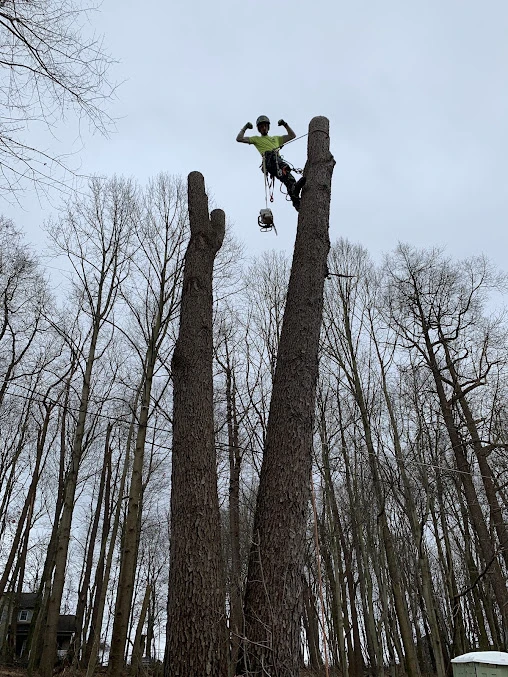
That’s a good share of what we do here. Steep ground behind Fall Run and the wooded streets above the flats means rigging from the tree rather than reaching from a bucket, and dropping wood uphill or sideways into a controlled zone instead of letting gravity vote. It takes longer than flat work. It also means nothing lands on your roof, which is the entire point. We bring our own rope, blocks and anchor points for that ground, and the climber sets them before a single cut happens.
Do I actually need this thing removed, or am I being sold?
Ask us and you’ll get the real answer. A lot of the big poplars and oaks up on the hillsides look alarming because they are enormous and they move in wind, and enormous trees are supposed to move. Frequently the fix is a proper prune: deadwood out, the heavy long limb shortened, weight pulled back off the house side. If care solves it we say so and the tree stays standing.
What’s this going to run me?
Depends completely on the tree, what’s underneath it, and whether we can get equipment near it, which is why we don’t throw guesses around on the phone. Send photos or book a walk-around and you get an up-front number in writing before anybody starts a saw. No surprises added at the end.
Something in your yard finally worth calling about?
Ring the number or send pictures. Chris walks it, you hear the price up front, and the crew clears it in one visit with the stump ground and the yard raked. In sawdust we trust.