
Forty trees, one plan
Property tree maintenance for acreage, not just yards
When you own an acre with forty trees on it, calling a tree company every time something looks wrong is the expensive way to do this. We walk the whole place once, write down what every tree needs and when, and then work that list across seasons instead of emergencies.
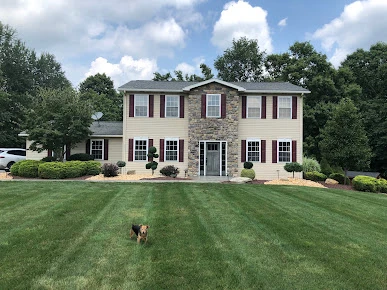
A treed property is one system, and most people manage it one crisis at a time
Here is the pattern we see on big lots all over the North Hills. A limb comes down on the driveway, so somebody gets called. Two years later a different limb comes down on the fence, so somebody else gets called. Nobody has ever looked at the other thirty-eight trees, so nobody knows that four of them are on the same track and one of them is going to be a much bigger bill in three winters than it would be this fall.
That is not a maintenance program. That is a series of surprises with invoices attached. What we do on a property plan is the opposite: one long walk, every tree looked at on purpose, and a written list that tells you what is urgent, what is watchable, and what is fine and should be left alone.
The properties this fits are the ones where the trees came with the deed. An acre and a half in Fox Chapel with a tree line older than the house. A ravine lot where the back third of the yard turns into actual woods. On places like that, treating the trees as forty unrelated problems costs more and looks worse than treating them as one canopy you are responsible for.
The walk-through, and why every tree gets a note
Chris does the walk himself. It takes a while on a big lot, which is the point. Every tree gets sorted into one of three piles, and the piles are honest.
Keepers. Healthy, well-structured, in a spot where they can be what they are. Most of your trees land here, and the correct thing to do with them is almost always nothing. Twenty-five years in this trade has mostly taught us how many trees do not need anybody touching them.
Watchers. Something is not quite right. A codominant union that will split eventually but has not moved in five years. Some crown dieback that might be drought and might be the beginning of a decline. A lean that has been the same lean since you bought the place. These trees do not get removed. They get written down, and they get looked at again on the next visit, so we are comparing the tree to itself instead of guessing.
Problems. Dead, structurally failing, or aimed at something expensive. These are the ones with a date attached, and the date is usually sooner than people want to hear. When a problem tree is over a house or a power drop, it moves to the front of the list regardless of what else is on it.
You get that list in writing. Not a sales sheet with everything marked urgent, just what we would do about each tree if it were our property.
Spreading the work across seasons instead of eating it in one bill
Very few people want to do the whole list at once, and on most properties they should not. Triage budgeting is the useful half of this service. The dead ash over the garage happens now. The four watchers get a look next spring. The woods-edge work that is really just housekeeping can wait two years without anything bad happening, so it waits two years.
Sequencing also matters biologically. Structural pruning on young hardwoods is best done in the dormant window. Storm-vulnerable deadwood is best cleared before the wind season, not after it. Oaks around here should not be pruned in the spring stretch when the beetles that spread wilt are moving. So the plan is not just a budget schedule, it is a calendar that follows what the trees actually want, and it carries year to year whether you call us in March or forget until October.
One thing that does not change: each visit closes out clean. Wood gone, chips gone, ruts graded, lawn raked. The plan spans years, the individual day does not linger. You should never be looking at last visit’s mess while we work on this one.
Where the lawn stops and the woods start
Almost every large property around Pittsburgh has an edge, and the edge is where the problems live. Inside the woods, trees grew up in competition and hold each other up. At the edge, a tree that spent forty years sheltered suddenly has open sky on one side, and it responds by leaning into it, which is exactly the direction your house happens to be.
Woods-edge management is its own kind of work. It means keeping the boundary from creeping into the lawn, taking out the volunteer trash trees that seed into that strip, watching the first two rows of real forest for the leaners and deadwood that will eventually come down across the property line, and leaving the interior alone. Most people either ignore the edge entirely or clear it flat. A managed edge takes maybe a day of attention every couple of years.
Ravine lots get the same treatment with more caution. Root plates on a slope are already working harder than they should, so a tree on a Pittsburgh ravine edge is judged on soil movement as much as canopy condition. If the ground behind the trunk has started to lift, the tree has already made its decision.
What a property plan includes
A full walk-through with Chris, every tree noted, a written condition list with priorities, and a firm price on whatever you decide to start with.
Fully insured, military discount for those who served.
See finished properties in the gallery. For the timing side of the plan read seasonal tree care, and for what we look at on an individual tree see tree health.
“Chris was very responsive and transparent with the work scope and price. Work was executed according to the defined scope.”
Matthew Salac, Google reviewBuying a house whose trees were ignored for twenty years
This is the single most common reason somebody calls us about a whole property. Here is how the catch-up year usually runs.
Year one, first half
Safety first, everything else waits. Dead trees and hanging limbs over the house, driveway, and anywhere kids play come out. Anything touching the roof or the service drop gets cleared. If a tree failed during the inspection period and nobody dealt with it, we deal with it.
This is also when we find the surprises: the hollow silver maple behind the garage, the row of dying ash nobody mentioned at closing.
Year one, second half and beyond
Now the property gets shaped. Twenty years of no pruning means crossing limbs, storm stubs, and volunteer saplings in every bed line. Structural work on the young trees pays for itself over the next thirty years.
By the end of the catch-up year the list is short and stays short. From then on it is a visit or two a year and a phone call after a bad storm. Emergency response stays available the whole time.
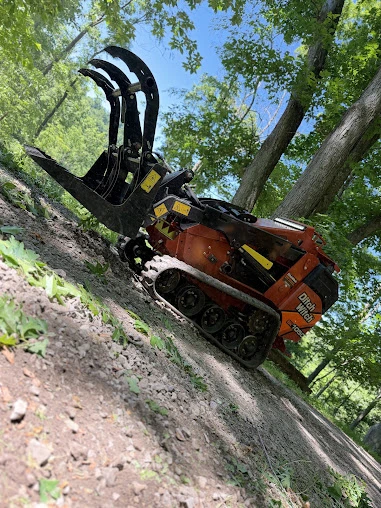

Left: moving wood off a wooded lot without trenching the lawn. Right: fall canopy work on a property we visit on a schedule.
The neighborhoods where the trees came first
Big-canopy property is not evenly distributed around here. Fox Chapel is the obvious one, where lots run large enough that the tree inventory genuinely is an inventory and the oaks and tulip poplars were established long before most of the houses. A lot of our multi-year plans live there simply because there is enough tree on a single property to justify one.
Next door in O’Hara Township the pattern shifts to hillside and ravine lots where half the property is woods and the other half is lawn, which makes edge management the main event. Down along the river in Aspinwall the lots are tighter but the street trees and the old backyard maples are just as mature, so the same walk-and-list approach works on a smaller footprint with less to schedule.
What ties all of it together is Western Pennsylvania soil and weather. Clay that holds water, spring saturation that softens root plates, freeze-thaw cycles that work on every crack, and wind that finds the tree with the weakest union. Trees on a plan handle all of that better, mostly because somebody noticed the problem while it was still small. Set up the walk-through and we will start with a list.
Whole-property questions
What people ask when the conversation is about forty trees instead of one.
How many trees before this makes sense?
Roughly a dozen mature trees, or any property where you honestly cannot say what condition your trees are in. Below that, calling about a specific tree works fine. Above it, you start paying for the same drive and setup over and over, and things get missed between visits because nobody is keeping a list.
Do I have to commit to a contract or a yearly package?
No. The walk-through and the written list stand on their own, and plenty of people take that list and do the work themselves over time. If you want us back on a schedule we will put it on the calendar, but nothing here auto-renews and nothing gets billed for showing up.
What happens to the trees on the watch list?
They get left alone and looked at again next visit. That is the whole point. A marginal tree checked three times over four years tells you far more than a one-time opinion, and it means we are not removing something that had another twenty years in it. If a watcher moves in the wrong direction, we tell you and it changes categories.
Can we do the list in pieces over a few years?
That is how most of these run. The safety items happen first, the rest gets ordered by urgency and by what the season allows. We give you the sequence with the list so you can spread the spending sensibly instead of taking it all in one hit, and the plan carries over even if you skip a year.
How do you handle the wooded part of the property?
We manage the first two rows in from the lawn and leave the interior forest alone. That means clearing deadwood and leaners that could reach the mowed area, taking out volunteer trash trees along the boundary, and holding the edge where it is. Full clearing of a wooded area is different work. That would be land clearing, and we will tell you plainly which one you actually need.
What does a property walk-through cost?
Chris walks the property, notes the trees, and gives you an up-front number in writing for whatever you decide to do. We never quote acreage over the phone because two properties with the same tree count can be completely different jobs. Get on the schedule and you will usually have the list within a few days.
Stop guessing about your own trees
One walk, one honest list, and a plan that spreads the work across seasons instead of dropping it on you all at once. In sawdust we trust.