
Cut back, cleaned up
Tree trimming that gives Pittsburgh yards their edges back
Limbs off the roof. Branches off the wire coming into your house. The maple that swallowed the end of the driveway so you back out blind. Trimming is the everyday work that keeps a property looking sharp and keeps small problems from turning into repair bills, and we cut lines straight enough that the neighbors ask who did it.
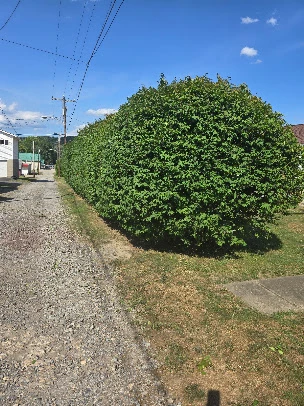
Clearance first, good looks right behind it
Most trimming calls start with something touching something it shouldn’t. Branches lying on shingles wear the granules off and hold water against the roof after every rain. Limbs hanging over the gutter drop a season’s worth of debris straight into it. And any branch that bridges from a tree to your roofline is a squirrel highway, which is how attics get residents. Pulling the canopy back three to six feet from the structure solves all three at once, and it stays solved for a couple years.
The other half of trimming is how the place looks. That hedge lane in the photo up top is a Triple T job, and Chris will happily tell you it took longer than it should have because he kept walking back to the far end to sight down the line. Hedges, ornamentals, arborvitae rows, the little maples people plant along a walk: they all want a shape, and a shape only reads right if somebody stands back and checks it instead of just running the blade at arm’s length.
Trimming is not the same job as tree pruning. Pruning is about the health and structure of the tree, taking out deadwood, crossing limbs, and weak unions so the tree grows strong. Trimming is about clearance and appearance, cutting back what’s in the way and shaping what’s in view. Plenty of properties want both on the same visit, and we’ll say which one your tree actually needs when we walk it.
The wire coming into your house is your problem, not theirs
This one surprises people every week. The line running from the utility pole to the side of your house, the service drop, is generally the homeowner’s responsibility once it hits your property, while the high lines out along the street belong to the utility. So when a limb is rubbing that drop and shedding bark dust on your porch, calling the power company usually gets you a shrug. We trim around service drops routinely, we coordinate with the utility when the work sits close to their side of the line, and we do not freelance anywhere near primary conductors. If your situation is a utility job, we’ll tell you that and save you the visit.
Sightlines are the other quiet one. A driveway apron on a Pittsburgh side street with a low canopy on both sides means you’re rolling into traffic on faith. Same for the branch that hides your house number from the delivery driver, or the one blocking the porch light. Raising the canopy eight or ten feet takes an hour and changes how the whole front of the property feels.
What a trim day looks like
Pole saws, climbing gear when the height calls for it, a chipper on the truck, and tarps down so your beds and lawn stay clean.
Fully insured, and a military discount for those who served.
See finished cuts in the gallery, or read about tree removal for the trees that are past trimming.
“Fantastic service! Would highly recommend! Very prompt and professional and did a great job cleaning up.”
Jamie Forrester, Google reviewSplitting up the work
A trim is a short visit. Your half of it is shorter.
Your part
Walk the property with us and point at what bugs you. Say whether you want strict clearance or a shaped look, because those are different cuts. Take the up-front number. Move the cars and unlock the gate on the day.
If you’re not sure what to ask for, describe the problem instead of the fix. “The gutter fills up every fall” tells us more than a branch count.
Our part
Read the trees and pick cut points that heal, at the branch collar, never a flush cut or a stub. Pull the canopy off the roof and gutters, raise it over walks and drives, clear the service drop, and shape hedges and ornamentals to a line we sight from a distance.
Then the part people actually remember: everything chipped and hauled, beds raked, drive blown clean. If a storm already did the trimming for you, that’s emergency work and it jumps the queue.
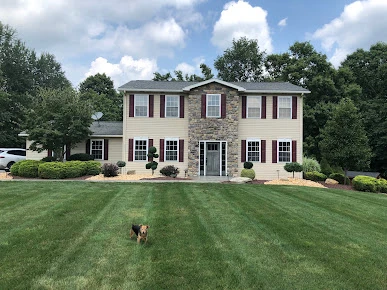

Our crew, our jobs, shot on North Hills properties.
Old streets, close houses, big canopies
North of the city the lots were laid out when the trees were saplings, and now those trees are forty feet over a roof that sits fifteen feet off the property line. In Ross Township the hillside streets put houses below their own canopies, so roof clearance is the call we get most. Down in West View the tighter lots mean a trim has to respect two properties at once, and we cut to the line rather than through it. Out through Shaler Township the yards open up and the work shifts toward hedge rows, ornamental shaping, and driveway sightlines on curving roads.
Western Pennsylvania weather does the rest. Wet springs push a season of soft growth, summer storms load that growth with water and snap the weak stuff, and freeze-thaw winters put ice weight on whatever is left hanging over your roof. A trim every two or three years keeps ahead of all of it. Ten years of nothing turns a routine visit into a big cut that stresses the tree and costs real money, and that’s the version we’d rather you never need.
Trimming questions
The ones that come up in the driveway, answered plain.
How often should trees get trimmed around here?
Every two to three years for most yard trees, and yearly for fast growers and formal hedges that need a crisp line. Trees near the roof or the service drop get checked on the shorter end of that range. Regular light cuts are easier on the tree and easier on your wallet than one heavy cut after a decade.
What’s the difference between trimming and pruning?
Trimming handles clearance and appearance: getting limbs off the roof, out of the wires, above the driveway, and shaping hedges. Pruning handles health and structure: deadwood, crossing limbs, weak unions. We do both, and we’ll tell you which one your tree actually needs instead of selling you the bigger word.
Can you trim the branches touching the line into my house?
Yes. That service drop is usually the homeowner’s responsibility, which is why the utility often won’t touch it. We work around drops regularly and coordinate with the utility when the job sits close to their equipment. We stay off primary lines out at the street, and if your situation belongs to the power company we say so.
When is the best time of year to trim?
Late winter into early spring is ideal for most Pennsylvania species, since the tree is dormant and the structure is easy to read without leaves. That said, clearance work happens whenever it needs to. A branch grinding on your shingles in July doesn’t get a pass until March. Spring-flowering trees are the one group we time carefully so you don’t lose next year’s bloom.
Do you clean up, or is that on me?
We clean up. Everything gets chipped and hauled off, beds get raked, and the drive gets blown clean before we roll out. One and done means you shouldn’t be able to tell we were there except by looking up. If you want the chips left for mulch, say the word and we’ll pile them where you want them.
What does a trim cost in Pittsburgh?
Depends on tree size, how many, access, and whether we’re climbing or working from the ground. That’s why nobody should quote you a number over the phone. Chris walks the property, looks at the actual trees, and hands you an up-front number in writing before anything starts. Set up a visit and you’ll have it in a day or two.
Get the branches off your roof before winter does it the hard way
One call gets Chris out to walk your property, one number in writing, one crew visit and your canopy is back where it belongs. In sawdust we trust.