
Ross Township, Allegheny County
The maple is leaning at your roof
That is the call we take most often from Ross. Home base is one ridge away in 15223, so a look at the tree is a short drive and a phone call, not a week of waiting.
A lean by itself is not a verdict. Plenty of trees in this township have leaned the same twelve degrees since the Eisenhower administration and will keep doing it. What matters is whether the lean is old and settled or new and moving, what is standing underneath it, and whether there is any room at all to put a stem on the ground. On a postwar Ross lot, usually there is not.
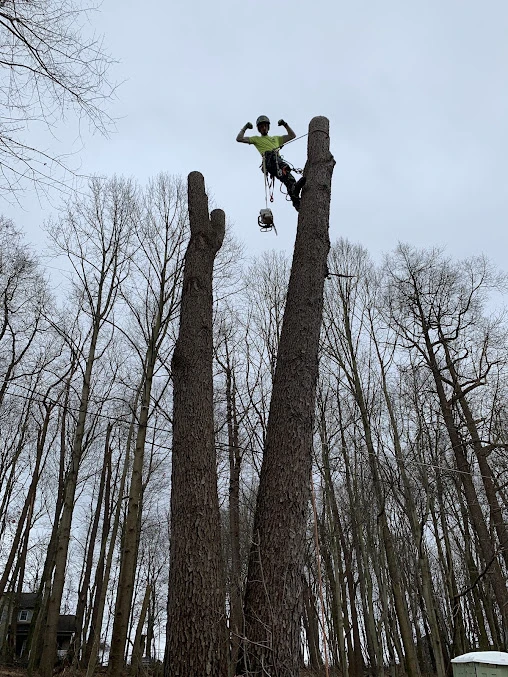
Reading a tree that leans toward the house
Somebody should stand under the tree and look at four things first. This is what Chris is looking at while you are talking.
Is the lean old or new
An old lean has a tree that corrected for it. The trunk curves back toward vertical above the bend, the bark on the underside is compressed and thickened, and the crown sits more or less over the root plate even though the base points sideways. A new lean does none of that. The trunk is straight and simply tipped, the crown hangs out past the roots, and the tree looks like a pole somebody pushed. New leans on a mature silver maple are the ones we come out for quickly.
What the ground is doing
The soil on the high side tells you more than the trunk does. A root plate that has started to lift leaves a crack or a low mound in the lawn opposite the lean, sometimes just a seam in the turf you would mow right over. If we find that, the conversation changes from scheduling to today, because a plate that has broken loose does not reseat itself.
The union eight feet up
Ross silver maples fork low and fork tight. Two stems leaving the trunk at a narrow angle trap bark between them instead of growing wood across the joint, and after six decades that seam is holding up half the tree with very little actually attached. When a tree like that leans, the lean is often the least of it. The failure, when it comes, comes out of that fork in a wet wind and takes one whole side down with it.
What is standing in the fall path
The roof, the garage, the neighbor’s fence, the service line, and on plenty of these lots an above-ground pool. The honest answer here is usually that the tree cannot fall anywhere without hitting something, which is why almost nothing in Ross gets felled. It gets taken apart.
Taking a tree apart when there is no drop zone
A drop zone is open ground long enough and wide enough to lay the whole tree down without touching anything. Most Ross Township back yards do not have one, and neither do most of the front yards, so the tree comes off in pieces from the top and every piece gets lowered on a rope instead of dropped.
The climber goes up with a saw and the rigging line. Limbs come off in an order, outside first, then the bigger wood closer to the trunk, each one tied off before the cut so it swings under control rather than falling. A second rope through a block at a higher point lets the ground crew take the weight and run the piece down slowly. Once the crown is gone, the bare stem comes down in short blocks, three or four feet at a time, each one lowered the same way.
When the piece is too heavy to swing safely over a structure, that is the point where we bring a crane in. The crane picks the section straight up and carries it away from the house instead of pendulum-ing it across the roofline. On a tight lot with a tree hard against the gutter, it is often the cheapest way to do it, because it turns a slow rigging day into a few controlled lifts.
What changes the plan
- Where the truck can park, and how far the wood has to travel to reach it.
- What is under the tree. Pool, patio, septic lid, gas meter, the fence line.
- Whether anything is touching a service line. Duquesne Light gets that call first.
- Gate width, and whether the chipper can reach the back at all.
- How soft the ground is. A ravine-side lot after a wet week is a different day.
One parking spot and a street to keep open
Getting the tree down is half of it. Getting sixty years of wood off a street with narrow shoulders and cars in front of every house is the half nobody thinks about until the day.
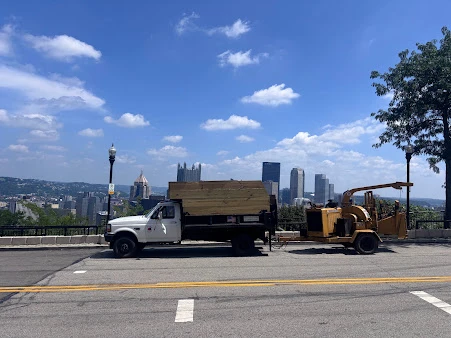
On most Ross removals the truck and the chipper get one spot, usually right in front of the house, and everything has to flow through it. Brush goes straight into the chipper. Trunk wood gets blocked to a length two people can move, then rolled or carried to the trailer. If the back yard is fenced or the grade drops away, the wood comes out by hand or by grapple rather than by driving a machine across your lawn.
We keep one lane open the whole time, and we work early on the streets where that matters. Send photos through the contact form and take one from across the street so we can see the parking, not only the tree. You get an up-front number in writing before the date goes on the calendar.
If the tree does not actually need to come out, we say so. Half the scary-looking maples in this township are a deadwood pass and a weight reduction away from another ten good years, which is trimming work, not removal work.
Nobody in Ross asks how tall the tree is once they watch the first piece come down on a rope. They ask why anyone would ever drop one.
Chris, on rigging over postwar roofsThe last decision: what happens to the stump
A removal on a small lot ends with a stump you cannot mow around and cannot really ignore. Most Ross jobs finish with the stump ground out the same visit, because the grinder is already on the truck and a second trip serves nobody. If you are planning sod or a new tree in that spot, tell the crew before they start and it goes deeper. If you want the rounds kept for firewood, say that too and they get stacked instead of hauled.
Removals that come out of weather usually arrive attached to other work. A tree down across the yard in a front is an emergency call first and a cleanup afterward, and the standing trees beside the one that failed deserve a look while we are there. We cover all of Ross Township weekly, from the West View line out along McKnight Road, and the rest of Allegheny County on the same rotation. Our tree removal page covers the work in general, and past jobs from around the North Hills are in the gallery.
Ross Township, Allegheny County. Postwar plans, the McKnight Road corridor, and the wooded runs off Babcock.
What Ross homeowners ask before a takedown
The questions that come up on nearly every walk-around in this township.
My tree leans but it has leaned for years. Does that mean it is fine?
Often yes. A tree that has leaned for decades has grown wood to hold that position and is usually stable. What worries us is a lean that changed. If the angle is new, if there is a crack or a raised seam in the lawn on the high side, or if the soil is bulging on the low side, the root plate is moving and the tree needs looking at now.
Do you have to climb it, or can you just cut it down?
On a Ross lot, almost always climb it. Felling a tree whole needs open ground longer than the tree is tall and most lots here do not have that anywhere. The crown comes off in roped pieces and the stem follows in short blocks. It takes longer than a fell and it is the reason nothing lands on your roof.
When do you bring a crane instead?
When a section is too heavy to swing over a structure safely, or when the tree is hard against the house and there is no rope angle that moves wood away from the roof. The crane lifts each piece straight up and sets it in the street. On the right tree it is faster and steadier than rigging, and the number often lands close to the same place.
Will you drive machinery across my lawn?
Only if the ground will take it, and we tell you before the day either way. On soft ground we mat the route or move the wood by hand rather than leaving ruts. Ross lots by the wooded runs stay wet well into spring, and on those we plan the work around the grade instead of fighting it.
How much wood is left behind when you are done?
None, unless you ask for it. Brush goes through the chipper, trunk wood goes on the trailer, and the lawn gets raked before we pull out. If you want rounds for a fire pit or a stove, say so when you book and the crew stacks them where you want them instead of loading them.
Can you take two or three trees on the same visit?
Yes, and it is usually the better way to do it. The setup cost of getting a crew and a chipper onto your street is the same for one tree as for three, so trees that are all due within a couple of years are worth handling together. Neighbors on the same block often go in on one visit for exactly that reason.
Point us at the tree and we will tell you straight
Call Chris and describe it, or send two photos, one close and one from across the street so the access shows. You get an up-front number in writing, then one visit: the tree down, the wood gone, the stump ground, the lawn raked. Questions about scheduling go through the contact page any time.