
The dig itself
Stump excavation, from the first shovel to the last pass
Once you’ve decided the roots have to leave, everything that matters happens below the grass. This is the machine work: reading the root plate, opening the ground without cratering the yard, hand-digging where the utility marks say hands only, and getting a couple tons of wood-laced dirt off the property without wrecking the lawn on the way out.
What’s actually down there
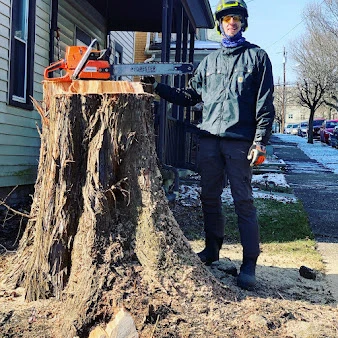
The stump you can see is the small part. Under it sits a root plate, and it’s a piece of engineering the tree spent decades building. Big buttress roots flare off the trunk like the legs of a tripod, each one thickest where it leaves the collar and tapering out toward the drip line. Below the flares, sinker roots drive straight down out of the buttresses, and those are the ones nobody expects. On a mature maple in Pittsburgh clay, a sinker can go three or four feet before it splits into hair. The whole mass, wood plus the soil locked into it, routinely weighs three times what the visible stump does. People look at a knee-high stump and picture a bucket of firewood. What comes out of the hole fills a truck bed.
That shape decides how the dig runs. You cannot pull a root plate straight up, because the sinkers are anchoring it like tent stakes and the buttresses are wedged into undisturbed soil on all sides. Yank on it and one of two things happens: the machine loses traction and just spins, or the plate comes free all at once and takes a four-foot ring of your lawn with it. Neither one is a good afternoon. So the plate gets cut free before it gets lifted, and the order of the cuts is most of the skill.
Chris reads the flare before the bucket touches dirt. Where the buttresses run tells him where the mass is, and where the mass is tells him where to open first. A tree that spent forty years leaning downhill built its heaviest anchors on the uphill side, so that’s the side that gets excavated last, when there’s room to work it loose without the whole thing rolling. Twenty five years of digging these teaches you which direction a plate wants to go before it decides to go there.
Cutting the plate loose without cratering the yard
The working method is a trench, not a crater. We open a narrow ring around the collar, deep enough to expose the buttress flares and no wider than it needs to be. Then the roots get cut at that ring, one at a time, with the saw or the bucket edge depending on diameter and how much grit is packed around them. Cutting roots inside a tight ring instead of ripping them out at the drip line is the difference between a repairable hole and a lawn that needs to be re-sodded from the patio to the fence.
With the laterals cut, the plate is still sitting on its sinkers. That’s where the machine rocks it. A few controlled pushes from opposite sides break the vertical anchors in tension, which they hate, and the mass starts to move as a unit. Once it’s loose you feel it more than see it. Then the grapple takes it out in one piece if the access allows and in halves if it doesn’t, and the hole underneath is a clean bowl instead of a torn-up mess with roots still bridging the bottom.
Hand work is part of this on plenty of jobs. Tight side yards, roots running under a walk you want to keep, a foundation corner six feet away. There the shovel and the mattock do what the machine can’t do carefully enough, and yes it takes longer, and yes we’d rather spend the extra hour than explain a cracked sidewalk. This page is the how. If you’re still deciding whether the whole plate needs to leave at all, the stump removal page is the decision page and it lays out grinding against digging in plain terms.
How the dig runs
Locates first, then a ring trench to the buttress flares, roots cut at the collar, sinkers broken in tension, plate lifted out whole, spoil separated and hauled.
Insured, PA HIC #163598, military discount, one and done.
Excavations in progress and finished ground are in the gallery. Next step after the lift: stump hole filling.
“Chris was very responsive and transparent with the work scope and price. Work was executed according to the defined scope.”
Matthew Salac, Google reviewDigging where the lines are
Every stump in a developed neighborhood is near something buried. Here’s how that gets handled instead of hoped about.
Before the ticket
PA One Call goes in ahead of the work and we wait out the full notice period. Gas, water, electric, and telecom get painted. That is a legal requirement on any mechanized dig in Pennsylvania, and it is also the reason we will not do a same-afternoon excavation no matter how badly somebody wants the stump gone today.
Locates only cover public utilities. Your irrigation, dog fence, downspout drains, the electric run out to the garage, and whatever a previous owner buried are yours to point at during the walk-around.
Inside the tolerance zone
Pennsylvania gives every marked line a tolerance zone on both sides of the paint. Inside that band the machine stays out of it and the digging is done by hand until the line is exposed and we can see exactly where it runs. A gas service is usually shallower than people assume, and roots have often grown around it.
Sometimes the answer is that a root stays. If a buttress is welded to a utility line, we cut it back and leave the last section rather than risk the strike, and we tell you that’s what happened. Storm damage that put a tree over the lines instead of beside them is emergency work, different day, different call.

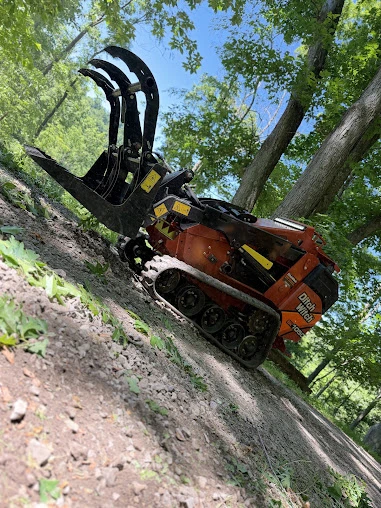
Our machine, our crew, our jobs around Allegheny County.
Spoil, mud, and the reality of a spring dig
The dirt that comes out of a root plate is not dirt you want back in the hole. It’s laced with cut root, bark, and fine wood, and every bit of that wood is going to rot and shrink over the next decade. Put it back and you’ve built yourself a slow-motion sinkhole. So the spoil gets separated at the truck: the wood-heavy material leaves with us, and clean fill comes back in from outside. It’s the single most common shortcut in this trade and it’s invisible for about two years, right up until the lawn dishes out or the pavers start to rock.
Then there’s the clay. Ground around Shaler Township, Etna, and Millvale holds water like a bathtub, and in March and April an open stump hole becomes one. Water finds the void, the sides slump, and a machine parked next to it starts making ruts you can lose a boot in. Our answer is to keep the hole open for as little time as possible, pump or bail it when the weather forces our hand, and mat the travel path so the tracks ride on plank instead of saturated turf. On the worst spring days the honest call is to wait a week, and Chris will say so rather than hand you a churned yard and an up-front number that didn’t cover the repair.
Steep lots get one more look. These hillside streets mean a root plate is often holding soil on a grade, and pulling it out leaves a void where a structure used to be. That gets filled and packed the same day, never left open overnight, because one hard rain on an open hole in a slope is how a stump job becomes a drainage job. Walk it with us and we’ll tell you what your ground is going to do.
Questions about the dig
The ones that come up once the machine is on the trailer.
How deep does the excavation actually go?
Deep enough to get under the sinker roots, which on most mature hardwoods in this soil means somewhere between two and four feet at the center, shallower out toward the ring. Species and drainage change it. A shallow-rooted spruce comes out of a smaller bowl than an oak of the same diameter, because the oak sent anchors straight down and the spruce spread sideways instead.
How wide will the hole be when you’re done?
Figure the disturbed area runs roughly one and a half to two times the width of the trunk flare, plus a working ring around it. On a two-foot stump that’s a hole a person can stand in comfortably. We keep the ring tight on purpose, because every extra foot of open ground is more fill coming in and more turf to put back.
What happens to all the dirt you dig out?
It gets sorted. Material full of cut root and wood leaves on the truck with the plate, because buried wood rots and whatever sits on top of it settles. Reasonably clean soil off the top can go back. Anything short after that gets made up with fill hauled in, so the hole closes with material that will hold instead of material that will disappear.
Can you dig a stump that’s tight against my foundation?
Usually, and it turns into mostly hand work. The machine opens the outboard side, then the last couple feet near the wall get dug with shovels so nothing bumps the block or a footing drain. If the buttress has actually grown into the foundation we stop, show you, and talk through options rather than pulling on something attached to your house.
Do I need to be home while you dig?
Not for the whole day, but be there at the start. Ten minutes walking the yard with Chris to point out the private lines and confirm the machine’s path is worth more than any phone call. After that, move the cars off the driveway if we’re staging there and go about your day.
Can you excavate in winter or during a wet spring?
Winter is often better than spring here. Frozen ground carries a machine well and the spoil comes out in chunks instead of soup. Saturated spring clay is the hard one, and if the yard is going to get torn up worse than the stump is worth, we’ll tell you to give it a week. Deadlines get worked around when a builder is waiting. Get on the schedule and we’ll pick the window together.
Let’s look at what’s under it
Chris walks the yard, reads the flare, checks the access, and puts a written price in your hand before a shovel moves. One crew digs it, hauls the spoil, and closes the ground behind itself. In sawdust we trust.