
On your calendar
Construction site clearing that keeps the build moving
If excavation starts Monday, the trees are gone Thursday. Triple T works as the tree sub on active Pittsburgh job sites for builders, remodelers, pool installers and excavation outfits. Certificate of insurance before we roll in, scope in writing, and a crew that knows how to share a site with three other trades.

The tree sub nobody has to babysit
General contractors do not call a tree company because they like trees. They call because something with a trunk is standing where a foundation, a pool, an addition, or a haul road has to be, and every day it stands there is a day the next trade is sitting idle. That is a scheduling problem wearing bark.
So the way we work a construction site looks almost nothing like a homeowner’s backyard. On your site the customer is a calendar, and the finish detail is whether your excavator can start at seven the next morning without stopping to ask somebody a question. That changes what time we mobilize, how the wood leaves, and where the machines park.
Chris is on site for the walk with whoever is running the job, not a salesman with a tablet. Twenty five years in the trade means he has stood on enough active sites to read the sequence before you explain it: what has to be clear for the survey stakes, what can wait until after the footers, what is going to be in the way of the concrete truck’s swing. That conversation takes fifteen minutes and it saves a change order later.
Mobilizing on the builder’s clock, not ours
Every job we take on an active site starts with one question: what date does the ground have to be open. Not what date would be nice. The real one, the one the excavator or the pool crew or the framing package is already booked against.
Once we have that, we commit to it or we tell you straight that we cannot. There is no third option where we say yes, show up a week late, and let you find out on the day. We would rather lose the job on the phone than lose your next four jobs by blowing a Thursday.
Weather is the honest exception. Saturated clay on a hillside site means our loader will rut your access before it does anything useful, and that damage becomes your problem when the concrete trucks come in behind us. When rain moves a date we call you the night before, not at nine the next morning, so you can shuffle the trade behind us instead of paying them to stand around.
Working a site that already has four crews on it
Plenty of our construction work happens after the job is underway, which means we are dropping wood while somebody else is running a trencher forty feet away. We check in with the superintendent before the first cut and again before we leave. We stay out of the laydown yard, keep the chip truck off the pour, and rope pieces rather than free-drop them when there is anything on the ground worth protecting, which on an active site is almost always. If the utility drop is live and the tree is near it, that gets coordinated before saws run, not discovered mid-climb. And when a piece of your equipment is parked in our fall zone, we come find you instead of working around it and hoping.
Access is the number that quietly runs the whole job. A site with a gravel entrance and room to swing a loader clears fast. A tight infill build where every stick comes out through one gap between a construction fence and a neighbor’s driveway takes longer, and we tell you which one you have during the walk so your schedule reflects reality.
Surprises get scoped in writing, not discovered on the invoice
Mid-project tree surprises are their own category on a build. The survey missed a grove behind the tree line. The lot has a buried row of old locust the topo never showed. A tree that looked fine at the walk turns out to be hollow once we get a saw into it, or the neighbor takes an interest in a trunk that is technically two inches on your side of the line.
None of that is unusual and none of it is an excuse to pad a bill. Extra work gets scoped, described, and priced in writing before the saw touches it. You approve it or you do not. If you do not, we finish what was originally scoped and leave the rest standing. A sub who quietly adds trees and explains it later is a sub who costs you a fight with your own client.
The reverse holds too. If the walk-through number covered eleven trees and only nine actually need to come out once we are into it, that comes off the number. One and done means the job is right the first time, and it means the paperwork matches what happened on the ground.
Paperwork we already have
Certificate of insurance sent to your office before mobilization, additional insured on request, and a crew that signs into whatever site safety plan you run.
Fully insured, and a military discount for veteran-owned builders and homeowners alike.
Finished sites are in the gallery. Pre-build work for a homeowner is site preparation, and a vacant parcel cut to the pins is lot clearing.
“Chris was very responsive and transparent with the work scope and price. Work was executed according to the defined scope.”
Matthew Salac, Google reviewHow the trade handoff works
You have a schedule to protect. Our column is the long one for a reason.
Your part
Send the address, the plan set or a marked-up aerial, and the hard date the ground has to be open. Tell us which trades are on site that week and who runs the gate. Say what stays: a specimen tree the owner is paying to keep, a line of screening the buyer wants, the pole guy wire.
Point us at whoever needs the certificate of insurance and we send it before the truck moves. Then approve the number and give us the window.
Our part
Walk the site with your super, mark what comes out, and put the price on paper before anyone signs. Mobilize on the agreed morning, stage off your travel path, and take the trees down in the sequence your build needs rather than the sequence that is easiest for us.
Rig anything over your equipment or a neighbor’s structure, pull stumps where footers and utilities are going, chip and haul as we work so nothing piles up, and clear the site so the next machine starts clean. Storm damage on a live job goes through emergency tree service, usually same day.
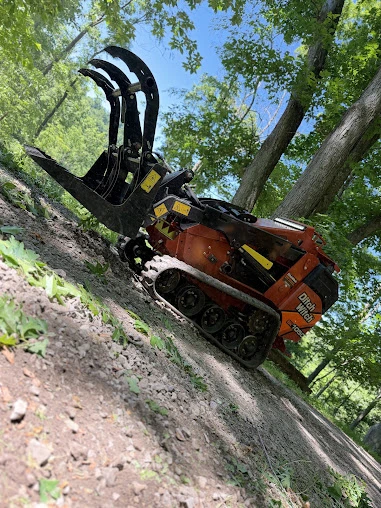

Our crew and our iron on working sites around Allegheny County. No stock library.
Phasing a build that cannot stop
On anything bigger than a single lot, clearing is not one event. Clearing everything on day one just means the first cleared ground grows back and erodes while framing runs. So we phase with you: clear what is being built on, leave the rest as standing screening and stormwater cover, and come back on a date instead of a guess.
That approach shows up on the pad sites out toward Cranberry Township, where new construction runs in sequences and the site work has to stay ahead of the trades without getting so far ahead that the ground sits open all winter. In Moon Township a lot of the work is commercial and light industrial, so the clearing has to respect an operating business next door and a traffic pattern nobody can shut down. Around Robinson Township the builds tend to be tight to existing retail and housing, which means rigging over occupied structures and a very short list of hours when a chipper is welcome.
Pittsburgh ground adds its own habits. Hillside sites mean fall zones run downhill and machine travel has to be planned instead of improvised. Old fill and buried slab edges sit right where a stump wants to come out, so we probe before we pull. And a wet week on clay turns your access road into a rut field, which is why we stage on one defined path from the entrance in and keep the loader off everything else.
Contractor questions
What supers, builders and site foremen ask before they put us on the schedule.
Can you hit a hard date the rest of my schedule is built on?
That is the only kind of date we take on a construction job. Tell us the morning the excavator or the pool crew is booked and we either commit to being clear and off the site before it or we tell you on the phone that we cannot make it. Rain is the one honest exception, and if it moves the date you hear from us the night before so you can shuffle the trade behind us.
Do you carry insurance and can you send a COI to my office?
Fully insured, and the certificate goes to whoever you name before we mobilize. If your GC agreement requires the owner or the general listed as additional insured, say so when you send the address and it goes on the certificate the first time instead of after a phone tag round.
What happens when we find trees nobody scoped?
You get a written change order before anything extra comes down. We walk the surprise with you, describe exactly what is coming out, put a price on it, and wait for a yes. If the answer is no, we finish the original scope and leave the rest standing. Nothing gets added to your invoice that you did not approve while the crew was still on the ground.
Can you work while my other trades are on site?
Yes, and most of our construction work happens exactly that way. We check in with your super before the first cut, stay clear of the laydown yard and any fresh pour, and rig pieces instead of free-dropping them when equipment or materials are anywhere near the zone. If your machine is parked where a limb has to land, we come find the operator rather than working around it.
Will you clear in phases on a bigger build?
Regularly. Clearing everything on day one means the first phase erodes and grows back while your framers are still on phase one. We open what is being built on, leave the rest as screening and cover, and return on a scheduled date for the next section. Give us the phase calendar and we will build our mobilizations around it.
What does clearing an active job site run?
It comes down to tree count and size, stump work under footers and utilities, access, and how tight the schedule is, which is why nobody serious prices it off a photo. Chris walks the site with your super and hands you an up-front number in writing, usually within a day or two. Set up a walk-through and you will have something you can put in a bid.
Put a date on it and we will hold it
One walk with your super, one written scope, one mobilization, and the site is open for whoever digs, pours, or frames next. One and done. In sawdust we trust.