
When a rake stops being funny
Leaf removal for yards with grown trees in them
Three mature oaks do not drop a lawn’s worth of leaves. They drop a dumpster’s worth, twice, and the second load lands after the borough vacuum truck has already made its last pass. We come with the truck, the blowers, the tarps and the crew, and the leaves leave the property with us.

Tree-scale leaf fall is a hauling problem, not a chore
A single ornamental in a front yard is a Saturday and a rake. A property carrying three or four full-grown oaks is something else entirely. Those canopies spread sixty feet across and shed a layer deep enough that you cannot see the grass through it, and the pile does not compress the way people expect. Homeowners who try it themselves usually get one section done, run out of bags, and then discover the borough will not take forty of them anyway.
That is why our version of this work is built around removal rather than tidying. Blowers move the volume out of the corners and off the beds, tarps carry it in loads a person could not drag, and the whole thing goes onto the truck and off your property in one visit. The lawn gets a final pass so it looks combed, not scraped. Same one-and-done idea we bring to everything else, applied to a job most people underestimate until they are standing in it.
Pin oaks do not read the calendar
Here is the thing nobody warns you about when you buy a house with oaks. Maples and ashes drop clean and early. Pin oaks and some of the young red oaks hold their brown leaves through December and into January, a habit called marcescence, and they release them in dribs all winter long whenever the wind gets serious. If your plan was one visit in early November, those trees will make a liar out of it.
We are honest about that up front. On oak-heavy properties the sensible pattern is a main clear once the bulk is down and a lighter return trip once the stragglers finish, and we tell you which of your trees are the guilty ones during the walk-around. Nobody likes paying twice for something they thought was finished, so we would rather set the expectation in October than argue about it in January.
What a packed leaf mat actually does down there
Leaves left to sit are not neutral. Under a few inches of wet matted leaf, turf goes hypoxic and comes out of winter as bare mud that crabgrass finds first. The mat also makes a covered runway for voles, who spend the cold months eating grass crowns and girdling the bark on young trees where you cannot see it happening. Against a foundation, a damp leaf pile holds moisture on the sill and stains masonry, and it invites everything that likes to live in a dark wet place next to your house.
Then there are the drains. Every yard inlet and every areaway grate in this town becomes a strainer in November. A blocked one sends water where the grade was never designed to send it, usually toward a basement wall. Clearing the leaf load off those drains is a small piece of the visit and quietly one of the most valuable.
The homeowners who feel this most are the ones with a lawn they actually care about. You can spend a season on seed, water and fertilizer and then hand all of it back by letting a heavy mat sit on the grass from Thanksgiving to March. Getting the load off before the first real freeze is the cheapest thing you can do for turf you already paid to grow.
What shows up
Backpack and wheeled blowers, tarps sized for real loads, rakes for the bed work that machines cannot do, and a truck that takes the whole pile away.
Fully insured, and a military discount for those who served.
See finished properties in the gallery, or pair this with a full yard cleanup and the seasonal care calendar.
“Triple T came and fell a broken pine tree in my front yard. They were in and out in about an hour and left my yard looking better than ever.”
A Google reviewerBeds and lawn get opposite treatment
The honest answer is that leaves are good for some parts of your yard and bad for others, and a crew that treats the whole property the same way is doing half of it wrong.
Out of the beds
Whole leaves blown into planting beds settle into a dense shingled mat that sheds water instead of letting it through, and it stays wet against the crowns of perennials and the base of shrubs all winter. Rot and rodent damage follow. Beds get cleared out by hand, including the awkward strip behind the foundation plantings where a blower just packs things tighter.
Big flat leaves are the worst offenders. Sycamore, Norway maple and the broad oak leaves overlap like roof shingles once they are wet, and by February that layer has turned into something closer to felt than mulch. Pulling it off in spring takes the top inch of your bed with it.
Chopped, they earn their keep
Shredded leaves are a genuinely good winter mulch, and there is no reason to haul away material your yard wants. Where a property has open bed space or a wood line, we can chop a portion and lay it where it will break down and feed the soil instead of smothering it. Tell us during the walk-around and we plan the split. The rest rides out on the truck.
The difference is entirely in the shredding. Chopped leaf breaks down over one winter, lets rain through, and holds soil temperature steady through the freeze-thaw swings that heave shallow roots around here. Whole leaf does none of that. Same material, two completely different outcomes, decided by whether anyone ran it through a machine first.
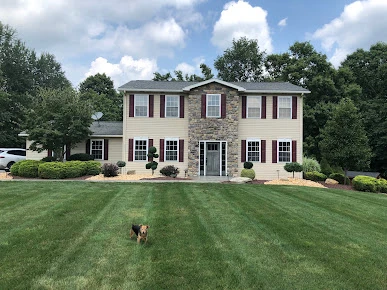
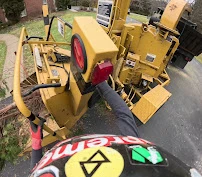
Left: how a property reads when the leaf load is off it. Right: our crew, our machine, our photos, not a stock library.
Wet leaves on a Pittsburgh hill
Nobody talks about the slip hazard until somebody goes down on it. A layer of wet leaves on old brick sidewalk is genuinely slick, and this region has more of both than almost anywhere. On the terraced streets in Edgewood, where front walks climb from the sidewalk to the porch in three flights of steps, a leaf-covered tread is a real risk for anyone carrying groceries. Same story on the steep approaches in Swissvale and along the older blocks of Wilkinsburg, where mature street trees dump straight onto public walks that you are responsible for keeping passable.
The municipal side has its own rules and they rarely line up with the trees. Some communities want paper yard-waste bags at the curb on a specific day, others run a loose-leaf vacuum on a published route, and almost all of those programs wrap up before the oaks are finished. When the schedule and the canopy disagree, hauling is the only clean answer, and that is what we do.
We clear ground level and low roof edges where leaves collect on porch roofs and dormers within safe reach. Full gutter cleaning is a separate trade with its own gear and its own liability, and we will say so rather than pretend otherwise. What we will do while we are there is look up. Bare crowns in late fall show every dead limb, every split union and every hanger that the summer canopy was hiding, so a leaf visit doubles as a free read on the trees themselves. More than a few of our winter removals started as somebody’s leaf job. Ask for the walk-around and you get both.
Leaf questions
What people actually ask standing in their front yard in November.
My trees are not done dropping. Should I wait to call?
Call anyway and we will time it. On maple-dominant properties one visit after the bulk is down usually covers it. On oak-heavy lots we plan a main clear plus a lighter return once the late holdouts let go, because a single November trip on a pin oak yard is a trip you will need to repeat.
Can you just blow them into the woods behind my house?
Sometimes, and we will tell you honestly whether it is a good idea on your lot. A thin scatter along a wood line is fine. A deep bank of leaves piled against tree trunks at the edge holds moisture on the bark and creates exactly the rodent habitat you do not want twenty feet from your foundation. If the volume is heavy, it goes on the truck.
Do you take the leaves with you or bag them for the borough?
We haul. A big-tree property makes more volume than any curbside program will accept, and municipal pickup windows tend to close before the oaks are through. If your community runs a vacuum route and the timing genuinely works for your trees, we will say so instead of charging you to remove something the truck was coming for anyway.
Will the blowers tear up my grass or wreck the beds?
No. Blower output gets throttled down near planting beds and mulch, and bed work is done by hand where machines would just pack things tighter or scatter your mulch across the lawn. The turf gets a final light pass so the yard reads combed rather than stripped.
Do you clean gutters while you are here?
We clear leaves off ground level and off low roof edges like porch roofs and dormers we can safely reach. Full gutter service is its own trade with its own equipment, and we would rather point you to somebody who does it right than half-do it off a ladder that is not ours.
What does leaf removal run for a property like mine?
It comes down to canopy size, how much of the property is bed versus lawn, access for the truck, and whether your trees need one trip or two. Chris walks it, counts what is actually up there, and hands you an up-front number in writing before anything starts. Set up the visit and you will have it.
Get them off the lawn before the snow lands on them
One walk-around, one written price, one crew that takes the whole load with it. And while we are looking down at your lawn, we are looking up at your trees. In sawdust we trust.