
Dense crowns on the plan streets
Let the wind through. Keep the whole tree.
The trees that went in with Hampton’s subdivisions through the nineties have filled out, and plenty of them are now so dense that a summer storm hits the crown like a sail. Crown thinning takes out selected limbs from the inside, crossing and rubbing ones first, so wind and light get through and the tree keeps its natural shape. We do not top trees, period. Chris walks you through which limbs he means to take before the saw starts.

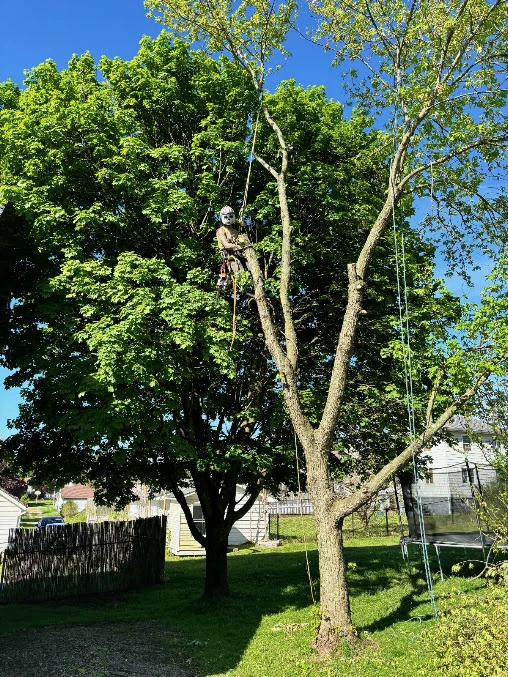
Thinning and topping are opposite jobs
Topping cuts a tree straight across at whatever height somebody picked, right through big limbs, and leaves stubs. It looks neat for one season. Then the tree answers with a thicket of fast, weakly attached sprouts off every stub, the cut ends rot back, and a few years on the crown is denser and heavier than before with worse wood holding it up. We will not do it, and if you ask, we will talk you out of it.
Thinning runs the other direction. Nothing gets shorter. Instead of cutting across the outside, the climber works through the middle of the crown and takes whole limbs back to where they join a bigger one. From the street the outline looks the same. What changes is that you can see sky through it, wind slips through instead of shoving, and every limb that stays has room.
If you want a tree smaller, that is a different cut called reduction, and that is not topping either. Finished work of both kinds is in the gallery.
Which limbs go first, and when to stop
The order matters. Dead and broken pieces come out first, and they cost the tree nothing. Next are limbs that cross and rub, because two branches sawing at each other in the wind wear an open wound into both. Then the ones growing back in toward the trunk, and anywhere two limbs are fighting over the same patch of light, the weaker one goes.
Then we stop and look, because live leaves are how a tree feeds itself. Thinning takes a measured share of the living foliage and spreads it evenly through the crown, inside to out. It never strips the inner limbs bare and leaves tufts hanging at the ends. That habit has a name, lion-tailing, and it throws all the weight out to the tips where a limb is most likely to snap. A tree that needs more opened up than it can give in one visit gets the rest later, once it has recovered.
From the ground, a well-thinned tree mostly looks like the same tree on a clearer day. You notice the light on the lawn and the way the crown sways in a breeze long before you notice anything missing. If the first thing you see afterward is how much is gone, then too much is gone.
Each cut lands just outside the branch collar so the wound can close over. The crown thinning page lays out the method in more detail.
Four Hampton crowns we open up most
What you want out of the thinning decides where the climber spends his time. Plenty of yards up here have more than one of these.
- The nineties plan tree
- Planted with the house and left alone since, a lot of these have closed into one solid mass of leaves over the roof. Thinning them is mostly about wind. A crown the air can pass through puts far less strain on the trunk and the forks during a summer storm.
- The big oak over the garden
- Grass thins out and tomatoes sulk under a heavy oak. Opening the interior lets broken sunlight reach the ground without raising the canopy or shrinking the tree, which is usually what the gardener was after all along.
- The fencerow giant
- Those wide sideways limbs carry a lot of leaf weight far from the trunk. Thinning spread along the longest of them lightens what hangs out over the patio and the swing set.
- The tree with two tops
- When two or three stems are racing each other, a lighter crown means less load swinging on the fork below them, which can be the whole fix or the step before a cable.
Winter is thinning season, and oaks are the reason
Most of our thinning happens between late fall and early spring. With the leaves down, a climber sees every fork, every crossing limb and every old wound instead of guessing through a wall of green, and the ground is firm enough to work on without tearing up the yard.
Oaks get extra care on timing. Oak wilt is a fungus spread partly by sap beetles that are drawn to fresh wounds, and those beetles are active through the warm months. So on an oak we keep pruning cuts out of spring and summer unless a limb is broken or hanging over something. Storm-broken wood is the exception and comes off right away. The routine thinning waits for the dormant season.
Maples and most other plan-street trees are more forgiving, but winter still gives the cleanest look at how the tree is built. Call in July about a dense oak over the house and expect Chris to look at it then and pencil the work in for the cold months.
Fewer limbs, better ones. From the street, the outline never changes.
Sometimes thinning is only step one
A lot of cabling conversations start with a thinning. A plan tree with two or three leaders and a tight seam of included bark between them carries less load once the crown is lighter, and now and then that is all it needed. When the fork still worries Chris afterward, tree cabling is the next step, and the two usually happen on one visit.
Sometimes the climb turns up bigger news. Dead wood running deeper than a few limbs, fungus at the base, or a crown dying back from the top means the tree is past thinning, and that is dead tree removal. Limbs a storm already broke fall under storm-damaged tree removal. And if the oak gets no light because a wall of locust and grapevine is crowding it from the back corner, brush clearing fixes the cause instead of the symptom. The rest of our work in the township is on the Hampton Township page.
Hampton’s plan streets and old farm lots, north of the city up the Route 8 corridor.
Asked from the patio, looking up
Straight answers about thinning a big crown without hurting the tree.
What is the difference between thinning and topping?
Topping cuts across big limbs at a chosen height and leaves stubs that sprout weak, crowded regrowth and rot back. Thinning removes selected whole limbs from inside the crown, back to a larger branch, so the tree keeps its height and shape while wind and light pass through. We only do the second.
How much of the tree comes out?
A measured share of the live leaves, spread evenly from the inside out, never most of the crown. Dead and broken wood comes out first and does not count against that. If a tree needs more opening up than it can safely give in one visit, the rest waits until it recovers.
Will thinning make my tree safer in a storm?
It usually helps. A dense crown catches wind like a sail and passes that force down to the trunk and the unions. Opening it lets air move through, and removing rubbing and weak limbs takes out likely break points. It will not fix a cracked trunk or a rotten base.
When is the best time to thin an oak?
Late fall through winter. Oak wilt spreads partly through beetles drawn to fresh cuts in the warm months, so we keep routine oak pruning to the dormant season. A broken or hanging limb is the exception and comes off right away. Winter also shows the branch structure clearly with the leaves down.
Will grass grow back under a big oak after thinning?
Often it does better. Thinning lets broken sunlight through to the ground without raising the canopy or shrinking the tree. Grass and garden beds under a heavy crown mostly struggle because of shade. Just keep in mind the tree’s roots share that ground, so go easy on digging and tilling.
My plan tree has two big stems. Thin it or cable it?
Often thinned first. Lightening the crown lowers the load each stem swings, and that can be enough. If the seam between them shows included bark or a crack, Chris may recommend a cable as well, usually on the same visit. If the union is already failing, the honest answer is removal.
How much sky can you see through it?
Stand at the trunk and take one photo straight up into the crown, then one from the street that shows the whole tree and the house beside it. If you can barely find sky in the first picture, that tells Chris plenty. Send both through the contact form with a line about what bothers you: the wind, the shade on the garden, limbs rubbing. You get an up-front number in writing, and for an oak, a winter date to go with it. Or call, and he will come look.