
Before and After a Canopy Lift: What Came Off and What Stayed
A homeowner in Ross once looked at her tree after we finished and said we had made it taller. We had not touched the top. What we had done was take the bottom third of the canopy off the patio, and the eye reads the rest of it differently once the low heavy skirt is gone.
That is a canopy lift, and it is the single most common piece of pruning we do here. Worth walking through what actually comes off, because the before and after pair explains it faster than any description of technique.
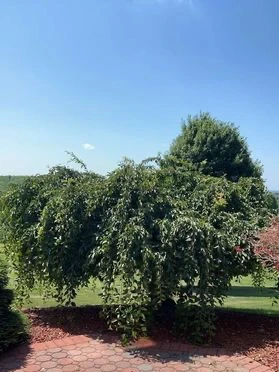
Reading the before picture
Look at where the lowest branches sit relative to the patio. They are not dangerous and nothing is broken. The tree is simply carrying its weight low, the way a tree does when nothing has ever asked it not to.
Three things follow from that. The patio underneath it stays damp, because nothing dries out under a canopy that dense. The grass on that side thins to dirt. And the lowest limbs are the ones that catch a shoulder, a mower, or a car door, so they pick up small wounds year after year.
The other thing in that picture is the interior. From the ground you cannot see through the crown at all, which means air does not move through it either, and neither does light. A crown that solid also presents a broad flat face to a gusty front instead of letting wind pass.
None of that is an emergency. It is the ordinary condition of a sixty-year-old shade tree on a small lot, and it is exactly the condition a lift fixes.
What actually comes off
Less than people expect, and from specific places rather than evenly all over.
The lowest scaffold limbs go first, taken back to the trunk at the branch collar so the tree can seal the wound properly. That raises the working height of the canopy and opens the space underneath. On a patio tree we usually take that to a height where a person walks under it without ducking and a mower passes without contact.
Then deadwood, everywhere in the crown, not just down low. Dead limbs in a mature maple or oak are the highest-value cut we make, because a dead branch is what a wet snow load or a summer gust finds first. That pass alone changes how a tree behaves in weather.
Then selective thinning, which is where the judgment lives. Crossing limbs that rub each other get one of the pair removed. Branches growing back into the center of the tree come out. A few interior laterals get taken to open a path for air and light. What does not happen is a uniform shave of the outer canopy, because that is not thinning, that is a haircut, and it produces a dense flush of weak regrowth the following year.
By weight it usually adds up to well under a quarter of the living crown. That ceiling is not arbitrary. Take more and you are asking the tree to run a full season on less than it needs.
Why the tree looks bigger afterward
Here is the visual trick, and it is not a trick, it is geometry.
Before the lift, the crown reads as one mass from the ground to about head height. The eye takes the whole thing in as a single blob, and a blob with its bottom edge near the ground looks squat no matter how tall it is.
Lift the bottom and you separate trunk from canopy. Now the eye sees a length of trunk, then a crown floating above it, and it reads that as height. You can suddenly see the trunk’s taper and the first main forks, which on a mature maple is the best-looking part of the tree and the part nobody had looked at in twenty years.
The thinning does the rest. Sky through a crown gives it depth. A solid canopy is flat, a thinned one has layers, and layers read as size. Same tree, same height to the inch, and it looks like a bigger and better specimen because you can finally see what it is.
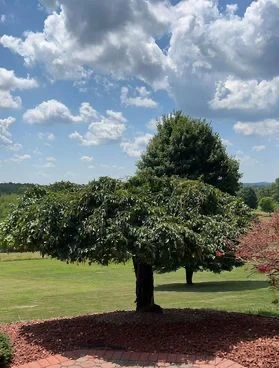
What the lift does that you cannot see
The appearance is the part people notice. The reasons we recommend it are mostly the other ones.
Roofs and gutters come first. A limb resting on shingles wears through the granules in a couple of seasons, and a canopy overhanging a gutter fills it every fall no matter how often you clean it. Getting the edge of the crown back off the roofline ends both problems, and on most Ross houses that is a handful of cuts rather than a major reduction.
Wind comes second. A thinned crown lets a gust pass through instead of pushing against it, which lowers the load on the branch unions where failures actually start. That matters most on the silver maples, which grow weak double trunks and tend to come apart at the union in a wet windstorm. Reducing end weight on the heavy side of one of those is not cosmetic work.
Then the ground under it. Light reaching the lawn means grass instead of moss and mud, and a patio that dries after it rains instead of staying green along the joints.
And the visit finds things. Half the cracked unions and hidden decay pockets we ever deal with turn up during a routine lift, because somebody was finally up in the crown looking at it from six feet away rather than sixty feet below.
What a lift is not
It is not topping, and the difference is worth being blunt about. Topping means cutting main limbs back to stubs with no lateral left to take over as the new leader. The tree responds with a dense mass of weakly attached shoots, the stubs decay from the cut face down, and in ten years you have a bigger hazard than you started with. We do not top trees. If somebody offers to, that is the answer to whether you should hire them.
It is also not a fix for a tree that has outgrown its spot. If a maple genuinely does not fit between a house and a garage, no amount of lifting changes that, and a lift sold as the solution is just a deferral with a nicer invoice.
And it is not permanent. Trees grow. A lift on a mature shade tree holds its shape for several years before the low growth starts coming back, and that is a normal maintenance cycle rather than a sign something went wrong.
What it is: the cheapest useful thing you can do for a big tree you intend to keep. Most of the trees we lift never need anything else done to them.
Common questions about lifting a canopy
How much can come off without hurting the tree?
Well under a quarter of the living crown in a single visit, and less on an older or stressed tree. Deadwood does not count toward that, since removing it costs the tree nothing. If a plan calls for taking half the canopy, the tree either has a real structural problem that changes the conversation or somebody is overselling the job.
When is the right time of year for this?
Late dormancy is the best window for most species, because the structure is visible with the leaves off and the cuts seal quickly once spring growth starts. Oaks are the exception and should not be pruned in the growing season because of oak wilt. Clearance work over a roof or a drive can happen any time, since a branch wearing your shingles does not wait for February.
Will it grow back thicker underneath?
Proper cuts taken back to the branch collar do not sprout the way stub cuts do, so a correctly done lift stays lifted for years. What comes back over time is ordinary growth from elsewhere in the crown, which is why this is maintenance on a cycle rather than a one-time event.
If your tree is sitting on the patio
Send a photo from far enough back to show the whole tree and what is underneath it. That answers most of it without anyone driving out.
Call (412) 526-2028 or use the contact form. You get an up-front number, then one visit. More on our work around Ross Township, and the detail on trimming and pruning. In sawdust we trust.