
One visit, gone for good
Pittsburgh’s everyday tree removal, handled clean
The maple that died two summers ago. The volunteer tree crowding your driveway. The spruce dropping limbs on the shed every time the wind picks up. Most removals in Pittsburgh aren’t dramatic, they’re just overdue. We show up with the right saws and the right truck, take it down in pieces, and haul every bit of it off your property before we leave.

The regular takedown, start to finish in one day
Standard removal covers the trees most Pittsburgh homeowners actually deal with. Twenty to fifty feet. A trunk you can wrap your arms most of the way around. Close enough to a fence, a driveway, or a neighbor’s hosta bed that you can’t simply lay it over and walk away. That’s the bread and butter of this trade, and after twenty five years in it, Chris has taken down more of these than he can count.
The work itself is calm when it’s done right. We read the lean, pick the side we want the wood to land on, and start clearing limbs from the bottom up so nothing bounces where it shouldn’t. Sections come down roped or free, depending on what’s underneath. The grapple loader picks up the wood instead of us dragging trunks across your grass, and the chipper turns the brush into a truckload of chips that leave with us.
By the time we pull out, the trunk is cut flush, the yard is raked, and the only thing left to decide is whether you want the stump ground out too. That’s the whole idea behind one and done. You book it once, you’re home or you’re not, and it’s finished either way.
Reasons a tree ends up on our list
Dead is the obvious one. A tree with no leaves in July isn’t coming back, and every freeze-thaw cycle after that loosens something. Disease is the quieter version: a pin oak thinning from the top down, a maple with a seam of decay running up one side, an ash that got hollowed out years ago and still looks fine from the street. Those trees fail from the inside on a schedule nobody publishes.
Then there’s the crowding. Pittsburgh lots were laid out narrow, and trees planted in 1970 as a nice bit of green now sit six feet off a foundation with roots under the sidewalk and limbs on the roof. Sometimes removal is the honest answer. Sometimes a good pruning buys you another fifteen years, and we will say so. We have talked plenty of people out of cutting a tree that was doing just fine.
And sometimes it’s just in the way. A garage addition, a new driveway, a fence line, a septic field. No drama, no hazard, the tree simply lost the argument with the plan. We take those down the same way we take down the dead ones, with the same care about what’s underneath.
What shows up in the driveway
Saws sized for the tree, climbing and rigging gear, a grapple loader so the wood never gets dragged, and a chipper that clears the brush as fast as we cut it.
Fully insured, and a military discount for anyone who served.
See the crew mid-job in the gallery. If your tree is genuinely huge or sitting over the roofline, that’s large tree removal instead, and finishing the job below grade is stump grinding.
“They were very responsive, scheduled quickly, and removed the tree efficiently. The cleanup afterward was excellent.”
LG, Google reviewTwo lists, and yours is short
You handle four things. We handle everything with a motor attached.
What you do
Send a photo or point at the tree in person. Tell us what’s underneath it that you care about, the sprinkler line, the new sod, the mother-in-law’s rose bush. Say yes to the up-front number. Move the cars off the driveway on the morning we come.
You do not have to be home. Plenty of our removals happen while people are at work, and they get a photo when it’s done.
What we do
Walk the property, check the lean and the decay, and pick the drop zone. Clear the limbs, rope anything that can’t fall clean, and section the trunk down to a flush cut. Load the wood with the grapple, chip the brush, blow the driveway, and rake the lawn back to how we found it.
If the tree turns out to be bigger or worse than the photo showed, we tell you before the first cut, not after. Same goes for anything hiding in the canopy, wires, nests, old cable line.
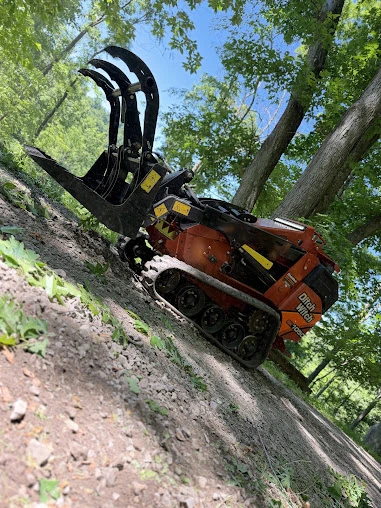

Left, the loader keeping trunk wood off the grass. Right, the reason that tree came down, visible the second it opened up.
What Pittsburgh dirt does to a root plate
Heavy clay soil is the local complication. It holds water through a wet spring, then bakes and cracks in August, and mature roots never get the drainage they want. Add a hillside lot, which around here is most of them, and a tree can be perfectly healthy above ground while its anchor slowly gives out on the downhill side. That’s why so many removals we run in Shaler Township and Glenshaw start with a homeowner noticing the trunk sitting a little differently than it used to.
The species tell their own story. Silver maples grow fast, get brittle, and shed big limbs in ice. Pin oaks hold dead wood in the crown for years before anyone looks up. Norway spruces planted as privacy screens in the sixties are now sixty feet of shallow-rooted sail. Up in Hampton Township we see all three on the same street.
Freeze-thaw winters finish what the soil starts. Water gets into a crack, freezes, widens it, and does it again forty times before spring. If a tree on your property has a seam up the trunk, a soft spot at the base, or soil heaving on one side, that’s worth a look before the next storm decides for you. Ask for a walk-around and we will tell you straight whether it needs to come down this year or not.
Before you book, the usual questions
The same handful come up on every driveway. Here they are without the runaround.
What does tree removal cost around Pittsburgh?
It comes down to height, trunk diameter, how close the drop zone is to something breakable, and how far we have to carry the wood. Nobody can answer that honestly over the phone from a description. Chris comes out, looks at the actual tree, and hands you an up-front number in writing that does not move later. Set up the visit and you will usually have it within a day or two.
How long does one tree take?
A typical mid-size removal runs two to five hours from the first cut to the last rake. Tight access, a fence we have to work over, or three trees instead of one can push it to a full day. You will know which one your job is before we schedule it.
What happens to all the wood and brush?
It leaves with us unless you want it. The brush goes through the chipper, the trunk wood goes on the truck. If you burn or heat with wood, say so and we will cut rounds and stack them wherever you want them, at no extra charge. Plenty of people take the wood and skip the firewood delivery that winter.
Do I need permission or a permit?
For a tree on your own private property, almost never in this area. Street trees on the city right of way are a different matter, and a few boroughs have their own rules. If yours looks like it might sit in that gray zone, we will flag it during the walk-around instead of finding out mid-job.
My tree is huge. Is this still the right page?
If it towers over the house, needs a crane, or has other companies telling you no, read large tree removal instead. Same crew, more rigging, different plan. Either way you call the same number and Chris sorts out which job it actually is.
Is the stump included?
The removal takes the trunk down flush with the ground, which is enough for a lot of people. Grinding out what’s left below grade takes a separate machine and is its own step, covered on the stump grinding page. Ask for both together and we will put one number on the whole thing.
Point at the tree, we’ll take it from there
One call, one walk-around, one crew day, and the tree is gone with the yard raked behind it. No return trips, no surprise line items, no chasing anybody down for the last load of brush. In sawdust we trust.