
Hardware in the canopy
Tree cabling that keeps Pittsburgh’s best trees standing
Some trees don’t need a saw. They need steel. A cable system installed high in the crown limits how far two competing leaders can pull away from each other in a wind event, which is often the difference between a tree you keep for another thirty years and a tree that ends up split down the middle across your driveway.
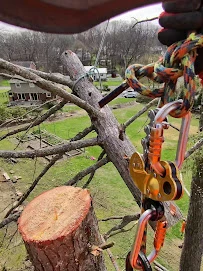
The V-crotch is the problem, and everybody has one
Walk any older street around Pittsburgh and look up. You’ll find silver maples, Bradford pears, and big old ashes that never grew one trunk. They grew two, side by side, splitting off at four or five feet and racing each other for the sky. Arborists call those codominant stems. The union where they meet looks solid from the ground, but a lot of the time there’s bark trapped inside it, pinched between the two stems instead of wood knitting them together. That’s included bark, and it means the joint is a seam, not a weld.
A seam holds fine on a calm Tuesday. It holds through most summer thunderstorms. Then one night in February we get an inch of ice on every twig, the wind comes across the ridge, and one of those stems folds outward at the union and takes half the tree with it. If the tree is over a garage, a fence, or a kid’s swing set, that half goes right through it. Around here the silver maple is the poster child, but we’ve cabled river birch, callery pear, honey locust, big multi-stem oaks, and one enormous ash that a family in Shaler simply refused to lose.
Cabling is the answer when the tree is otherwise healthy and worth keeping. We run high-strength cable between the leaders, well up in the crown, so each stem is limited in how far it can travel away from its partner. The stems still sway. Trees are supposed to sway. They just can’t reach the angle where the union tears.
The height matters more than people expect. A cable set too low barely restrains anything, because the leverage is all out at the ends of the branches. Set roughly two thirds of the way from the union up toward the top, that same cable catches the stems where they actually move, and the load gets spread instead of yanked. Get the height wrong and you’ve hung expensive hardware in a tree that will still split.
Two kinds of cable, and why the choice matters
Static systems use steel cable anchored through the stems with hardware. They’re rigid, proven, and the right call when a union is already cracked or when the tree has serious mass to hold. Dynamic systems use a synthetic rope-style cable with a bit of built-in stretch, installed without drilling through the wood. They let the tree keep flexing and building its own reaction wood, which is better for a tree that’s structurally suspect but not yet damaged.
Which one your tree gets is a judgment call made at the tree, not off a price list. Chris climbs it, looks at the union, checks for old cracks, decay pockets, and how much crown weight is sitting out on each leader, and then tells you which system fits and why. If a cable belongs at one level and a second cable belongs higher up, you’ll hear that too, along with an up-front number covering the whole install.
Sometimes cabling is only half the prescription. Where the weak union sits lower in the tree and the two stems are actively trying to peel apart, threaded rods driven straight through the union do the work the cable can’t: they clamp the joint itself. That’s tree bracing, and it’s a companion to cabling rather than an alternative. Cables limit motion up top; braces hold the union together down low. Plenty of trees get both in the same visit.
What the install involves
A climb into the upper crown, hardware rated for the load, cable set at roughly two thirds of the height from the union to the top, and a written note of where everything went.
Insured, 25 years in the trade, and a military discount for those who served.
Cabled trees usually want a pruning pass too, since reducing end weight on a heavy leader takes load off the cable. Installed systems show up in the gallery.
“Chris is a real stand-up guy! His professionalism and honesty are exceptional. Just a great guy to work with.”
John Smith, Google reviewWho does what on a cabling job
Short list for you, long list for us. That’s how it should read.
Your part
Show us the tree and tell us the history. Did a limb come out of it? Has that crack been widening? Is there a story about the ice storm a few years back? All of that shapes the plan.
After that, mark your calendar for the follow-up. Cable systems are not install-and-forget hardware, and we’ll remind you when the next look is due.
Our part
Climb it and read the union up close, because you cannot judge included bark from a lawn chair. Choose static or dynamic. Set anchor points at the right height and the right angle so load is shared instead of concentrated. Tension it correctly, since a cable pulled bar-tight is nearly as wrong as one hanging slack.
Then we tell you the truth about the tree’s odds. If the wood at the union is already gone soft, hardware is a bandage, and we’ll say so instead of selling you one. Ask us straight and you’ll get it straight.
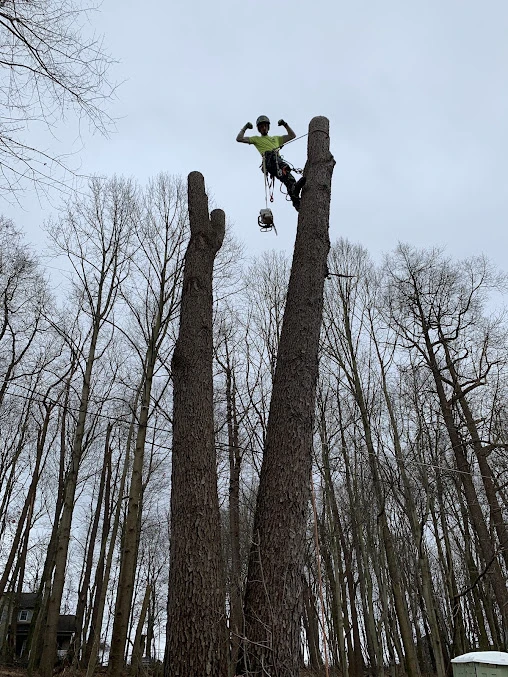
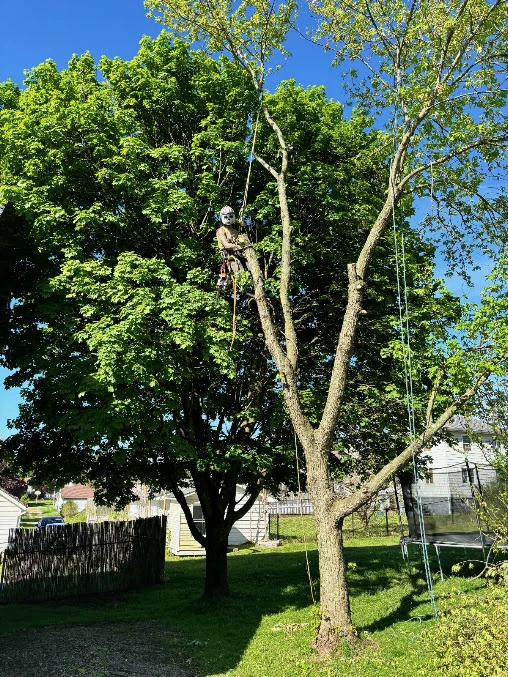
Our climber and our work on Allegheny County properties, not a stock library.
Old neighborhoods, older trees, real freeze-thaw winters
The trees worth cabling around here tend to be the ones planted when the neighborhood was young. In Fox Chapel that means big specimen hardwoods that are genuinely part of what the property is, and losing one changes the whole lot. Down along the river flats in O’Hara Township the silver maples grew fast in good soil, which is exactly how you get two enormous leaders on a weak union. Up in Franklin Park, newer builds sit under trees that were field-grown in the open and never learned to shed wind the way a woods-grown tree does.
Then there’s our weather. Western Pennsylvania runs through freeze and thaw over and over from December into March, and every cycle works a crack open a little further. Add a wet snow that loads a crown with hundreds of extra pounds, or an ice event like the ones that shut down half the North Hills, and the tree finds its weak point. A cable installed in October is a cheap way to be somewhere else in your head when the February forecast turns ugly.
Timing helps in another way too. Late fall and winter, once the leaves are off, is when a climber can see the whole structure of a tree instead of guessing through a canopy. Every union, every old wound, every crossing limb is right there. That’s the season we do a lot of this work, though a tree with a union already opening up does not get to wait for a convenient month.
Cabling questions
The ones people ask standing in the yard, pointing up.
Which trees are actually candidates for cabling?
Healthy trees with a structural flaw. Codominant stems, a union with included bark, a long heavy leader reaching over a target, or a limb that’s cracked but still alive and feeding the tree. The wood around the union has to be sound. Hardware bolted into decayed wood pulls out, so a tree that’s mostly hollow at the union is a removal conversation, not a cabling one.
How long does a cable system last?
Properly installed hardware commonly serves twenty years or more, and plenty of systems go longer. What ends a cable’s life is usually the tree, not the steel: stems grow, anchor points get swallowed by new wood, and load paths shift. That’s why the system gets looked at rather than forgotten.
How often does it need to be inspected?
We recommend a look every year or two, and always after a major storm or ice event. The check covers hardware condition, tension, how the tree has grown around the anchors, and whether the union has changed. Most inspections take a few minutes and turn up nothing, which is the point.
How do you decide between cabling and removal?
We weigh the health of the tree, the soundness of the wood at the union, how much crown weight each stem carries, and what’s underneath it. A sound tree with a geometry problem is a great cabling candidate. A declining tree with decay, dieback, and a target under it is not, and we’d rather tell you that than take money for hardware that only postpones the failure by a season.
Can I install a cable myself with chain from the hardware store?
Please don’t. Chain wrapped around two stems girdles them and kills the bark it touches, and it does nothing at the moment of failure because it can’t be tensioned correctly. Anchor height, angle, hardware rating, and drilling technique all matter, and every part of it happens forty or fifty feet up on rope. A wrong install can concentrate load and make the split worse than it would have been.
What does tree cabling cost in Pittsburgh?
It depends on how many cables the tree needs, how high the anchors sit, the climb itself, and whether bracing or crown reduction belongs in the same visit. Nobody can answer that over the phone honestly. Chris comes out, climbs or scopes the union, and hands you an up-front number in writing. Set up a visit and you’ll have it in a day or two.
If you already know which tree we mean, call about it
Most people reading this page have one specific tree in mind and have been thinking about it for two winters. Let’s go look at it together and settle the question. One and done, in sawdust we trust.