
It is already down
Fallen tree removal, from ground level up
The tree is lying in the yard. It missed the house, nobody got hurt, and now there are four tons of oak across your back lawn that has to leave somehow. This is the page for that job: sectioning wood that is still under load, getting the tonnage out without wrecking the grass, and deciding what happens to the crater the roots left behind.

A tree on the ground has not finished moving
People assume the danger ended when the tree landed. It did not. Gravity already did the loud part, and what is left is a very heavy object propped at odd angles with all of that weight looking for somewhere else to go. The whole trade of taking one apart is figuring out where the stored force sits before you put steel into it.
Two words cover most of it: tension and compression. Where a trunk is bridged between the root ball and a limb still touching the ground, the top side is being pulled apart and the bottom side is being squeezed. Cut the compression side and the kerf closes on the bar, and now a running saw is pinched solid inside several thousand pounds that is about to shift. Cut the tension side and the wood opens fast and the far end swings. A saw does not have to be moving at speed to hurt somebody. The log does.
That is why our first pass on a fallen tree is not a cut at all. We walk the whole length, find every point where it is bearing on something, and work out the order that lets the weight down in stages instead of all at once. It looks unhurried on purpose.
The root ball that stands back up
Here is the one that kills people, and almost nobody outside the trade knows about it. When a tree tips over, the root plate levers out of the ground and stands up on edge, sometimes eight or ten feet tall, still hinged to the soil and still attached to the trunk. That whole disc is being held over by the weight of the trunk lying on the ground. Sever the trunk near the base and you have just cut the counterweight loose, and the root ball snaps back into its hole like a trap closing.
It happens fast and silently, and the person cutting is standing exactly in the arc it swings through. We treat the root plate as loaded from the moment we walk on the property. It gets blocked, or the trunk gets sectioned from the far end down so the counterweight is never removed all at once.
Slopes add a second version of the same problem. A round cut free on a Pittsburgh hillside becomes a wheel, and a twenty-inch oak round weighs a few hundred pounds and rolls faster than anybody moves. On a grade we cut uphill of the piece, chock rounds as they come free, and stage the drop zone below. If your fallen tree is on a slope, mention it when you call.
One clear line about what belongs here
If the tree came down on your house, your garage, your car, or anywhere near a wire, this is not that page. That is live danger and it gets handled tonight, not scheduled. Call and say so, or read the emergency tree service page. Everything below assumes the tree is on the ground, on the ground only, and can wait for a proper crew visit.
Getting tonnage out without ruining the yard
The physical problem with a fallen tree is not cutting it. It is moving it. A mature maple can be six or eight tons of green wood sitting in the middle of grass that has to look like grass again afterward. Dragging full trunks across a lawn trenches it, and a machine that goes wherever it wants leaves ruts you will still see next summer.
So the wood comes to the machine rather than the machine roaming the yard. We buck the trunk into rounds sized for what we are lifting with, chip brush on site, and use the grapple loader to pick wood up cleanly instead of skidding it. Where equipment has to cross soft ground, we plank the route. On the way out, ruts get graded, the lawn gets raked, and the driveway gets blown off.
As for the wood itself, you decide. Most of it leaves with us. If you burn, say so and we will buck rounds to your stove length and stack them where you want them. Chips can stay for your beds or ride out.
Why calm days drop trees
Not every faller is a storm faller. Western Pennsylvania clay holds water, and after a wet week the soil around a root plate turns to pudding. A tree that stood through decades of wind tips over in a light breeze because the ground let go, not the tree.
The other quiet killer is root rot from old trenching, a driveway poured over the root zone, or years of mower damage at the flare. Those trees fall on a Tuesday afternoon with nothing in the forecast.
Insured, military discount for those who served. Finished jobs are in the gallery.
“They were very responsive, scheduled quickly, and removed the tree efficiently. The cleanup afterward was excellent.”
LG, Google reviewDividing up a tree that is already down
Your list is short because everything on ours has weight in it.
Your part
Stay off it. Do not walk the trunk, do not let kids climb it, and keep the dog away from the root plate. Photos from a safe distance help us load the right gear, especially one shot showing the base and one showing the full length.
Tell us three things on the phone: whether it is on a slope, whether a truck can get within reach of it, and what you want done with the wood. Chris takes it from there and you get an up-front number in writing.
Our part
Walk the length and map the bearing points. Secure or deliberately drop the root plate before anybody cuts near the base. Section from the far end inward so the counterweight stays put, boring and wedging where the wood is bound, chocking rounds on any grade.
Then grapple the wood out on a planked route, chip the brush, grade the ruts, and rake the lawn. Ask about the hole while we are standing there and we will give you the options for it. Get us out to look and the whole thing is one visit.
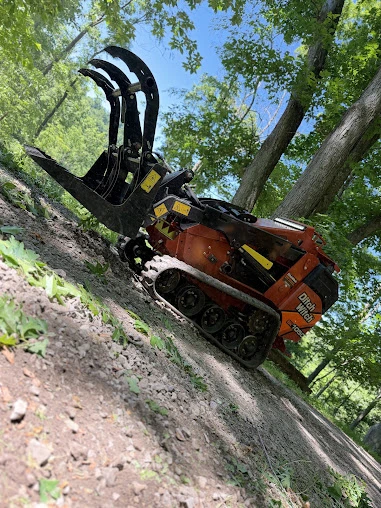

The grapple on the left is the whole reason your lawn survives the extraction. Wood gets picked up, not dragged.
What to do about the hole
Every fallen tree leaves a question at the base, and it is usually the last thing anybody thinks about. When a tree tips, the root plate pulls a shallow bowl of soil up with it, so you are left with a crater on one side and a mound of dirt and roots on the other. There are three honest answers.
First, cut the stump and plate flush and grind it, which is the usual choice when the base is still mostly seated. Second, pull the plate out entirely with a machine, which makes sense when it is standing up and already loose. Third, backfill and be done, which is what most people want when the spot is going back to lawn. We handle all three, and the details live on the stump removal and stump hole filling pages.
Around here that question comes up constantly, because the hillside neighborhoods northwest of the city sit on clay that heaves and settles. Up in Ben Avon Heights the lots are steep and heavily wooded, so a fallen tree usually means a slope job with rolling rounds. Down in Emsworth the yards are tighter and closer to the river, so soil saturation drops trees that looked fine. Out through Kilbuck Township the parcels run big enough that a fallen tree may sit a hundred feet from anywhere a truck can park. Same fallen tree, three different jobs.
One last thing worth saying plainly. If a tree came down with no storm to blame, walk the rest of them before you assume it was bad luck. Saturated ground that let one root plate go is holding the others too.
Questions from the yard
What people ask standing next to a tree that is already on the ground.
The tree is already down. Why can I not just cut it up myself?
Because a fallen trunk is bound. Sections of it are under tension and sections are under compression, and picking the wrong one pinches your bar or springs the log. Add a root plate that can stand back up when you free the trunk, and you have the exact scenario that fills chainsaw injury reports every spring. If you insist on doing the small brush yourself, leave the trunk and the base to us.
What is the danger with the root ball exactly?
When a tree tips, the root plate levers up and stands on edge, held over by the weight of the trunk on the ground. Cut the trunk free near the base and the plate slams back into its hole, straight through where the person cutting is standing. We block it, pull it deliberately, or section from the far end so that counterweight never comes off unexpectedly.
My tree fell on a totally calm day. How does that happen?
The ground gave out, not the tree. Our clay soil holds water for days after a wet stretch, and a saturated root plate loses its grip with no wind involved. Old trenching through the roots, a driveway poured over the root zone, or rot at the flare will do the same thing on a quiet afternoon. If one went down that way, the neighbors of that tree deserve a look.
Will your equipment tear up my lawn getting it out?
We plan against that. Wood gets bucked into rounds and picked up with the grapple instead of skidded across the grass, and we plank the route where machines have to travel. Soft ground still marks, and we say so up front. Ruts get graded and the lawn gets raked before we pull out. On genuinely soggy ground we will suggest waiting for a few dry days.
Can I keep the wood for firewood?
Absolutely, and plenty of people do. Tell us your stove length and where you want it and we will buck and stack it there instead of loading it. Straight clean trunks can also be left long as saw logs if you have a mill lined up. Whatever you do not want rides out with us, brush and all.
Does the price change if it fell over a fence or into the woods?
It changes what the work involves, so yes. Access drives most of it: how close a truck can park, whether the trunk crossed something we have to protect, and whether it is on a grade. That is why nobody should be guessing over the phone. Chris walks it, reads the load, and hands you an up-front number in writing. Set up the walk-around and you will have it fast.
Let us take the loaded end of it
The tree is down, the hard part is over, and the rest is heavy and awkward and best handled by people who do it every week. One visit sections it, hauls it, and leaves the yard raked. In sawdust we trust.