
The takedown itself
Emergency tree removal on a tree that already moved
A cracked stem holding itself up by a strip of fiber. A trunk that shifted six inches overnight and might shift again. Getting a compromised tree on the ground fast is a different craft than a scheduled takedown, because the tree has already broken the rules once and nothing about it can be trusted a second time.

Heaviest thing first, then everything else
A normal removal works top down in a comfortable rhythm. Small stuff first, work toward the trunk, keep the tree balanced the whole way. An emergency takedown throws that out. The first thing that comes off is whatever is doing the most damage or carrying the most weight in the wrong direction, even when reaching it is the awkward part of the job.
The reason is simple. Every hour that a cracked leader hangs over a bedroom is an hour the crack can finish opening. So the sequence gets rebuilt around risk instead of tidiness: relieve the loaded side, take the mass off the failure point, get the tree back into a shape that will hold still, and only then work it down in the orderly way anyone would prefer. It usually looks backwards from the driveway. It is the difference between a takedown and a collapse.
That reordering is also why we do not send one guy with a saw to an emergency. Somebody is running rope, somebody is watching the crack, and somebody is on the ground calling movement that a climber twenty feet up cannot see. For the timeline of the phone call, the triage, and what happens before the crew even arrives, that story lives on the how the call works page. This one is about what happens once we are standing under it.
Rigging a stem you have no reason to trust
On a healthy tree, a climber ties into the trunk and the trunk holds. On a storm tree, that assumption is the whole danger. A vertical seam running down a maple means the two halves are separate columns pretending to be one, and loading a rope on the wrong half pulls the seam open. Decay inside a dead oak turns a solid-looking spar into a shell. A tree that already tipped has a root plate half out of the soil, so the whole stem is a lever with nothing anchoring the bottom.
So the tie-in point moves off the tree. A neighboring tree takes the load, or a machine does, and the compromised stem gets treated as cargo rather than as structure. Pieces come off small enough that no single cut releases more energy than the setup can absorb. Where a scheduled job might rope a four-hundred-pound section in one pick, an emergency version of the same limb comes off in three, because a slow job that stays controlled beats a fast one that surprises somebody.
Reading which of those conditions you are dealing with is the part that takes years. Chris has spent 25 years in the trade watching wood fail in this exact climate, and the tells are physical: fiber pulled and splintered means tension release, a clean shear means it went all at once, bark sloughing at the base of a leaner means the root plate is still moving. A tree that groans when the wind picks up is telling you the cut order. None of that shows up in a photo, which is why somebody walks the property before the first rope goes up, even at two in the morning.
Soaked ground changes the machine list
Emergencies around Pittsburgh almost always follow rain, which means the yard we need to work in is saturated clay. That single fact drives half the equipment decisions on an urgent removal. A loaded truck parked on soft ground can sink to the frame and turn a four-hour job into a two-day recovery, and on a hillside lot it can lose footing at the worst possible moment.
So on wet jobs we stage heavy machines on hard surface and reach in, plank the travel path where wood has to come out, and lean harder on climbing and rigging than on driving equipment to the base of the tree. Sometimes the honest answer is that the tree comes down tonight and the wood gets hauled out in two days once the ground firms up, because dragging a grapple loader across a swamp to save one trip costs you a lawn you will be looking at all summer. We tell you which version applies before we start, and the up-front number reflects the plan we actually intend to run.
What makes it urgent
A visible crack or seam in the trunk. A tree that has visibly moved since the storm. Soil heaved or split at the base. A leader hung up in the canopy. Weight resting on a roof, a car, a fence, or a wire.
Any one of those means the tree is on its own schedule, not yours.
Insured, military discount. Takedowns in progress are in the gallery. Related reading: storm damaged tree removal and large tree removal.
“I had a tree damaged by wind and close to falling. Triple T came out within an hour and cut it down.”
Peter Cardone, Google reviewThe takedown, start to finish
What the crew is doing while you watch from the porch, and the two things we need from you.
Your part
Clear the drop zone if you can do it safely: cars out, grill and furniture moved, gate unlocked, dog inside. Then pick a spot to stand that is nowhere near the tree and stay in it.
Tell us about anything buried or hidden under the work area. A septic lid, a shallow water line, a French drain, a stone patio under the leaves. We plan around what we know about.
Our part
Walk the failure and pick the tie-in points, on a neighboring tree or a machine when the stem cannot be trusted. Set the rigging before any saw runs. Pull the worst weight off first, then dismantle in controlled pieces with a spotter calling movement the whole time.
Flush-cut the stump, chip what we can reach, and stage the rest where the ground can carry it. You get a straight answer on what leaves tonight and what leaves later, along with the number for the finish work.

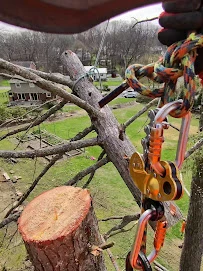
Our crew, our gear. The block on the right is what lets a heavy piece come down at walking speed instead of falling.
Tight lots, steep yards, and one shot to get it right
The North Hills makes emergency removals harder than flat country does. Houses sit close together on narrow frontages, so the drop zone for a failing tree is often a strip of yard shared by two properties. Add a slope and gravity stops being neutral: a piece that swings on a hillside lot travels further than the same piece would on level ground, which means smaller cuts and more rope.
We run these takedowns through Ross Township, Shaler Township, and McCandless, where mature oaks and silver maples were planted a lot closer to houses than anybody would plant them today. Knowing the streets matters at night. We know which ones a chip truck cannot turn around on, which driveways will hold a loaded machine and which will crack, and where the shortest route in is when a main road is blocked by somebody else’s tree.
The other local reality is timing. When a front comes through the whole region at once, everybody calls at once, and the trees that get taken down first are the ones actively threatening a person or a structure. If your tree is cracked but standing and nothing is under it, you may wait a few hours behind a tree that landed on a bedroom. That is not us being slow, it is us putting the worst thing first, which is the same principle we apply to every individual takedown.
Questions about the cutting
What people ask once they know we are coming and start wondering how it will actually go.
Can a climber go up a tree that is already cracked?
Sometimes, and sometimes absolutely not. If the crack is above the work zone and the lower trunk is sound, a climber can work below it with the tie-in set clear of the damage. If the seam runs through the base or the tree has already moved, nobody climbs it. The load goes on a neighboring tree or a machine and we take the stem apart from outside it.
Why not just drop the whole thing at once and be done?
Because a compromised tree does not fall where a sound one would. The hinge you cut is only as good as the wood holding it, and on a split or decayed stem that wood can tear early and send the trunk somewhere nobody planned. Sectional removal costs an hour and takes the guessing out of it. On the rare property with real open space and a healthy base, felling it whole is the right call, and we will say so.
My yard is soaked. Will your equipment sink or tear it up?
That is exactly what we plan around. Heavy machines stay on hard surface where the ground is questionable, we plank travel routes, and we will haul wood out on a later dry day rather than trench your lawn to finish tonight. If part of the property cannot be protected, you hear that before we drive on it, not after.
Can you take it down in the dark?
We can, and we do when something is actively threatening the house. Night takedowns run slower and more conservatively, with lighting set up and smaller pieces than we would take in daylight. If the tree is stable enough to hold until morning, waiting a few hours is often the safer and cleaner choice, and we will tell you honestly which category yours falls in.
Does the stump come out during an emergency removal?
The takedown gets the trunk cut low and flush. Grinding is a separate machine and a separate trip, and on an emergency job it almost never happens the same night. Most people book it once the urgency has passed, and we can fold it into the same finish visit that clears the remaining wood.
What if the tree is leaning but has not fallen yet?
That is the best call we get, because we still control the outcome. A leaner with a moving root plate is genuinely urgent, but nothing has been damaged yet, so we can pull it in the direction we choose instead of the direction it picks at three in the morning. Get us out there and you get a real answer on how much time that tree has.
If it moved once, it will move again
Cracked, leaning, hung up, or resting on something it should not be resting on: get it on the ground on our terms instead of its own. One call, one crew, one and done. In sawdust we trust.