
Where the truck can’t go
Difficult access removals, done by hand and rope
A gate thirty inches wide. A yard you get to by walking down forty steps. A maple boxed in by a pool, an addition, and the neighbor’s garage. Every crew that quoted you said the same thing about access. We say fine, and we bring the tree out over the top instead.
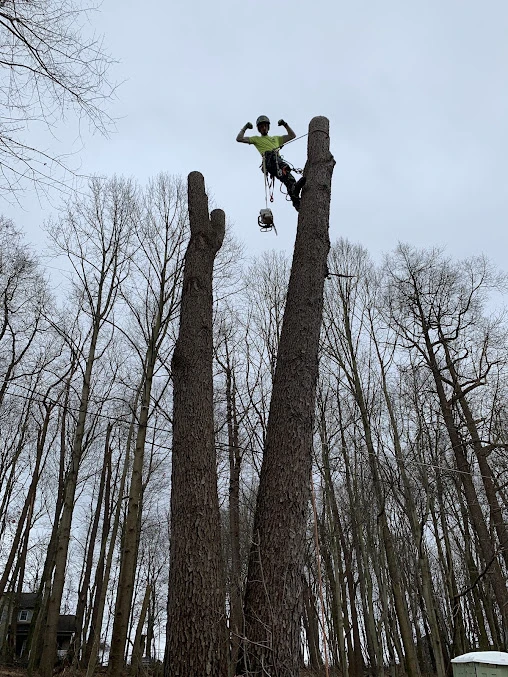
The tree is fine. Getting to it is the whole job.
Pittsburgh might be the hardest city in the country to run a tree truck in. The lots were platted before anybody owned a car, so half the backyards in Lawrenceville, Millvale and Troy Hill open onto an alley barely wide enough for a garbage truck. The hillside neighborhoods stack yards in terraces held up by hundred-year-old block walls. Whole streets are staircases. And in the suburbs the trouble is newer: a deck went on in 1994, a pool in 2003, a sunroom in 2015, and now the only path to the oak in the corner is a thirty-inch side gate with a gas meter in it.
None of that changes what the tree needs. It changes how the wood gets out. On a normal removal the loader drives in, grabs trunk sections, and the yard is clear in an hour. On a landlocked job there is no loader, so everything that comes down has to be caught, lowered, cut to a carryable size, and moved out by people. That is the actual work, and it’s why “we don’t do those” is such a common answer from bigger outfits running crews on a three-jobs-a-day schedule.
Chris has been in the trade twenty five years and he’d rather have this job than a wide-open front-yard maple. There is real craft in it. Setting a highline across two anchor trees and flying brush over a fence people said couldn’t be crossed is the part of the trade that keeps a climber interested. That is the honest reason we take these calls, and it’s why the up-front number for a hard-access removal reflects hours and hands, not a penalty for owning an awkward yard.
What comes out of the truck when the truck stays on the street
The toolkit is deliberately low-tech and it works. Climbing gear first: the whole tree comes apart from a saddle, top down, in pieces sized to whatever the exit path can handle. Rigging next, because a piece that free-falls into a courtyard hits a patio, so limbs get roped off a friction device and set down at walking speed. Then the moving problem. Sometimes that’s a highline, a tensioned rope between two points that lets brush ride out over a roof or a fence. Sometimes it’s a portable capstan winch and a skid path on a hillside, dragging wood uphill to the street in a straight line that doesn’t touch a flower bed. Sometimes it’s plywood, laid two sheets wide across a lawn so a compact machine can squeeze through a gate without leaving ruts. And often it’s just eight guys walking rounds up a set of city steps because that’s the only method the site allows.
The one thing we don’t do is force a machine into a space it doesn’t fit. Ruined turf, a cracked walkway, a scraped retaining wall: those cost more to fix than the removal did, and they’re the reason people call us after somebody else has already been there. When a crane can set up on the street and reach the tree, that’s usually the fastest and gentlest answer, so we check for it first. On plenty of Pittsburgh lots the crane simply can’t see the tree, and that’s when everything in this paragraph starts.
Access also changes the clock, and we say so before you book. A tree that would be a three-hour job in an open yard can run a full day landlocked, occasionally two if the wood is big and the only exit is a staircase. You’ll hear that number on the walk-around, not as a surprise at four in the afternoon. Same crew, same insurance, same one-and-done finish where the yard is raked before the trailer leaves.
Access gear, not access excuses
Climbing saddles and spurs, friction lowering devices, highline rope systems, a portable winch for slope work, plywood road panels, and hand carts for wood that has to go up steps.
Fully insured, military discount, and Chris on site for every hard-access walk-around.
Tight-yard work photographed in the gallery, and if a crane can actually reach your tree, the crane page explains that route instead.
“Absolutely fantastic work, carefully executed, highly recommend.”
John Seifert, Google reviewReading a yard before reading the tree
On these jobs the walk-around is half the work. Here’s what each of us is doing during it.
Your part
Show us the gate, the steps, the meter, the septic lid, the buried invisible fence, and the neighbor who might let us cross. Say which plants you’d be upset to lose. Then move the cars on the day and let us work.
If you already have photos of the yard from the alley side or the street below, send them. It saves everyone a trip.
Our part
Measure the gate and the tightest turn. Find every anchor point worth rigging from. Decide whether wood exits by highline, winch, plywood road, or shoulder. Then dismantle top down, keep the pieces small enough for the exit we chose, and put the number and the day count in writing before anything starts.
Storm damage on a landlocked lot is the worst version of this. Emergency calls get answered day or night.
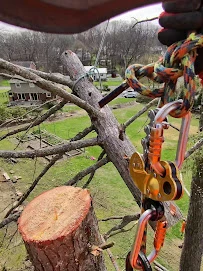
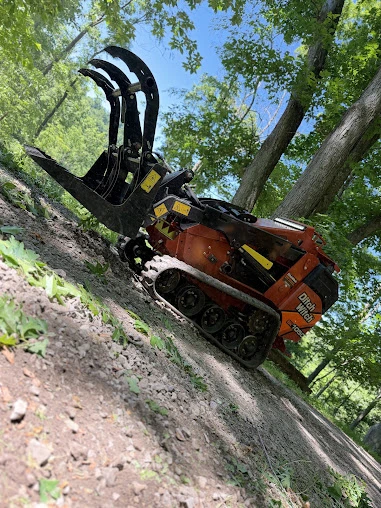
Rigging gear does the work in the yard. The loader waits at the curb, which is often as close as it gets.
Stair streets, terraces and alleys from 1910
The eastern suburbs give us a different flavor of the same problem. In Monroeville the postwar lots are deep and the mature oaks sit at the very back, behind a shed, a fence line, and forty years of added landscaping. Plum runs to steep wooded parcels where the house sits above the trees and the only route to a trunk is straight down a slope, which is winch-and-skid country. In Verona the older borough blocks are narrow and the yards open onto alleys, so the crew works out of the alley and carries wood through a gate that hasn’t been widened since the house was built.
Add clay soil that turns to grease after a Pittsburgh spring rain and you get the other rule of hard-access work: the calendar matters. A slope job that’s clean and safe in September is a mud problem in March, and a frozen morning is sometimes the best turf protection available. If your tree is in a spot everybody else has already turned down, tell us what’s back there and we’ll tell you honestly whether it’s a climb, a crane, or a job that should wait for dry ground.
Tight-yard questions
The ones people ask after three other companies said no.
My gate is thirty inches wide. Is that a dealbreaker?
No. Thirty inches is enough for people, hand carts, and rope. It isn’t enough for any machine we own, so the plan becomes climb, rig, cut small, and carry. Roughly a third of our removals go out through a gate narrower than a wheelbarrow is wide.
The tree is downhill from my house with no road below. How does the wood get out?
Usually a portable winch and a skid path. We anchor uphill, pick one route that avoids beds and walls, and pull rounds up that single line rather than dragging them all over the slope. On very steep Plum and Verona lots we sometimes highline brush out instead of skidding it.
Can you get equipment across my lawn without wrecking it?
When a compact machine fits, we lay plywood road panels and drive on those, which spreads the weight and keeps the tires off the turf. When it doesn’t fit, nothing drives on your grass at all. Either way you hear which one applies before the day, not after.
Does a courtyard or pool tree get handled differently?
Yes. Anything that can’t take an impact changes the rigging plan, so every piece gets lowered under control rather than dropped, and we cover or fence the pool surface before the first cut. Brush usually goes out over the roof line on a highline instead of through the house side of the yard.
How much longer does a no-access job take?
Plan on double the time of the same tree in an open yard, sometimes more if the exit is a set of city steps. You get a real day count on the walk-around. We would rather tell you it’s a two-day job in advance than start one and leave your yard half finished.
Do you need my neighbor’s permission?
Sometimes the easiest exit runs across the property next door, and when that’s true we ask you to make the introduction and we handle the rest. If the neighbor says no, we plan around it. That happens often enough that we always carry a second route in mind.
If everyone else said the yard was impossible
Send photos or have Chris walk it. You’ll get an honest read on the access, a written number, and a day count before anybody straps on a saddle. In sawdust we trust.