
Day or night, 24/7
Emergency tree service when Pittsburgh weather wins
A tree on the roof. A trunk split down the middle at 1am. A limb hung up over the driveway where your kids walk to the bus. Storm work is the one job that can’t wait for a callback next Tuesday, so the phone rings straight through to us and the truck gets loaded while we’re still talking.

First thing: get away from it, then call
Before anything else, put distance between your family and the tree. Storm-damaged wood is loaded with stored energy in ways you cannot see from the ground. A trunk that split and caught itself on a fence is a spring under tension, and a hanging limb the trade calls a widow-maker can let go with no wind at all, hours after the storm passed. Nobody should be underneath it, and nobody should be trying to pull it down with a truck and a chain.
If any part of the tree is touching a wire, treat every wire as live. It does not matter whether it looks like cable, phone, or power, and it does not matter whether your lights are on. Stay off wet ground near the contact point, keep pets in, and call us plus the utility. We coordinate the utility side ourselves on most jobs, because the sequence matters: the line gets addressed first, then the wood comes off, and doing that in the wrong order is how people get hurt.
Stabilize now, finish clean later
Emergency work splits into two visits more often than people expect. The first visit is about making the property safe: cutting the hanging pieces out of the canopy, taking weight off a structure, releasing a bound trunk in a controlled sequence with rigging instead of luck, and getting a tarp coordinated where the roof is open. That part happens fast and in the dark if that’s when it’s needed.
The second visit is the part that makes it look like it never happened. Full removal, stump handling if you want it, wood hauled off, lawn raked. Splitting the job that way means we’re not doing precision cleanup work by headlamp at 3am, and it means your house is buttoned up hours before a full crew could realistically finish everything. You get a written up-front number for the finish work before we do it, same as any other job here.
Chris has been reading damaged wood for 25 years, and storm trees are the ones that punish guessing. Every cut on an emergency job gets planned against where the load actually wants to go, not where it looks like it should go. A trunk that snapped forty feet up is still connected by a hinge of fiber nobody can measure from the driveway, and the only safe assumption is that it will move the moment that hinge is disturbed. That’s why the rigging goes on before the saw comes out, even when it costs us twenty extra minutes on a job everybody wants finished.
What actually shows up on these calls
The calls sort into a handful of patterns. A whole tree failed at the root plate and is lying across the roof or the garage. A leader tore out and is hanging in the canopy over a walkway. A trunk split vertically and the two halves are leaning against each other, which is the one that looks stable and absolutely is not. A tree came down across the driveway and now nobody can get a vehicle out. Or the tree is leaning hard after a wind event and has not fallen yet, which is genuinely the best version of this call because we get to take it down on our terms.
Each of those gets a different plan. Weight on a structure comes off in small pieces from the far end so the roof is never asked to carry a swinging load. A hung-up leader gets roped and pulled from a position nobody is standing under. A split trunk gets relieved in a sequence that lets the stored energy out gradually instead of all at once. None of that is complicated to explain and all of it is easy to get wrong with a rental saw and good intentions, which is most of what we get called out to undo.
Before we arrive
Move the cars if the driveway is clear and safe. Keep everyone out of the room under the impact. Do not climb on the roof to look.
Shoot photos from a safe distance, wide and close. They help us load the right gear the first time, and they become your first piece of insurance documentation.
Insured, military discount. See real storm work in the gallery, or read up on large tree removal and standard tree removal for the non-urgent version.
“I had a tree damaged by wind and close to falling. Triple T came out within an hour and cut it down.”
Peter Cardone, Google reviewWho does what while the clock is running
Storm calls move fast. Here’s the division of labor so nobody wastes a minute.
Your part
Call. Tell us what the tree is touching: house, garage, car, fence, wires, nothing. Send the photos if you can do it safely. Then stay clear and let us handle the rest.
Have your insurance carrier’s name handy. We take documentation photos on site and hand them over so your claim starts with real evidence instead of a memory.
Our part
Triage over the phone first, because some situations mean leave the house and some mean sit tight. Then on site: read the load paths, secure the scene, coordinate the utility when lines are involved, and take the hazard apart in the order that keeps the pieces under control.
Photos for your claim, tarping coordinated where the roof is open, and a clear plan for the finish work before we leave. One and done, even when it starts at midnight.

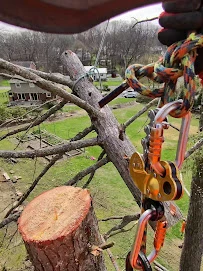
Our own storm calls. The hardware on the right is what keeps a loaded limb from going where it wants to.
Three storms, three different failures
Pittsburgh does not have one storm season, it has three problems. Summer downbursts come through as a wall and snap green wood mid-trunk, usually in the crowns that grew fastest. January ice loads a canopy with hundreds of extra pounds until limbs peel off at the union. And the spring pattern is the sneaky one: a warm rainy week saturates the clay, the root plate loses its grip, and a healthy-looking tree tips over in wind that would not have moved it in August.
We run emergency calls across the North Hills, including Glenshaw, Shaler Township, and Fox Chapel, where mature street trees sit close to old rooflines and hillside lots put the failure zone right on top of the house below. Being local matters more here than anywhere: we know which streets close, which slopes we can stage a truck on, and how long it actually takes to get a chipper up a narrow North Hills road at night. If you need us, reach out and we’ll tell you honestly how fast we can be there.
One more local wrinkle worth knowing: a lot of the trees that fail here were never a surprise. They had a dead leader, a seam running down the trunk, or a lean that got a little worse every year, and the storm just collected on a debt that was already there. If a tree on your property already looks questionable on a calm day, that is the one to deal with before the next front comes through, and it costs a fraction of what the same tree costs after it lands on something.
Storm night questions
The things people ask us while the wind is still blowing.
A tree just came down on my house. What do I do first?
Get everyone out of the rooms under the impact and stay outside that footprint. Do not go up on the roof and do not try to move anything. Shut the power off at the panel if water is coming in near fixtures and you can reach the panel safely. Then call us at (412) 526-2028 and take photos from the ground.
The tree is on the power lines. Should I call you or the utility?
Both, and the utility first if anything is arcing, smoking, or lying across the road. Treat every wire as live regardless of what it looks like, and keep well back from wet ground near it. We handle the coordination from there so the line is addressed before a saw touches the tree.
How fast can you actually get here?
Honest answer: it depends on how widespread the storm was. A single tree down on a quiet night usually means we’re rolling within the hour. After a regional storm that dropped trees across the whole North Hills, we work the list by danger, so a tree on a house or on lines jumps ahead of a tree lying in a yard. We’ll tell you your realistic window on the phone rather than promising twenty minutes we can’t hit.
Do you really answer at night?
Yes. Emergency calls come to a real person, not a voicemail box checked in the morning. Night work has limits, though: we do what makes the property safe in the dark, and the detailed cleanup happens in daylight when we can see what we’re walking on.
Will my insurance cover this?
That’s between you and your carrier, but coverage usually turns on whether the tree hit something. We photograph the scene before and during the work, note what was struck, and give you that documentation for your claim. Call your carrier as soon as the property is safe, since most policies want prompt notice.
Does emergency work cost more than a scheduled job?
Emergency response carries a different rate than a job we can schedule for a Tuesday, because it means a crew, a truck, and after-hours risk on short notice. What doesn’t change is that you get a clear number in writing before the non-urgent portion of the work, and we don’t invent charges because you’re having a bad night. Get in touch and we’ll be straight with you about what your situation involves.
If it’s happening right now, stop reading and call
Storm damage does not get safer while you research it. One call gets Chris on the phone, gets the truck loaded, and gets the hazard off your house. In sawdust we trust.