
Properties, not just yards
Commercial tree work for Pittsburgh properties
HOAs, apartment complexes, office parks, retail lots, churches, schools, and municipal grounds. If you manage property around Pittsburgh, the trees on it are either an asset or a claim waiting to happen. Triple T handles the maintenance side so the second thing never occurs, with paperwork your insurer and your accounting department will both accept.
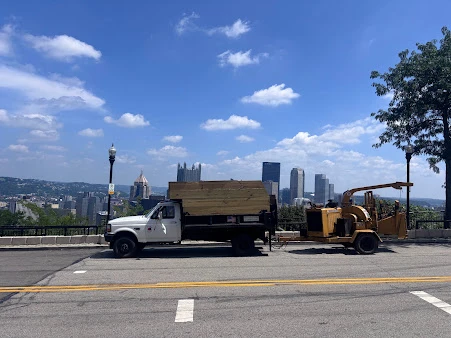
Property managers don’t buy tree work, they buy documented risk reduction
Nobody who runs a 180-unit apartment complex wakes up wanting to talk about silver maples. What they want is for the limb over building C to stop being their problem, and for the file to show that somebody qualified looked at it, wrote down what they found, and did something about it before it came down. That file is half the job on a commercial property. The saw work is the other half.
Triple T works the commercial side the same way we work driveways in Ross Township, with one difference: everything gets written down. Scope in plain language before the crew mobilizes. An up-front number that doesn’t move once the chips start flying. A walk-through afterward, with photos if you want them for the board packet or the owner’s file. Chris runs the walk and Chris signs off at the end, so there’s no gap between the person who promised something and the person responsible for it.
We’ve got a couple decades in the trade behind that, full insurance, and EHAP certification for work anywhere near energized lines. That last one matters more on commercial ground than anywhere else, because the parking lots and access drives that hold your mature canopy also hold the service drops feeding your buildings.
The trees that generate the phone calls
On residential jobs the problem tree is usually one tree. On commercial ground it’s a category. Parking lot islands where the canopy has grown down into truck-height clearance and somebody’s box van clips a limb every other week. Perimeter tree lines that separate you from a neighbor and drop everything they’ve got onto their side of the fence. Deadwood over a walkway that has to be cleared before a resident finds it the hard way. Storm-cracked leaders over playgrounds, dumpster pads, HVAC equipment, and the one section of roof that is expensive to replace.
Most of it is pruning and canopy management caught early. Some of it is outright removal of a tree that has run out of runway. The point of a maintenance schedule is to keep the second category small, because a planned removal on a Tuesday morning is a fraction of the disruption of an unplanned one on a Saturday night with a truck under it.
Working around a business that has to stay open
The complicating factor on commercial work is almost never the tree. It’s that people are trying to park, shop, worship, learn, or sleep while we do it. So we schedule around you rather than the other way around: early mornings before a retail lot fills, evenings after an office park empties, weekends at a school, and off-hours at an apartment complex when the resident cars are actually somewhere else.
Lot closures get staged section by section so you never lose the whole thing at once. Residents get notice ahead of the day if you want us to handle that. Access routes get planked where the equipment has to cross soft ground or new asphalt. And when we leave a site, the lot gets blown clean, because a parking lot full of chips is your complaint the next morning, not ours.
Paperwork you’ll actually get
Certificate of insurance on request, named to your entity or management company before the crew shows up. Written scope, written number, and a single invoice per property or per site, whichever your accounting side prefers.
One point of contact the whole way through: Chris’s cell, not a call center queue.
See the crew and the equipment on real jobs in the gallery, or send us the property address and we’ll come look at it.
“Chris was very responsive and transparent with the work scope and price. Work was executed according to the defined scope.”
Matthew Salac, Google reviewWhat a commercial engagement looks like
Two columns because two parties. Yours is deliberately light, because you’ve already got a job.
Your part
Send the property address and tell us whether this is a one-time problem or an ongoing headache. Walk the grounds with us once, or hand us a gate code and let us walk it alone. Tell us who the COI gets named to and where the invoice goes.
After that, approve the scope and pick the window. If you’d rather we notify residents or tenants directly, say so and we’ll write the notice.
Our part
Inventory what’s there: species, condition, deadwood, defects, clearance problems, and anything sitting over a structure, a walkway, or a car. Flag what needs attention now versus what can wait a season, so your budget isn’t front-loaded with work that doesn’t need doing yet.
Write the scope, hand you the number, get the COI to your inbox, and schedule around your operating hours. Then do the work, haul everything off the property, and blow the lot down. Storm damage on a property under contract jumps the queue.
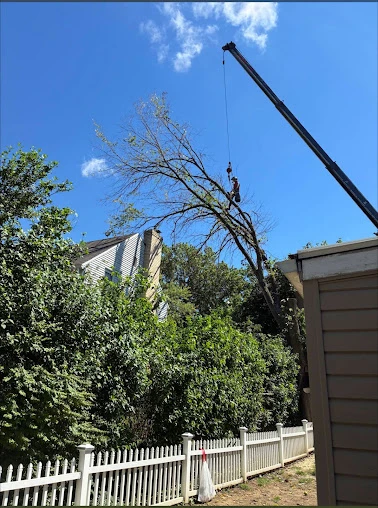

Our crew and our equipment on Allegheny County jobs. The same gear shows up on commercial ground.
Where the commercial calls come from
Suburban development around Pittsburgh built parking lots and buildings underneath trees that were already fifty years old, which is why so much commercial tree work here is really clearance work. Out in Monroeville, the retail and office corridors along the Parkway sit under mature perimeter tree lines that drop limbs onto lots every storm season. Robinson Township runs heavier on big-box lots and hotel properties where canopy has grown down into delivery-truck clearance. Up in Cranberry Township it’s newer development and HOA common areas, so the problem is usually landscape trees planted too close to buildings in the nineties that nobody has pruned since.
Western Pennsylvania weather does the rest. Clay soil holds water, spring saturation loosens root plates, and freeze-thaw cycles work cracks open a little wider every winter. Trees on commercial property fail the same way trees anywhere fail, they just do it with more expensive things underneath them. A maintenance schedule is the cheapest insurance a property manager can buy, and it makes the annual budget conversation a lot shorter.
Questions from property managers
The ones we get before anybody signs anything. Straight answers, no runaround.
Can you provide a certificate of insurance?
Yes, on request and before the crew mobilizes. Tell us the entity name, the management company, and any additional insured language your policy requires, and we’ll have the COI in your inbox from our carrier directly.
Will you work outside business hours?
Regularly. Retail lots get early mornings before the doors open. Office parks get evenings. Schools and churches get weekends or breaks. Apartment complexes get whatever window puts the fewest resident cars in the way. Tell us your operating hours and we’ll build the schedule around them.
Do we need a contract, or can we call as needed?
Both work. Plenty of properties call us when something breaks and that’s fine. But a seasonal or annual schedule means we already know your trees, the problems get caught while they’re still pruning instead of removal, and the work lands in a predictable budget line instead of an emergency one. We’ll tell you honestly which one your property actually needs.
What documentation do we get for our liability file?
A written scope before the work, an itemized record of what was done after, and site photos if you want them for a board packet or an owner’s file. When we flag a tree as a hazard and you decide to defer it, that gets written down too, with the date. That paper trail is exactly what an adjuster asks for when something does eventually come down.
Who do we actually talk to?
Chris. He walks the property, writes the scope, runs the crew, and answers his own phone. There is no account manager relaying messages to a foreman you’ve never met. If something changes on your end at seven in the morning, you call the person who can actually change the plan.
How is commercial tree work priced?
By what’s actually on the property: tree count, size, access, equipment needed, and how much of the work has to happen outside normal hours. That’s why we won’t throw a number over the phone at a site we haven’t seen. Send us the address, we’ll walk it, and you’ll have an up-front number in writing that doesn’t move.
Get the trees off your problem list
One walk-through, one written scope, one number, one invoice, one guy who answers the phone. Insured, licensed, and used to working around businesses that can’t afford to close. In sawdust we trust.