
Raising a Crown Off the Roof and the Driveway
A canopy tree on a Franklin Park lot grows out as much as it grows up. After enough years the lowest limbs are resting their leaves on the roof, scraping the top of a delivery truck in the driveway, or making you duck the mower under them every single week.
Crown raising lifts those low limbs and keeps the tree. Here is how we decide what comes off, how much of it, and exactly where each cut goes.
The limbs that got in the way
The low limbs on a big oak or hickory are often the oldest on the tree. They grew out when the tree was smaller and the house was new, and they kept reaching toward the light along the same line ever since.
Now they are the ones touching shingles, filling the gutters and hanging over the deck so low that nobody sits under them. Over a driveway, they catch the top of anything taller than a sedan.
Raising the crown takes off a few of those lowest limbs, or shortens them back to a side branch, so the space underneath opens up while the canopy above stays put.
Keeping a healthy tree standing and out of the way is what crown raising in Franklin Park is for, since the woods here have no young trees coming up beneath them to take a big one’s place. A dead oak hanging over the roof is another story, and that one belongs to large tree removal.
Clearance on roads that bend with the hills
Franklin Park roads follow the terrain, so many of them curve through stands of trees with no straight line of sight. A low limb hanging over the end of a driveway where it meets one of those curves can hide an oncoming car until it is right there.
Raising those limbs clears the view both ways from the end of the drive. It also lifts the canopy over the driveway itself, so a moving van or a delivery truck can come and go without dragging branches across its roof.
Mailboxes, walks and the edge of the road get the same look. Anywhere people walk or drive under a tree, the lowest limbs should sit high enough to pass under standing up straight.
Next to a removal it is a small job. On a winding road with no shoulder, it makes pulling out of your own driveway a lot less of a guess, and it takes branches out of the path of the plow and the school bus too.
Leaving most of the leaves on the tree
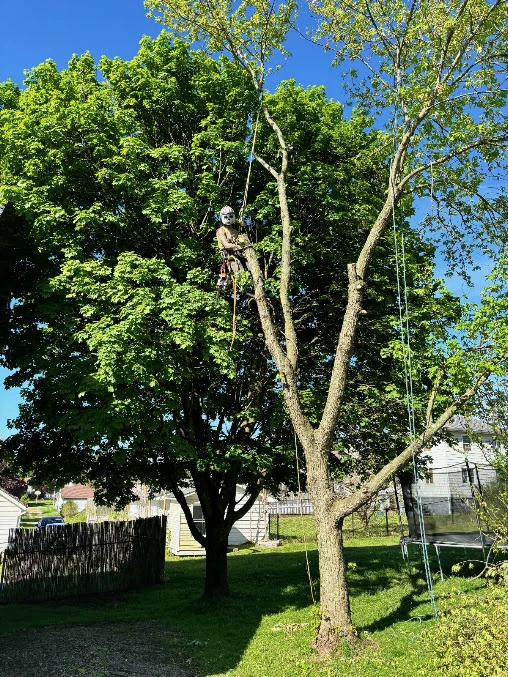
Every limb that comes off takes leaves the tree uses to feed itself, so raising a crown has a limit. Take too much from the bottom and the tree ends up top heavy, with its weight and its wind load carried high on a long bare trunk.
We stop well short of that. The goal is to keep most of the living crown on the tree, spread through its height, and lift only enough to clear what needs clearing. On a big lift, part of the work can wait a season so the tree is never stripped in one visit.
Each cut goes back to the branch collar, the slightly swollen ring where a limb joins the trunk. Cutting there lets the tree close the wound over. Cutting flush into the trunk, or leaving a stub poking out, invites decay into wood the tree needs.
The climber in the photo is tied in high with lines running down to the lawn.
Edge trees that lost their neighbors
When part of a wooded lot gets cleared for a house or a yard, the trees left standing at the new edge face wind they never had to handle before. They grew up sheltered inside a stand, and now they are out front by themselves.
Wind does strange things in these plans. Curving streets through cleared pockets of woods can funnel it, and one cul-de-sac can lose several limbs in a storm while the street behind it loses none.
On an edge tree, raising the crown and lightening the low, heavy side facing the open ground gives the wind less to grab. Taking weight off a long limb before a storm beats picking it off a roof after one.
These are the trees Chris looks at first when somebody asks for a preventive check. If yours went from sheltered to exposed when the lot next door was cleared, that is reason enough for a look.
Lightening the low side does not mean hollowing the tree out. The cuts thin the heaviest limbs and shorten the longest reach toward the open ground, while the far side, still sheltered by the woods, gets left mostly alone. The tree keeps its shape from the street and carries a lot less leverage on the side the wind finds first.
The weeping tree version
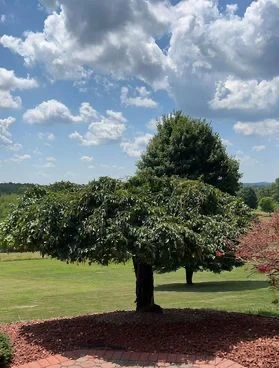
Weeping ornamentals need their crowns raised too, just on a smaller scale. Left alone, the branches hang to the ground in a dense mound, swallow the edge of a patio and hide the trunk completely.
The photo at the top of this post shows one after the work: the skirt lifted so the trunk and a clean mulch ring show under a rounded canopy, with the paver edge clear in front.
That is done with hand cuts and never with shears. We trace each low branch back to where it joins a bigger limb and cut it there, so what remains still weeps and simply ends higher off the ground.
A straight sheared line around the bottom backfires, because every clipped tip sprouts several new shoots and the drape thickens. It is the same hand-cut thinking we bring to hedge trimming on overgrown shrubs.
On a spring bloomer, the lift waits until right after the flowers drop, so next year’s buds stay on the tree. Clippings get picked out of the mulch, the patio gets swept, and the brush goes out on the truck.
Questions about lifting a canopy
Will raising the crown hurt my tree?
Not when the cuts are made right and the lift stays modest. We leave most of the living crown in place, spread through the height of the tree, and cut each limb back to its branch collar so the wound can close. Trouble starts when too much comes off the bottom at once, leaving a long bare trunk with all the weight up top.
How high should the lowest limbs be?
High enough to clear what you need cleared, and no higher. Over a driveway, that means room for the tallest vehicle that uses it. Over a lawn or a walk, room to pass underneath without ducking. Over a roof, enough space to keep leaves and limbs off the shingles. Chris sets the height with you at the walk-around.
Is crown raising different from trimming the whole tree?
Yes. Crown raising works on the lowest limbs to open up the space under the tree. Pruning across the whole crown deals with dead wood, crossing branches or weight higher up. Plenty of jobs need a bit of both, and after a walk around the tree we will tell you which one yours actually needs, and why.
Get the limbs off the roof
If a canopy tree is resting on your roof or crowding the end of the driveway, call (412) 526-2028 or send a photo through the contact form. Before any cuts, the up-front number is yours in writing. More on crown raising, and on everything else we do in Franklin Park. In sawdust we trust.