
Lifting the Skirt on a Weeping Tree
Weeping ornamentals get planted as small, tidy accents next to a patio or a front walk. Enough springs later, the same tree has turned into a green mound that covers the bed, swallows the walk and hides its own trunk completely.
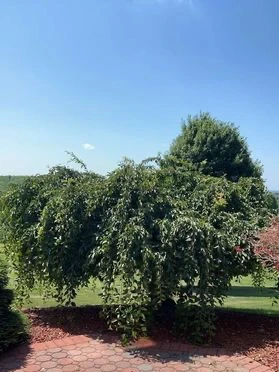
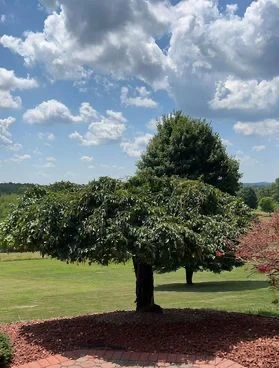
The two photos in this post are the same weeping tree on either side of one hand pruning. Reading them side by side is the easiest way to see what the work actually does, and what it deliberately leaves alone.
What the mound was hiding
In the before photo, the tree reads as one solid shape. Branches hang all the way to the mulch, the outer layer is so dense that you cannot see into it, and the edge of the brick paver patio disappears under the drape.
That is how a weeping tree grows when nobody stops it. Every branch heads out and down, the tips get a little longer each year, and once they reach the ground they keep going along it. The outer shell gets thicker and thicker.
What you cannot see from the patio is the inside. With no light getting through that shell, the interior fills with thin, dead twigs and crossing branches. The trunk is buried. The mulch ring around it has vanished under fallen leaves and the drape itself, and moisture sits against the bark.
None of that makes the tree dangerous. It just means the tree has lost its proportions and is quietly crowding itself from the inside, which is exactly the kind of problem ornamental tree pruning in McCandless is meant to solve.
The cuts between the two photos
We keep hedge shears away from a tree like this. Shearing a weeping tree in a straight line around the bottom looks neat for a few weeks, then every clipped tip throws out several new shoots and the shell gets denser than before.
Instead, each hanging branch that needs to come up gets followed back by hand to where it joins a larger limb, and the cut goes there, or back to a side branch growing in a better direction. The branch that remains still hangs and still moves in the wind. It just ends higher.
Inside the crown, the dead twigs come out, along with branches rubbing against each other and some of the crowded interior growth. That lets light back into the middle of the tree, so it can hold healthy leaves on the inside instead of only on the outer shell.
Clippings from a job like this land almost entirely in the planting bed. They get picked out of the mulch by hand, the bed gets raked, the patio gets swept, and the brush leaves on the truck.
Straight shoots from below the graft
Many weeping ornamentals, weeping cherries especially, are grafted: a weeping variety set on top of an upright trunk. That is why the trunk stays fairly short and straight while the crown spills outward from the top.
The part below the graft is a different plant, and it does not weep. Every so often it sends up shoots of its own, from the trunk or from the roots near the base. Those shoots grow fast and stand straight up, and they look completely out of place poking through the top of a weeping crown.
Left alone, they keep growing and can take over. The upright growth is often more vigorous than the weeping top, and over time it can shade it out and leave you with a tree that no longer weeps at all.
So those shoots come off every time we prune, cut close to where they start. If you notice straight, stiff branches heading skyward out of a weeping tree, or new sprouts coming up around the base, that is what they are. You can snip small ones yourself. Bigger ones are worth having us take out properly.
What the after photo is showing
The first thing you notice in the after photo is the trunk. It is visible again, rising out of a clean mulch ring instead of disappearing into a mound. That alone makes the tree look like a deliberate planting rather than a shrub that got away.
The skirt now ends well above the ground, so the paver edge in front is clear and the bed underneath gets light and air. The canopy is still rounded and still weeping. Lifting and opening a crown keeps the tree recognizably itself.
On a spring bloomer, the cutting waits until just after the flowers drop, so next year’s buds do not leave with the wood. Width only comes back as far as it takes to keep the tree in proportion with the patio and the house behind it.
Look past the tree to the shrub with red leaves and the open lawn. The tree now sits in its bed instead of covering it.
Keeping the after looking like the after
A weeping tree does not stop growing because it was pruned once. Every spring the tips start heading down again, so the shape in the after photo needs a little help to hold.
Most of that help is light. A touch-up visit every so often, lifting the newest tips off the ground and thinning the interior before it closes back in, keeps the tree from ever returning to the before photo. Kept up like that, the bigger job rarely has to happen twice.
Between visits, a few simple habits help. Keep the mulch ring around the trunk clear and do not let mulch pile up against the bark. Pull any upright shoots or base sprouts while they are small. And resist the hedge shears, even when one branch is brushing the walk. One hand cut back to a side branch fixes it without starting the shell again.
If the tree starts sending a lot of upright shoots, or a section of the crown stops leafing out, call. Those are signs that something other than ordinary growth is going on.
Questions about weeping and ornamental trees
Can I just trim the bottom of my weeping tree myself?
You can trim a few branch tips off the walk, but a straight sheared line around the bottom makes the problem worse over time. Each cut tip sprouts several new shoots, the outer shell thickens, and the interior keeps dying back. If the tree needs more than a light touch-up, hand cuts back to side branches inside the crown work much better.
Will lifting the skirt hurt my tree?
Not when it is done with hand cuts in the right places. Lifting the skirt takes off the lowest and oldest hanging growth, while thinning the inside lets light reach leaves the tree can actually use. The tree keeps its weeping shape and usually looks healthier the next season. Shearing or removing too much in one visit is what causes trouble.
Is it too late if the tree already covers the patio?
Usually not. Weeping ornamentals respond well to having their skirt lifted and their interior thinned, even after years without pruning. It may take more than one visit to get it fully back in shape without taking off too much at once. The one exception is a tree that simply has no room where it was planted, and we will tell you if yours is one.
Bring the trunk back into view
If a weeping tree has taken over your patio or front walk, a careful hand pruning can give you the yard back and keep the bloom. Call (412) 526-2028 or send a photo through the contact form, and you will get an up-front number in writing before any cuts. More about ornamental tree pruning and our work in McCandless. In sawdust we trust.