
When a Forest Tree Ends Up Standing Alone
A lot of the trees in McCandless backyards were never planted. They were already there, part of the woods the plans off Ingomar Road and Perry Highway were cut into, and they spent most of their lives with other trees around them.
You can learn a surprising amount about one of those trees from the sidewalk, without a ladder or a climber. This post is about that read: what the trunk, the first limbs and the crown are telling you, and what is worth watching through one full season before you decide anything.
The taper tells you where it grew
Stand far enough back to see the whole trunk, from the ground to where the crown starts. A tree that grew up in the open usually has an obvious taper, wide at the bottom and narrowing steadily as it goes up, because wind worked it from every side and it thickened its base to handle that.
A tree that grew up inside a woods often looks more like a pole. The trunk stays nearly the same width for a long way up, because its neighbors took most of the wind and it put its energy into height instead. That is not a defect. It is a record of where the tree spent its first decades.
It does tell you something about how the tree was built. A pole-shaped trunk with a big crown on top was designed for sheltered conditions. If the woods around it are gone and the crown has grown wider since, that trunk is carrying a load it was not shaped for.
Look at the base too. A healthy tree flares out where the trunk meets the ground. If yours goes straight into the dirt like a fence post, the flare may be buried under fill from when the lot was graded, which is worth mentioning when you call.
How high the first limbs start
In a closed woods, the lower branches of a tree get shaded out by its neighbors. They die, fall off, and the trunk heals over the spots. That is why forest trees often have no live limbs at all for the first long stretch of trunk.
From the sidewalk, compare how much of the tree’s height is bare trunk to how much is crown. A woods tree with a small crown perched way up on top grew that way to reach light. It is normal, but it means most of the tree’s weight and wind catch sits high, at the far end of a long lever.
Now look for change. Once a tree like that is standing alone, it often starts pushing out new shoots along the bare trunk, because sunlight is reaching bark that never saw it before. A handful of small shoots is the tree responding to light. A trunk suddenly covered in clusters of them can also be a sign of stress, and that is worth a closer look.
Dead stubs where old lower limbs broke off are normal too. The question is whether the bark has closed over them or whether you can see dark, open holes.
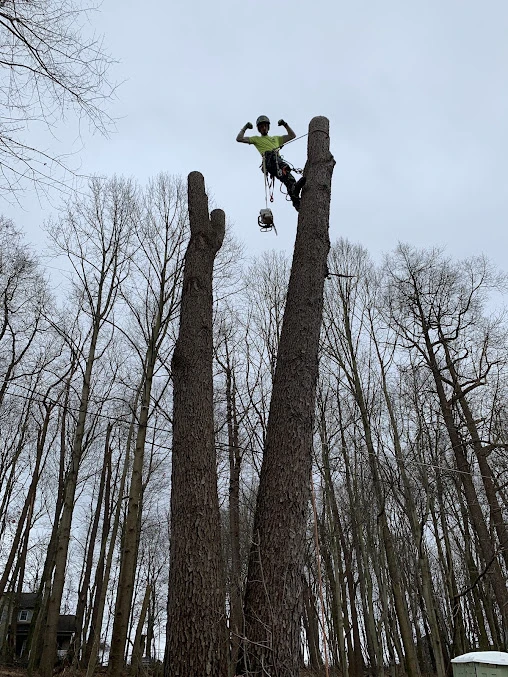
Crown spread against what holds it up
When the lots around a forest tree were cleared, its crown suddenly had room. Many of them spread out sideways into the new light, sometimes a lot. What usually did not change as much was the root system, which was built for a tree that leaned on its neighbors for shelter.
From the street, step back and picture the crown as a shape. Then picture what is holding it up: a trunk shaped for sheltered growth and roots that never had to brace against open wind. If the crown has grown much wider than the tree’s base looks able to handle, especially on one side, that imbalance is the thing to pay attention to.
A crown that has spread heavily toward the house, the driveway or the street is the most common version. The tree grew that way because that is where the light was. It also means the weight is sitting over the things that matter most.
This is often a pruning question rather than a removal question. Taking end weight off the heavy side brings the crown back in line with what holds it up, which is what crown reduction is for.
One season of watching
If a tree has you uneasy but nothing looks urgent, the most useful thing you can do is watch it through a full season and write down what you see.
Spring. Watch how it leafs out compared to the trees around it. Branches that stay bare after everything else has leafed out are dead or dying, and dead wood high in a woods tree is the first thing that comes down in a storm.
Summer. Look for leaves that wilt, yellow or turn early on one part of the crown while the rest stays green. After a soaking rain, check the base for mushrooms or shelf fungus.
Fall. Notice whether the tree drops leaves much earlier than its neighbors, and pick up what falls after a windy day. A few twigs are normal. Limbs as thick as your wrist are not.
Winter. With the leaves gone, the structure is easy to see. Look for cracks where the big leads meet, hanging broken limbs and any new lean. After a hard wind, walk to the base and check that the ground has not lifted or cracked.

What to send us after you have watched
Take photos from the same spot each time you check the tree, one of the whole tree and one close on the base. Photos from the same angle a few months apart show change better than memory ever will.
When you call, tell us what you noticed and when. A branch that stayed bare in spring, a patch of fungus after a rainy week, a crack you spotted in January. That gives us a head start before anybody stands under the tree.
If anything on that list shows up quickly, like ground lifting at the base or a fresh crack in the trunk, do not wait for the season to finish. Call that day and keep people and cars out from under it.
From there, we look at the tree in person and tell you what we see in plain words. Plenty of these trees need some pruning and nothing more. When one does need to come down, the hazardous tree removal page for McCandless walks through how that decision gets made.
Questions about reading a woods-grown tree
Is a tall, skinny tree more dangerous than a wide one?
Not on height alone. A tall narrow forest tree with sound wood and a settled root plate can stand for a long time. What raises the risk is a narrow trunk carrying a crown that has spread wide since the lot was cleared, or roots that never anchored against open wind. We check the base and the unions before saying anything about height.
Is it normal for the bottom half of the trunk to have no branches?
On a tree that grew up in the woods, yes. Its lower limbs were shaded out by neighboring trees decades ago and dropped off on their own. A long bare trunk is a sign of where the tree grew, not a sign of trouble. What matters is whether the old branch scars have closed over cleanly or show open, dark cavities.
Will you tell me if my tree does not need to come down?
Yes, and it happens often. A lot of the trees people call us about turn out to need deadwood removed, some weight reduced over the roof, or nothing at all for now. If pruning solves the problem, that is our recommendation. If you get a removal recommendation from us, you also get the reason in plain words before you decide.
Have us look at it
If a tree in your yard grew up with the woods and now stands alone, it is worth a look before the next storm. Call (412) 526-2028 or send a photo of the whole tree and one of the base through the contact form. You will get a straight read and an up-front number in writing if any work is needed. In sawdust we trust.