
Small trees, front beds
It used to sweep the patio. Now you can see the trunk.
The dogwood by the walk, the Japanese maple under the front window, the weeping tree that swallowed its own mulch bed. Small trees close to the house get pruned by hand here, one cut at a time, by the same crew that takes down the big oaks out back. Smaller saw, same standard, and we leave the bed cleaner than we found it.
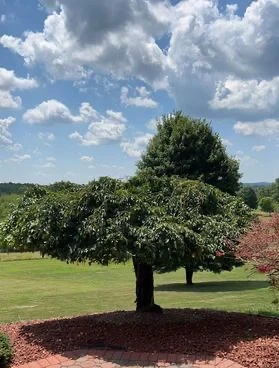
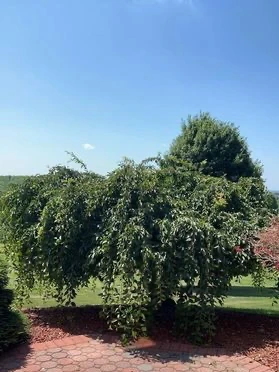
Lifting the skirt so the trunk and the mulch ring show again
That is one tree twice, the finished job first and the starting point second. Before we touched it, the weeping branches had grown all the way down and spread into a single heavy mound over the bed and the edge of the brick patio. You could not see a trunk. The mulch under it stayed wet, and anybody walking to the pavers had to step around it.
The fix was lifting the skirt: shortening the hanging tips back to a bud or a side shoot at a height that clears the pavers and the mulch ring, then thinning inside the curtain so the canopy reads as a rounded weeping shape again. The interior had dead twigs and shoots climbing straight up through the top, and those came out by hand. Now air moves underneath, the bed dries out between rains, and the trunk is part of the picture.
More before and after work like this is in the gallery.
Thinned with hand pruners and a handsaw, never sheared into a ball
Hedge shears are fast, and on a tree that is the only good thing about them. Shearing a dogwood or a crabapple into a ball cuts every branch tip at the same line, and each of those cuts pushes two or three new shoots out right behind it. Do that two summers running and the tree becomes a dense shell of twigs with a dark, dead interior and flowers only on the outer inch.
Hand thinning works the other way around. We go into the canopy, find the branch that is crossing, crowding or heading somewhere it should not, and take it back to where it joins a bigger limb or to a bud facing outward. The cut disappears into the branching. Light reaches the middle, the natural shape holds, and the tree has no reason to answer with a flush of sprouts.
The kit for this is small on purpose: hand pruners, a folding saw, a pole pruner for the high tips of a weeping canopy, and a tarp spread under the tree so clippings never land in the ground cover. Nothing heavy rolls across the lawn for a job this size, and nothing gets left in the mulch.
It takes longer, and on a small tree right by the front door, that patience is what you see every time you walk in. A Japanese maple especially wears every cut for years, so each one gets picked from a step back before it gets made. Our ornamental tree pruning page walks through how we handle the common species one at a time.
Wait for the flowers to drop, then prune
On an ornamental the month matters as much as the cut, because the wrong one throws away next year’s show.
- Spring bloomers
- Dogwood, flowering cherry, weeping cherry and crabapple all set next spring’s flower buds the summer before. Prune them right after the blooms fade, and the tree has a whole growing season to make new buds on the wood that stays.
- Winter
- A winter cut on a spring bloomer takes off buds that were already sitting on the branch, waiting. The tree survives fine. You just get a thin spring and wonder what went wrong. Winter is for deadwood and broken limbs, which can come out any time of year.
- Japanese maples
- No flowers to protect, so structural work happens with the leaves off, when every branch and layer is easy to read, and light touch-ups wait for summer if something starts reaching into a walkway.
- After a storm
- A split limb does not wait for the calendar. Torn wood gets cleaned back to a proper cut right away, so the tear does not keep running into the trunk.
In proportion with the house it stands in front of
An ornamental gets planted for scale. The dogwood at the corner of a colonial or the weeping tree at the end of the patio was chosen because it fit there at five feet tall, and then it kept going. Part of every visit is walking out to the street and looking at the tree with the house behind it.
Usually that means keeping a weeping form a little wider than it is tall, so it reads as a fountain beside the patio, and keeping an upright tree like a dogwood or a crabapple below the gutter line with its branches clear of the siding. We hold the height by shortening the tallest leaders back to side branches, the same idea as crown reduction on the big hardwoods, worked at a much smaller scale. Branches touching the house, a window or a downspout come back far enough that the next season’s growth will not close the gap by August.
The bed counts too. A tree with its roots under a mulch ring and ground cover does better when its canopy lets light and rain through to the plantings, so we lift and thin with those in mind, and every clipping leaves on our truck.
A small tree near the front door is the first thing anybody sees of the house. It should look chosen.
When an ornamental has simply outgrown its spot
Some small trees are not small anymore. A Japanese maple planted two feet off the foundation, a crabapple under the bay window, a weeping tree whose canopy now covers the whole bed and half the walk: pruning can buy time, but a tree that has to lose half its growth every year just to fit is in the wrong place. Cutting it that hard every season starves it and leaves it looking chopped.
When that is where things stand, Chris will say so on the first visit rather than sell you the same fight every spring. Sometimes the answer is changing the bed instead of fighting the tree. Sometimes it is taking the ornamental out and planting something that tops out at the size the space actually allows. A small removal goes quickly and cleanly, and the stump gets ground so the bed can be replanted.
The same plain read applies to the big trees behind the house. If one of those is the real worry, start with hazardous tree removal. If the back edge of the yard has gone to brush and saplings, lot clearing covers it, and when the only way out for a big one is up and over the house, that is crane-assisted removal.
McCandless and the plans around it, on the regular route out of 15223.
Small trees close to the house: what people ask
Short answers for the trees in the front bed and along the patio.
When is the right time to prune a flowering cherry or a dogwood?
Right after the flowers fade in spring. Both form next year’s buds over the summer, so pruning then gives the tree the whole season to replace what came off. A winter haircut is the most common reason we hear that a tree quietly stopped blooming.
Can you trim it into a neat round shape?
We can keep it neat. We will not shear it into a ball, because sheared trees fill up with twiggy sprouts, go bare and dead inside, and flower only on the outer skin. Hand thinning keeps a clean outline that still looks like the tree you picked out at the nursery.
How high do you lift the branches on a weeping tree?
High enough that the tips clear the patio, the walk and the mulch ring, and low enough that it still weeps. On most of them the trunk shows plainly and the curtain stops somewhere above the ground cover. We check it from the house and from the street before we call it finished.
My Japanese maple is crowding the front window. Can it be made smaller?
Usually, over a couple of visits. The branches reaching toward the glass get shortened back to side shoots and the layers get thinned so you can see through them. Trying to take it down to size in one hard session tends to leave a lumpy maple that sprouts everywhere.
Do you take small jobs, or only big trees?
Small jobs are welcome. A couple of ornamentals and a shrub bed is a real visit, done by the same crew with the same equipment and the same cleanup as a big removal. It also pairs well with work on a bigger tree out back, since the truck is already in the driveway.
Is my weeping tree too far gone to bring back?
Rarely. Even a weeping ornamental that has grown into a solid mound usually has a sound trunk and good branch structure under all that growth, and one careful visit opens it back up. The exceptions are trees with a lot of dead wood up top or a trunk that has started to split.
Show us the tree and the bed around it
A photo from the patio or the front walk tells us most of it: how far the branches hang, what is planted underneath, how close the trunk sits to the house. Send it along with what kind of tree you think it is, if you know, and Chris will tell you what one visit does for it and which time of year to book. You get an up-front number before a single branch comes off. The rest of what we do up here is listed on the McCandless page, and the contact form takes photos.