
Crane-assisted removal, McCandless
The tree is behind the house. The crane goes over it.
A big oak at the back of a McCandless lot will not fit out the side yard in one piece, and it should not swing over your shingles on a rope either. So we set a crane at the curb or on the drive, the climber cuts each section loose, and the weight rides through the air to a landing spot chosen before the day of the job. The setup gets worked out before anybody books a crane.
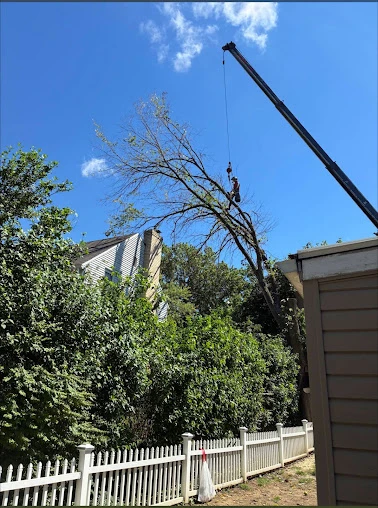
Somebody walks your street before a crane is ever booked
Crane day runs quietly because of a short visit before the day of the job. Chris parks, stands at the curb and looks at four things, more or less in this order.
- How the driveway pitches.
Plenty of drives in the plans off Perry Highway climb or drop hard from the road. Outriggers need flat, solid footing, so a steep drive usually means the crane sits on the street and reaches a little farther.
- Where everything turns around.
A crane and a chip truck both have to get in, and more to the point, back out. On a cul-de-sac we decide where each one parks ahead of time, so nobody is reversing down a hill at eight in the morning.
- The service drop.
That wire running from the pole to your house tends to sit right where the boom wants to swing. We plan the swing around it. When it truly cannot be avoided, the utility hears from us well before crane day.
- The set point, and whose curb it is.
Sometimes the best spot is in front of the house next door. Then we knock or call that neighbor in advance, tell them roughly how long, and ask first. Nobody on the street gets surprised by a crane.
Same oak, forty feet more of it
Out in the open, an oak grows wide. Give it sky from the start and it spreads into the light and stays fairly low. The white oaks and red maples behind houses up here did the reverse. They came up inside standing forest, fighting their neighbors for light, so they went straight up. When the plans were cut in, they were already timber, and they have kept growing since.
Compared with a job in the inner North Hills, that usually means about forty extra feet of tree, and every one of those feet is wood we have to get down. A trunk section from near the top weighs more than most people would guess, and lowering it on rope past a gutter puts a lot of faith in the limb it hangs from.
A crane takes the faith out of it. The piece hangs from the hook before the cut is finished and travels exactly where we send it. On most big removals here, the crane is simply how the job gets done safely. Nobody is upselling you a machine.
Reaching past the deck, the fence and the garden
Deep lots put the big tree a long way from the street. A hundred feet back is normal, and between the curb and that trunk you will usually find a deck, a fence, a shed and raised beds somebody spent three summers getting right.
Without a crane, every piece of that tree has to cross all of it. The tree gets cut down in sections and carried or dragged out, trip after trip over the same grass. With the boom set out front, almost none of it touches the yard. Each section lifts straight up, crosses the roof in the air and lands by the chipper at the curb. The deck stays a deck. The tomatoes keep growing. What walks across the yard is the crew and the climbing gear, and they leave no ruts.
When the roof is the only route the boom has, you get shown the swing path at the walk-through, so nobody spends the morning at the window wondering.
Still deciding whether that tree needs to come down at all? Start with hazardous tree removal, and if the answer turns out to be a lighter crown, crown reduction covers it. A whole overgrown tree line is lot clearing, and the small trees beside the patio belong to ornamental tree pruning.
Chris and his team removed a very tall, old poplar tree from my yard in just a few hours. The cleanup was excellent, they left it spotless.
A Triple T customer, on a tall removal
One piece at a time: rig, cut, lift, land
Every pick happens in the same order, and the order is what keeps it safe. The climber goes up and works from the tree itself. Before he cuts, the crane line is choked around the section and the operator takes up its weight, so when the saw comes through, that piece is already hanging from the hook.
Then it flies. The operator lifts it clear of the stub, swings it over whatever sits in between and sets it down in the drop zone, a stretch of street or driveway the crew cleared and marked that morning. On the ground they unhook it, buck it into lengths and feed the brush to the chipper while the next pick is rigged up top.
Big leaders come off in several picks, and the trunk usually comes down last in long sections. How long each one is depends on what the crane can hold at that reach, and nobody guesses at it. Smaller limbs that are not worth a pick get lowered on rope through a friction device like the one in the photo. How we approach this work across the whole area is on the crane-assisted tree removal page.
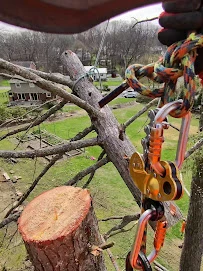
If the crane cannot get in, we climb it out and say so
Climbed out instead
Some setups just do not work. The drive is too steep, the road too narrow, the wire in the wrong place, or the tree too far back for any boom we can bring. You hear that at the walk-through, before the day of the job, not during it. Then the tree comes out the slower way: a climber takes it apart from the top, roping each piece to the ground, and the crew carries the wood out along a single path.
The yard afterward
Where the turf is soft, plywood goes down before anything heavy crosses it. Brush leaves on the route it came in by, so there is one track to rake. The stump does not wait for a second trip either. The grinder takes it below grade the same visit, chips fill the hole, and topsoil and seed go on if you want grass back there. The stump grinding page has the details, and the gallery shows how these yards look when we leave.
McCandless, Allegheny County. Home base in 15223 is down McKnight, so the walk-through is a short drive for Chris.
What people ask before a crane shows up
Most of these come up during the walk-through, standing at the end of the driveway.
Will the crane crack my driveway?
The outriggers sit on wide pads, and on a driveway we add mats or cribbing under them so the load is not concentrated on one small square of asphalt. If the drive is new, thin or already cracking, we usually set up on the street instead and reach a little farther to make up for it.
Do I have to be home on crane day?
Not really. We need the driveway and the curb out front clear of cars that morning, plus a way through the backyard gate. Plenty of people leave for work and come home to the stump ground out and the lawn raked. If you want to watch the picks, that is fine too, from wherever we put you.
Does my neighbor have to agree to anything?
Only when we need their curb, their driveway or the air over their yard. When the plan uses any of those, Chris talks to them before the day and explains how long the crane will be parked there. If they say no, we find a different set point or a different way to take the tree down.
What about the wire that runs to my house?
We plan the boom’s swing around the service drop at the walk-through, and most of the time it works above or beside the line without any trouble. When a section has to pass close, the utility is contacted ahead of time about protecting or dropping the line. Nobody guesses about a live wire.
How long will the crane block the street?
That depends on the tree, how many picks it takes and how far the boom has to reach, so we lay out the plan at the walk-through instead of guessing on the phone. You will know when the crane arrives and when the street opens back up, and the neighbors will too.
Does bringing a crane make the job cost more?
The crane is a line on your up-front number, and you see it before you agree to anything. On a big tree behind a house it often saves hours of climbing and a lot of hauling across the lawn, so the total is not always higher than climbing it out. We will walk you through both ways.
Show us the driveway, the street and the tree
Three photos from the curb cover most of what the walk-through will confirm: how the drive pitches, where a crane could sit and how far back the tree stands. Send them through the contact page or call, and Chris will tell you whether this is a crane job before anybody books one. You get the up-front number in writing first. Everything else we run in town is on the McCandless page.