
How a Big Limb Comes Down Over a Roof Without Touching It
Stand in the yard while a six hundred pound limb comes off a tree above your garage and the whole thing looks anticlimactic. A cut, a short drop of maybe a foot, then the piece swings out and travels down to the grass at walking speed and stops. Nothing bounces. Nobody shouts.
That is the point. Everything interesting about the job already happened, in rope and hardware, before the saw touched wood. Here is what is actually going on up there.
The piece never falls, it gets lowered
The instinct is that you cut a branch and it drops and somebody catches it. That is not the system. The limb is attached to a rope before the cut, and after the cut it is still attached, which means it never becomes a falling object at all.
A rigging line runs from the limb, up to a block fixed high in the tree, and back down the trunk to a friction device at the base. A groundman holds the tail of that rope. When the cut releases the limb, its weight is taken by the rope through the block, and the groundman controls the descent by how much rope he lets past the friction device.
The short drop before the rope takes up is deliberate. Loading a rope instantly with the full weight of a limb produces a shock force several times the static weight, which is how hardware and anchor points get overloaded. Letting the piece move a little first, then catching it progressively through friction, spreads that force over time instead of concentrating it into one jolt.
Once it is hanging, it is just cargo. It swings clear of the roof, gets walked down to the lawn, and gets untied.
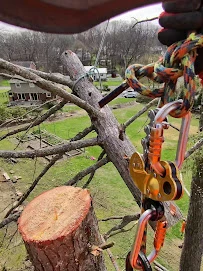
Where the block goes, and why that decides everything
The block is the pulley the rope runs through, fixed high in the tree above the limb being cut. Its position does more to determine the outcome than anything else in the setup.
High is the first requirement. If the block sits above the limb, the piece lifts slightly as the rope loads and swings inward toward the trunk, away from whatever is underneath. A block level with or below the limb gives you the opposite: the piece swings out and down, which over a roof is exactly wrong.
Sound wood is the second. The anchor point carries the whole load and then some, so it goes on a solid union on the main stem, never on a limb with a seam, never on the dead side of a declining tree. On a storm-damaged tree that often means the anchor goes in a different tree entirely.
Direction is the third. The block position sets the arc the piece will travel, so before anything gets tied the climber has picked where that arc ends. Over a garage with a fence on one side and a patio on the other, the landing zone can be a strip of lawn eight feet wide, and the whole setup exists to put every piece in that strip.
When no arc works, because the only path crosses the roof no matter where the block goes, the answer is not a cleverer rope. It is a crane picking the piece straight up.
Small pieces beat clever ones
The reliable way to get a big limb off a roof is to stop treating it as one limb.
A long branch cut at the trunk swings a long way and carries momentum at the far end. The same branch taken in four pieces from the tip inward never develops that. Each piece is short, light, and easy to place. It is slower and it is the right call on a tight lot.
Tip work happens first for that reason. The climber moves out the limb, takes the end sections off, and works back toward the trunk. By the time the heavy butt section is cut, everything past it is already on the ground and the piece has nothing to sweep through.
How small depends on what is underneath. Open lawn means bigger pieces and a faster job. A roof, a fence, and a pool all at once means pieces you could carry, and that is ordinary work on a postwar Ross lot rather than a special case.
People sometimes push for speed here. The honest response is that the pace is set by what is under the tree, and four extra cuts cost less than a shingle repair.
What the ground crew is actually doing
From the driveway the groundman looks like he is holding a rope. He is running the half of the operation that decides whether any of it works.
He is on the friction device, which is where the limb’s weight is managed. Too much friction and the piece stops hard, shock-loading the block and the anchor. Too little and it runs. Feeding the right amount of rope at the right rate is the skill, and it is felt through the hands rather than measured.
He is also watching things the climber cannot see. From up in the tree, distance to the roof edge and the true path of a swinging piece are hard to judge. The groundman has the whole geometry in view and calls it.
He owns the ground, too. Nobody stands under the work, nothing gets left in the landing zone, and the cars moved out of the drive before the first cut stay moved. If you are home while we work, that is the person to ask where it is safe to stand.
And he keeps the yard moving. Pieces get untied, dragged to the chipper, and fed as they come, so the lawn never fills up with limbs and the job finishes where it started.

What we set up before the saw starts
The walk-around settles the plan and takes a few minutes. Where the pieces land, where the rope goes, where the truck and the chipper sit, and what has to move first.
Cars come out of the drive even when the plan says nothing goes near them, because plans are about intent and a driveway is about consequences. Patio furniture, grills and anything light move clear of the landing zone for the same reason.
Then the anchor gets chosen and tested. The climber loads it before trusting it with a limb, and if the union it sits on has any question about it, it gets moved.
Then the sequence. Which limb first, which way each piece swings, where the tree’s weight shifts as material comes off. Taking a heavy side down before the opposite side changes how the whole tree stands, and that gets thought through before anything is cut rather than discovered in the middle.
Anything touching a wire is a different conversation entirely and goes to Duquesne Light first. We do not put a rope in a tree that is tangled with a live line.
When it is done the brush is chipped, the wood is off the property unless you asked for rounds, the lawn is raked, and the stump is ground if you booked it. One visit, whole job, and the up-front number you approved covers the cleanup.
What people ask while we are rigging
Is my roof at risk during the work?
The rigging exists so nothing reaches it. Pieces are tied before they are cut, lowered rather than dropped, and sized so their swing stays inside a landing zone we picked before starting. When no rope path avoids the roof, we bring a crane and pick the section straight up instead of arguing with physics.
Do I need to be home while you work?
No, as long as we have talked through the plan and access beforehand and the cars are out of the drive. Plenty of Ross jobs happen while people are at work and they come home to a raked lawn. If you would rather be there, stand where the groundman tells you and you will see the whole thing.
Why does one limb take so long?
Because it is not being removed, it is being taken apart and lowered in pieces, and each piece gets tied, cut, landed and untied on its own. On open ground the same limb is a few minutes. Over a roof with a fence on one side, the slow version is the one that leaves your house alone.
If something is sitting on your shingles
A limb resting on a roof wears through it, and the fix is usually a short visit rather than a big job.
Call (412) 526-2028 or send photos through the contact form. You get an up-front number, then the crew, then your yard back. More on our work in Ross Township and on after-hours and emergency calls. In sawdust we trust.