
After the Tree Is Gone: The Lawn, the Stump and What to Plant Next
The week after a big removal is strange for most people. The yard is bigger than they remembered, the house gets sun at hours it never did, and by four in the afternoon the living room is warm in a way it has not been in decades. Nobody warns you about that part. The stump and the bare circle get all the attention, and they are the easy half. The light is the half that changes how you use the yard, and it is the half worth thinking about before you pick a replacement tree.
What the first summer without shade actually does
Losing a mature canopy is not a subtraction from one spot. It redraws the sun across the whole property, and you feel it in four places.
The lawn nearby wakes up. Grass that was thin and patchy under the canopy for years suddenly has light, and in most Ross yards it thickens on its own inside a season with nothing more than the mower set a notch higher. Beds change character less kindly. Hostas, ferns and anything else that went in for shade will scorch by July in full afternoon sun, so those get moved rather than mourned, and fall is the right time to move them.
The house feels it hardest on the west side. West-facing rooms that stayed comfortable all summer get the full afternoon back, and that is the single most common reason people call us about a replacement tree. Go stand in those rooms at five o’clock in August before you decide anything. The window that is uncomfortable tells you where the new shade belongs, and it is often not where the old tree stood.
Give the yard one full season before you plant
We say this on almost every removal and about half of people take the advice.
A year of watching costs you nothing and tells you things a nursery tag cannot. You learn which corner bakes, which corner still holds shade from the neighbor’s trees, where the snow drifts, and whether the grass came back on its own or needs help. A tree planted against that knowledge sits in the right place for sixty years. A tree planted in October because the hole was already there sits wherever the hole was.
The other reason to wait is that the ground where the tree stood is not the ground you think it is. The old root plate is in there decaying, the grindings settle, and the spot moves for a year or two. We wrote the mechanics of that out in full, the grind depth, the chip pile, the soil swap and the offset, in what happens after the stump is ground, so we will not run through it again here beyond the short version: plant the new tree in undisturbed ground a few feet off the old center, or swap the soil properly first.
What you do want in that first season is grass. Early fall is the best seeding window around here by a wide margin, and pick the seed for the light you have now rather than the light you had. That circle went from deep shade to open sun in one afternoon. Whatever is growing in the sunny part of your yard is the honest guide.
Mature size is the only number that matters
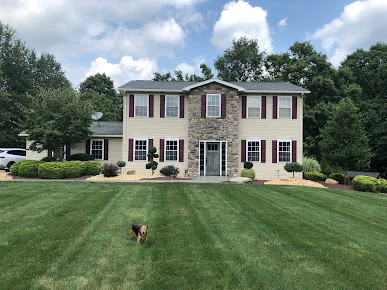
Most of the removals we do in Ross are the bill for a planting decision made in the postwar decades. The houses went up, the shade trees went in with the brick, and sixty years later those silver maples and pin oaks have outgrown the lots while the ranch houses underneath them have not moved an inch. A tree that made sense in 1958 now hangs over a roof, a driveway and the neighbor’s above-ground pool at once.
So the useful question is never which tree you like at the nursery. It is how wide and how tall the thing gets at maturity, and whether that fits the ground you are giving it.
A rough working rule on a small lot: half the mature spread is the minimum distance to anything solid. A tree that gets thirty feet across needs fifteen feet of clear ground from the foundation, and more is better because roofs and gutters do not want branches touching them at all. Twelve feet off the wall for a thirty-foot spread is the exact mistake that fills our schedule.
Overhead is the other hard limit. If there is a utility line over the planting spot, the mature height decides everything, and anything that tops out above roughly twenty-five feet under a line is a tree somebody will be cutting a hole through for the rest of its life. Under wires you want small: a serviceberry, a redbud, a dogwood, a crabapple, a small ornamental cherry. They give you flowers, fall color and a canopy you can still walk under, and nobody ever has to butcher them for clearance.
Silver maple is the one to skip outright anywhere on the lot. It was the fast-shade tree of the era, it grows weak double trunks, and the union between those trunks is where six decades of growth decides to come apart in a wet windstorm. They are the repeat offenders on our Ross calls and there is no siting that fixes them.
The foundation, the fence and the sewer line
Three edges on a small lot decide where a tree can go, and homeowners usually think about one of them.
The foundation is the obvious one, and the distance people pick is almost always too short. Beyond the branch question, a big tree close to a wall puts a root plate under the footer and drops leaf load into gutters for the life of the house. Push it out.
The property line is the one that causes arguments later, and we have refereed enough of them to be blunt. The trunk decides ownership, limbs over your neighbor’s side are generally theirs to trim back to the line, and a tree planted four feet off the fence will be half your neighbor’s problem in twenty years whether or not anybody wanted that. If the only open ground you have is near the line, plant something narrow and plant it as far in as the yard allows.
Underground is the one nobody pictures. Water and sewer laterals, gas services, the cable drop and the irrigation line all run through a small lot somewhere, and a root system finds them eventually. If you know roughly where your lateral runs, do not plant a large tree on top of it. If you do not know, that is worth finding out on a walk-around before you dig.
The first five years decide the next fifty
Here is the part almost nobody does, and it is the highest-value tree work there is.
A young tree wants structural pruning, not a haircut. In its first several years you are picking one central leader and removing the competing one, taking off branches that are attached too tightly or crossing into each other, and spacing the permanent limbs up the trunk so no two of them fight for the same spot. Every one of those cuts is small. A pair of hand pruners handles most of them.
Do it and the tree grows into a shape that holds weight. Skip it and the tree grows a co-dominant union, which is two trunks pressed together with bark trapped between them and no wood joining them. That union is fine at fifteen years and it is the thing that splits at sixty, over a car, in a wet windstorm. Taking a competing leader off a young tree is a cut that takes a minute. Taking half a mature maple off a garage roof takes a crane.
The other first-years basics: keep mulch two or three inches deep and pulled back off the trunk so the flare stays visible, water deeply through the first two summers rather than lightly and often, and get the nursery stakes off after the first year so the trunk can move and build wood. That is the whole program.
Questions about light and replanting
The removal made my west rooms hot. Where should the new tree go?
Usually southwest of the house rather than where the old tree stood, because that is the arc the afternoon sun actually comes from in July and August. Stand in the hot room at five o’clock and sight out the window. The new tree belongs on that line, far enough out that its mature spread never touches the roof.
What can I plant under the utility line along the street?
Something that tops out low on its own, so nobody ever has to cut a hole through it for clearance. Serviceberry, redbud, dogwood, crabapple and the small ornamental cherries all fit under wires and still read as real trees from the curb. Anything that wants to be a shade tree at maturity belongs in the back half of the lot instead.
My grass looks worse now, not better. What happened?
Most likely it is old shade-mix seed sitting in what is now full sun, or ground that got compacted while the crew worked. Both are fixable in one fall: loosen the surface, bring the level up where it has settled, and seed with a sun mix matched to the brighter parts of your yard. Give it one season before you conclude anything.
One visit, then your yard back
The takedown, the chipping, the wood off the property, the stump ground and the lawn raked all happen on the same trip. What you do with the light afterward is yours.
Call (412) 526-2028 or send photos through the contact form and you get an up-front number in writing. More about the crew in Ross Township and about how we prune a young tree. In sawdust we trust.