
Out toward the Plum line where the Penn Hills lots get bigger and the woods get closer, there is a particular tree we take out more than any other. It is gray, it has no leaves, the bark is falling off it in plates, and it has been standing there dead for a couple of years while somebody decided whether it was a problem.
It is an ash, and the reason there are so many of them is a beetle that arrived in this region years ago and worked through essentially every ash tree we had.
What actually happened to these trees
The emerald ash borer is a small metallic green beetle that lays eggs in the bark crevices of ash trees. The adult beetle does almost no damage. The larvae are what kill the tree.
They hatch and tunnel into the layer just under the bark, and that layer is the tree’s plumbing, the tissue that moves sugar from the leaves down to the roots. The larvae feed by cutting winding galleries through it. Each one severs a little more of the connection between the crown and the roots.
Enough larvae over two or three seasons and the tree is effectively girdled from the inside. The roots starve while the canopy is still standing, and the tree dies from the top down. That is why you see ash with dead upper branches and a flush of desperate growth low on the trunk, which is the tree trying to grow leaves anywhere it still has a working connection.
There is nothing selective about it. Without treatment, an untreated ash in an infested area is going to die, and our area has been infested for years.
How to tell if you have one
Ash is easy to identify once someone shows you what to look at, and worth knowing because these are the trees to prioritize.
- Opposite branching. Twigs and buds come off directly across from each other rather than alternating. Very few of our trees do this, so it narrows things down fast.
- Diamond bark. A mature ash trunk has ridges forming a tight, regular diamond lattice. It is distinctive once you have seen it.
- Compound leaves. Five to nine leaflets arranged along a central stalk, so a single leaf looks like a small branch of leaves.
Then the signs of infestation, roughly in the order they appear. Thinning starting at the top of the crown. Vertical splits in the bark. Shoots sprouting from the lower trunk. Heavy woodpecker activity, which is a genuinely reliable early tell because the birds are after the larvae and they find them before we notice anything. Then D-shaped exit holes about an eighth of an inch across, and S-shaped galleries visible where bark has come away. Finally the bark starts shedding in plates and what is left is a bare gray trunk.
Why so many of them are on the back of the lot
There is a reason the dead ash in Penn Hills are concentrated where they are, and it is not that the beetle preferred that side of the township.
Ash was never much of a street tree here. What builders planted out front in the fifties was maple, fast and cheap and shapely. Ash mostly came up on its own along the wooded edges, in the hollows, and on the bigger lots where nobody was managing what grew. So when the borer went through, the losses landed in exactly the places nobody looks at: the back third of the property, the treeline behind the plan, the strip along the ravine.
That is also why they sit dead for years before anyone deals with them. A tree dying in the front yard gets noticed the first summer it fails to leaf out. A tree dying eighty feet behind the garage gets noticed when a limb comes through the shed roof.
The practical upshot is that finding these is an active exercise rather than something that happens on its own. It is worth ten minutes and a walk to the back fence once a year, ideally in early summer when everything that is alive has leafed out and anything bare is obvious.
Why standing dead ash is a different job
This is the part that matters, and it is the reason we push on these when we see them.
Most dead trees decay gradually and stay reasonably predictable for a while. Ash does not. It goes brittle fast, and it loses strength in a way that is hard to see from the outside. A tree that a climber could have worked comfortably two summers ago is now something nobody should tie into.
The wood fails without the warning green wood gives. A limb that would bend and creak on a live tree simply snaps off a dead ash, often while somebody is working beneath it. Hinges do not hold, so the controlled cuts that direct a falling stem stop being reliable, and the trunk can shatter instead of folding. Meanwhile decay works into the root collar, so the base you are relying on is the part you can see least.
So the job changes. What would have been a straightforward climb becomes work from a lift or a crane, or careful felling from the ground where there is room. That equipment costs more, and it is why an ash left standing for four years is a bigger bill than the same tree at one year dead. There is more on how the different Penn Hills removals run on our removal page.
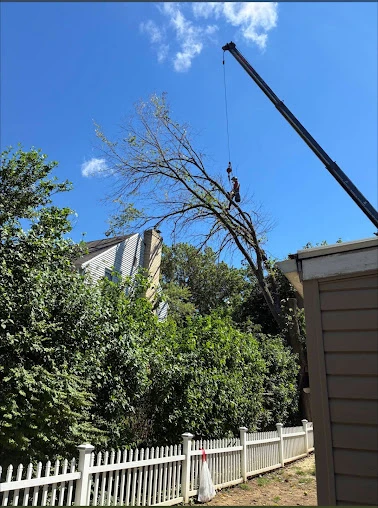
The cost curve, plainly
People assume a dead tree is cheaper because it has no leaves and weighs less. The opposite is true, and the price goes one direction over time.
A recently dead ash that is still sound can often be climbed and taken apart normally. A year or two on and it needs mechanical access, which means a bigger machine and more setup. Longer than that and you are dealing with something that may fail during the work itself, which means the most conservative and slowest approach.
And if it comes down on its own, into a fence or a garage or across the drive, you are paying emergency rates for the removal and repairing whatever it landed on. That is the version we get called out to after every real front, and it was avoidable at every earlier point.
What happens to the wood, and to the space
Two practical questions come up once the tree is down, and they are worth knowing before you book.
Ash makes genuinely good firewood, and this is the one silver lining. It splits cleanly, it burns hot, and it seasons faster than most hardwoods because it starts out relatively low in moisture. A standing dead ash is often part-seasoned already. If you burn wood, say so before we start and we will cut the trunk to length and stack it rather than putting it on the truck. Do not move it any distance, though. Quarantine thinking about ash wood exists for a reason, and hauling infested wood to a cabin two counties away is how the beetle covered this much ground in the first place.
The other question is the gap. Taking a dead ash out of a wooded edge leaves a hole, and the trees around it have grown in shelter for decades. They are now exposed to wind on a side they never had to resist. This is worth thinking about where several ash come out of the same treeline at once, which is common, because the remaining trees can end up more vulnerable than they were before anybody touched anything.
Where you are replanting, the useful advice is simply not to plant another ash. Nothing has changed about the beetle, and there is no reason to sign up for the same outcome in twenty years. Oak, maple away from structures, or something smaller under a line all make better sense.

What to do this fall
Walk your property line, particularly if you back onto woods, and look for gray barkless trunks with no leaves. Fall makes it easy because everything else is still showing color before the drop.
Prioritize by what is underneath. A dead ash in the middle of open woods a hundred feet from anything can be left to fall on its own, and there is no harm in that. A dead ash within reach of the house, the drive, the neighbor’s shed, or a power line is the one to move on now rather than next spring.
If it is on a neighbor’s or a vacant lot, the same logic applies but the route is different, and we have written separately about what you can do when the tree is not yours.
If you are not sure what you are looking at, take a photo of the trunk and one of the whole tree from far enough back, and send them through the contact form or call (412) 526-2028. Chris will tell you whether it is an ash, whether it is dead, and whether it is worth doing anything about this year.