
There is a pattern to which trees come down in Penn Hills, and once you see it you cannot unsee it. It is almost never the tree in the middle of the front lawn. It is the one at the back of the property, right where the ground starts to fall away into a hollow.
Every plan in this township eventually backs onto a ravine. That edge is where we do the hardest work and it is where the worst storm damage happens, and the reason is something that took the tree fifty years to get wrong.
A tree only builds roots where it needs them
Roots are not laid down evenly in a neat circle. A tree puts wood where it is being loaded. When wind pushes a trunk one way, the roots on the opposite side go into tension, and the tree responds by thickening exactly those roots over years. It is the same principle as a guy wire, except the tree installs the wires itself, and only where something has pulled.
Now consider a tree that grew up on a hollow edge. On three sides it is surrounded by other trees, sheltered, with the wind broken long before it arrives. On the fourth side the ground drops into open air. For decades that tree never gets a serious pull from the downhill direction, because there is nothing over there to push it. So it never builds meaningful anchor roots on that side.
It grows tall and straight and looks entirely healthy, because it is. It is simply anchored asymmetrically, and no one can see that from the surface.
Then the conditions line up
Two things have to happen together, and in western Pennsylvania they happen most springs.
First the clay saturates. Penn Hills sits on heavy soil that holds water rather than draining it, and after a wet stretch the ground around a root plate goes from something roots grip to something closer to a slurry. The mechanical bond between root and soil is a large part of what holds a tree up, and water takes it away.
Second, a gusty front comes through with the leaves on. A tree in full leaf is a sail. Wind pushes on the crown, the crown levers the trunk, the trunk levers the root plate, and on a hollow-edge tree the only thing resisting that on the downhill side is a set of roots that were never asked to do this job.
The plate lets go, and it does not go quietly. It rotates up out of the ground, taking a slab of hillside with it, and the tree lies down the slope with a wall of dirt and root standing where the base used to be.
The tell, and it is worth walking for
Here is the useful part. This failure gives warning, and almost nobody looks for it.
Before a root plate goes completely, it moves. Walk the base of any tree near your hollow edge after a real storm and look at the ground rather than the tree. You are checking for a low mound of soil lifting on one side of the trunk, often the uphill side, paired with a gap or a depression opening on the opposite side. Sometimes there is a crack in the turf following the arc of the roots, four or five feet out from the trunk.
That means roots have already torn and the plate has rotated slightly. The tree is standing on what is left. It has not failed, and it may stand for another year, but it has used up its margin and the next wet front is a genuinely different proposition than the last one.
The other thing to look at is whether the tree’s lean changed. People know their yards better than they think. If a tree looks a bit more tilted than it did last summer, trust that.
The species that show up in this failure
It is not random which trees end up on their sides at the bottom of a hollow. A few come up again and again on these edges.
Silver maple is the one we pull out of ravines most. It grows fast, gets big, holds an enormous crown, and puts down a shallow root system that was never going to hold that much tree on a slope. Plenty of them went into these yards in the fifties because they grow quickly, and the bill for that decision is coming due across the township now.
Black cherry is common along the wild edges here and it has a habit of rotting from the base up while the crown still looks respectable. Tulip poplar grows tall and straight and brittle, and it sheds large limbs before it goes over entirely.
Ash is its own situation. The emerald ash borer went through years ago and what is left standing on these edges is dead, and dead ash does not stay climbable. The wood goes brittle fast, and a tree that a climber could have worked two summers ago is now something nobody should be tied into. Those come out from the ground or off a lift, and they are worth moving on before they decide for themselves.
Oaks are the relative exception. They anchor deeper and hold on longer, which is why you sometimes see one standing alone on an edge where everything around it went down in the same event.

What a hollow removal actually involves
It is worth understanding why this work costs what it does, because people compare it to a front-yard removal and the numbers do not look alike.
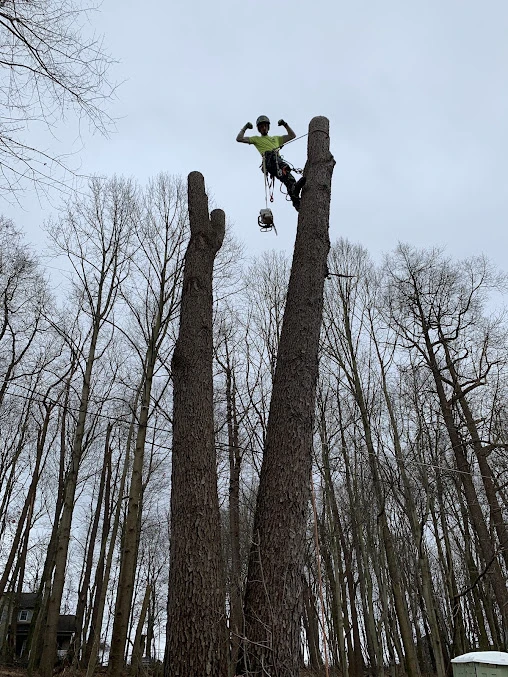
A street tree gets climbed or reached with a bucket, cut in pieces, and the wood goes twenty feet to a truck. A hollow tree has none of that. There is no vehicle access, so everything is rigged off other standing trees. Cut pieces have to be controlled on rope going downhill, because anything dropped simply keeps going and finds whatever is at the bottom. Then the wood has to come back up the slope, by hand or by winch, to reach the truck.
Add that the ground is usually soft, footing is poor, and there is often a fence or a shed underneath that everyone would like to keep. It is slow, technical work, and it is a large part of why we know this township the way we do. Our Penn Hills removal page goes into how we approach the different jobs here.
What happens to the ground after one goes over
People focus on the tree and forget the hole. When a root plate lifts it takes a slab of hillside with it, and what is left is a crater at the top of a slope with loose soil sitting above it.
That matters because it is now the lowest-resistance path for every bit of water that comes down that hill. Left alone through a wet season it starts cutting a channel, and the channel works back toward whatever is uphill, which on these lots is usually a lawn and eventually a patio or a foundation. We have been back to properties where the tree was dealt with promptly and the ground was not, and the erosion turned into the bigger job.
So when we finish a hollow removal, the plate gets laid back down into the hole where it can be, and the ground gets brought roughly back to grade rather than left as an open crater. It is not landscaping and we do not pretend otherwise, but it stops the slope unravelling while you decide what you want to do with that corner.
What actually helps
You cannot make a tree grow the roots it skipped. But a few things genuinely move the odds.
- Reduce the sail. Taking end weight off the crown lowers the leverage on the root plate. A proper reduction is the single most useful thing on an exposed edge tree. Topping is not the same thing and makes it worse.
- Look at the edge as a group rather than one tree at a time. Edge trees shelter each other, and taking one out exposes its neighbors to wind they have never felt. This is why we look at the whole line before quoting a single tree.
- Walk it after storms. Two minutes at the base of each tree, looking at soil rather than branches.
- Leave the leaf litter along that edge. Bare compacted soil on a slope sheds water instead of absorbing it and does the roots no favors.
And if you find fresh soil movement at a base, that is the call to make before the next front rather than after it. What we clean up after a storm is nearly always something that was showing this a season earlier. There is more on how we handle it on the storm cleanup page.
If you want a second opinion on something at the back of your property, call (412) 526-2028 and describe it, or send photos through the contact form with one taken from far enough back to show the slope. Chris will tell you straight whether it is worth doing anything about.