
The one that scares you
Hazard tree evaluations, answered this week
Something changed and you noticed. A lean that wasn’t there Sunday. A crack you heard at two in the morning. Mushrooms at the base that showed up overnight. You want one question answered by somebody who climbs these for a living: is this thing going to hit my house? Call and we come look, usually the same week and often the same day.

The five things that make people pick up the phone
Almost every call to this line starts with one of five sentences. The tree leans differently than it did before last night’s wind. There’s a crack in the trunk or a split where two stems meet, and it looks fresh. A shelf of mushrooms or a soft spongy collar appeared at the base of the trunk. A limb is hanging up in the canopy by a few fibers of bark. Or the crown is bare in the middle of July while every other tree on the block is green.
Every one of those is worth a look. Not every one of them means the tree comes down. A fresh lean with soil cracked and lifted on the far side of the trunk is a genuinely urgent situation, because the root plate is already moving. A tree that has leaned the same way for fifteen years with flat undisturbed soil around it is usually just a tree that leans. From the porch those two look identical. From twenty feet away with a probe and twenty five years of watching Pittsburgh trees fail, they do not.
So the honest answer to “should I be worried” is that you should be looked at, and quickly, and then most of you should stop worrying. That is what this visit is for.
Reading the failure path, not just the defect
The urgent read is a short list of questions asked in order, and the order matters. What breaks first? A trunk with a crack fails at the crack. A silver maple with a tight V union fails at the union and drops half the canopy. A root plate that’s heaving fails at the ground and the whole tree goes over as a unit. Each of those is a different failure, on a different timeline, with a different fix.
Which way does it go? Trees fall toward their weight and their lean, and Pittsburgh’s prevailing storm winds push out of the west and southwest. A dead leader hanging over your driveway on the east side of the trunk is a different problem than the same leader on the windward side. We stand under it, look up the stem, and read where the mass actually sits.
What’s under it? This is the part homeowners skip and it drives the whole answer. A hollow-based ash over an open back lawn is a maintenance item. The exact same tree over a bedroom, a gas meter, or the spot where your kid’s trampoline sits is a next-week job. The defect sets the odds. The target sets the urgency. We rate both before we say a word about what it costs.
Chris does the walking himself. He’ll sound the trunk, look at the collar, check the soil on the tension side, look for old topping cuts and included bark, and note anything the last storm already tore loose. If a defect sits too high to read from the ground, we get a climber on it or put binoculars on the upper canopy before anyone renders a verdict. You get the reasoning out loud while it’s happening, not a code on a form.
Before we get there
Move the cars out from under it. Stay out of the room directly beneath the worst limb, especially overnight. Keep kids and dogs off that part of the yard. Rope off the drip line if you have anything to rope with.
Do not go up a ladder, do not tie it off to your truck, and do not cut anything under tension. That is how a bad tree becomes a bad night at Allegheny General.
Insured, and the line answers 24/7. Photos of the tree from three angles help us triage before we arrive, and you can send them through the contact page.
“Came through did an excellent job removing a huge pine tree that was damaged in the recent storm.”
Allyson W., Google reviewThree verdicts, said out loud in your driveway
There is no fourth answer and no hedging. You get one of these before we leave.
Safe for now
The defect is real but the tree is holding, the target risk is low, or the thing that scared you is cosmetic. We tell you what to watch for and roughly when to call again. This verdict is more common than people expect, and we hand it out every week to homeowners who were braced for the worst.
Some of these turn into a pruning plan instead of a removal. Taking weight off an end-heavy limb can retire the hazard without retiring the tree.
Needs work, on a calendar
The tree has a defect that will get worse but is not going anywhere this month. We name the work, name the window, and put an up-front number on it in writing. You pick the date. Nobody is standing in your yard telling you the sky is falling to sell a Saturday.
Third verdict: it does not survive the next real storm, and here’s the crack, the lifted soil, or the rot column that tells us so. When that’s the answer we say it plainly and get on the schedule fast. Straight into hazardous tree removal, sometimes that same week.
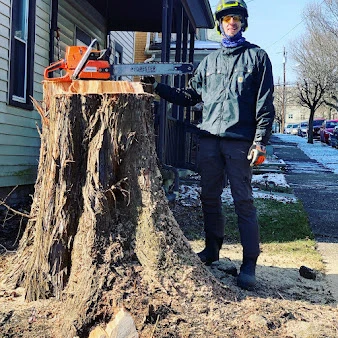
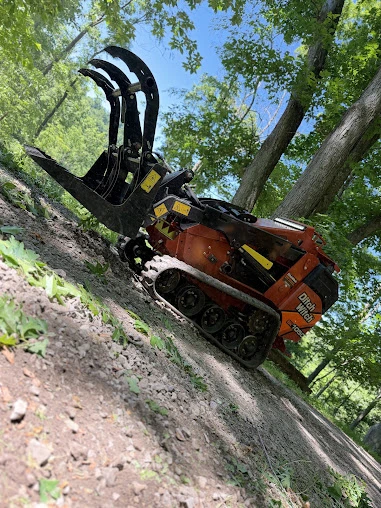
Trees that earned the third verdict, and the cleanup that followed. Our crew, our jobs.
After a storm, we look at the whole yard
When wind comes through hard, the tree that scared you is rarely the only one that took a hit. So a post-storm visit turns into a walk of the property. We check the trees you called about first, then the rest: hangers left in the canopy that will come down on the next gust, fresh tears where a limb ripped bark down the stem, soil that heaved on a tree nobody was thinking about. That whole-yard sweep takes an extra fifteen minutes and it catches things that would otherwise become next month’s phone call.
The North Hills sits on clay that holds water and slopes that put half the root plate on a downhill grade, which is why a saturated spring wind knocks over trees here that would ride out the same storm on flat ground. We see it constantly in Shaler Township, where mature oaks stand on graded hillside lots, and in Glenshaw, where old-growth canopy hangs over houses built long after the trees were already big. Etna adds tight lots and short setbacks, so a tree with a modest lean has almost no room to fail harmlessly.
If you want the systematic version across every tree on the property rather than a fast read on one, that’s a tree risk assessment, and it comes with a written mitigation plan. If nothing has changed and you just want a set of trained eyes on things once a year, book a routine tree inspection instead. This page is for the tree that changed on you recently. Photos of past work sit in the gallery if you want to see what the follow-up looks like.
The urgent-call questions
What people ask on the phone before we can get a truck there.
How fast can somebody actually look at it?
Same week is the normal answer and same day happens often, especially if the tree is over a house or a road. Text or email photos when you call. A clear shot of the base, the trunk, and the whole tree against the sky lets us decide on the spot whether you’re a Thursday appointment or a drop-everything.
It’s leaning over my bedroom and you can’t get here until Thursday. What do I do tonight?
Sleep in a different room, move the cars, and keep everyone off that side of the yard. That’s it. Do not tie it to anything, do not brace it, do not climb it, and do not let a neighbor with a chainsaw take a swing at a tree under load. Three nights of sleeping in the guest room costs nothing. A cut in the wrong place can drop the tree while you’re standing next to it.
Will you talk me out of a removal if the tree doesn’t need it?
Regularly. Plenty of what gets called in as an emergency turns out to be a healthy tree with an ugly habit, an old sealed-over wound, or a fungus that isn’t the structural kind. We’d rather tell you it’s fine and get the call again in three years than take down something that had decades left. It cuts the other way too: if it’s bad, you’re going to hear that in the same flat tone.
Do the mushrooms at the base mean it’s rotten?
Sometimes, and that’s why it earns a visit. Certain fungi feed on dead surface bark and mean very little. Others fruit only after the structural root wood is already gone, which means the tree is being held up by less than you can see. Identifying which one you have, and probing what’s behind it, is exactly the kind of call that needs somebody standing at the trunk.
Does looking at it cost me anything?
Chris comes out, reads the tree, and tells you where it stands. If there’s work to do you get an up-front number in writing before anything is decided, and there is never pressure attached to it. We’d rather be the crew you call the next three times than the one that squeezed you once.
It’s my neighbor’s tree hanging over my roof. Can you still evaluate it?
We can look at it from your property and tell you honestly what we see and what it threatens. Anything past that, including the work itself, needs the tree owner’s say-so. Many neighbors say yes once somebody credible has explained the actual risk, and we’re happy to walk it with both of you at the same time. Set that up here.
Stop staring at it from the kitchen window
One call, one walk-around, one straight answer. Either you sleep fine tonight or you know exactly what has to happen and when. In sawdust we trust.