
March to May, before green-up
Cutting the fire fuel back off your house
Nobody in Allegheny County is watching a hillside burn on the news. What we do have is a dry March, a pile of brush leaning on a garage wall, and thousands of dead ash trees standing around western Pennsylvania like kindling nobody stacked. This is the work that takes the fuel out of the first thirty feet.
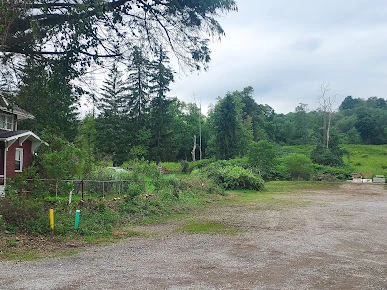
Pennsylvania has a fire season. It just isn’t the one on TV
Ask most people around here about wildfire and they picture California. Fair enough. Our version is smaller, quieter, and happens on a calendar almost nobody knows: roughly the second week of March through the middle of May, plus a stretch in October and November if the fall runs dry. The state runs a spring burn ban across most of those weeks for a reason.
The mechanism is simple once you’ve seen it. Snow melts off, last year’s leaf litter and dead grass sit exposed and cured, and the trees haven’t leafed out yet, so nothing is holding moisture and nothing is shading the ground. Two dry breezy days in April and that litter layer is as flammable as it gets all year. Then green-up happens, everything soaks up water, and the risk drops off a cliff until fall. Ninety-some percent of Pennsylvania’s wildfires start from people, mostly debris burning that got away from somebody on exactly that kind of afternoon.
Around Pittsburgh it almost never becomes a headline fire, because the topography chops the fuel up and there’s a hydrant on most streets. What it becomes instead is a grass fire on a hillside that runs into a brush pile, and the brush pile is against a detached garage, and the garage is what burns. That’s the local shape of it, and it’s the shape this work is aimed at.
The first thirty feet do most of the work
Everything in fuel reduction comes back to distance and continuity. Fire moves through material that touches other material. Break the chain close to the structure and you’ve done the majority of what a homeowner can do without a bulldozer.
So we treat the ring around the house as its own zone, and inside it three things get attention. First, dead material goes: the brush pile behind the shed, the limbs stacked against the foundation since the last storm, the dead lower branches on the evergreens by the porch. Second, ladder fuels get broken up. A ladder fuel is anything that lets a fire on the ground climb into a crown, which usually means shrubs growing tight under low limbs, or a dead branch hanging four feet off the ground with dry leaves underneath it. Cut those low limbs up and the ground fire has nowhere to go but out. Third, crowns come off the roof. Branches lying on shingles, overhanging a chimney, or bridging from a tree to the eave are how a fire that started in the yard gets inside the building.
That’s most of it. It isn’t dramatic and it doesn’t turn your yard into a gravel lot. Done right, you can’t really tell it was done, which is a hard thing to sell and the truth anyway.
Every dead ash on your property is a standing torch
The emerald ash borer went through this region hard and left a decade’s worth of dead ash behind it. You know the ones: bark sloughing off in sheets, a bare gray spire with woodpecker holes up the trunk, no leaves in July. Allegheny County has thousands of them and a lot of them are on private property behind houses.
A dead ash snag is the worst fuel object a property can have. The wood is bone dry, the bark is gone or falling, and a standing dead tree carries fire vertically the way a chimney carries smoke. It’s also the reason we push people toward removal sooner rather than later for a second, unrelated reason: dead ash gets brittle fast and unpredictably, which is why our crews will crane or rig one that has been standing five years instead of climbing it. If you’ve got gray spires along your back line, they belong on the dead tree removal list whether you care about fire or not.
Where the cut material goes, since you can’t burn it
Here’s the part that trips people up. You clear a bunch of fuel out of the danger zone and now you’re standing next to a giant pile of dry brush, which is the exact thing you were trying to get rid of. And for most of the spring you legally cannot burn it, because the statewide ban runs 6 a.m. to 6 p.m. through the highest-risk weeks, and plenty of boroughs and townships up here ban open burning outright year round.
Which is fine, because burning was never the good answer. Everything we cut goes into the chipper as we work, so it leaves as chips or leaves on the truck. You pick which. Chips can stay on site if you want them for beds and paths, though not piled against anything you’d hate to lose. Anything too big to chip rides out as firewood rounds or goes with us. Nothing sits in a heap waiting for you to deal with it later, which is the whole point of the one-and-done way we run a day.
A drive the truck can’t fit down is its own hazard
The last piece is access, and it’s the one people never think about until they need it. A fire engine is roughly ten feet wide with the mirrors out and thirteen and a half feet tall. If your lane through the trees is narrower than that, or the canopy hangs down at eleven feet, the truck stops at the road and the crew walks in with what they can carry. Same is true for an ambulance on a bad night, which around here is the far more likely call.
Opening a rural lane to a real fourteen by fourteen envelope, with turnaround room at the top, is straightforward work and it pays for itself the first time anything goes wrong. If your drive is the issue more than your yard is, start at right-of-way clearing instead, and if the fuel is mostly ground-level scrub rather than trees, brush clearing is the closer fit.
What shows up
Climbing and rigging gear for the dead standing wood, a pole saw for crown-to-roof and chimney clearance, saws and loppers for the ladder fuels, and a chipper so nothing you cleared stays on the property as a pile.
Fully insured, and a military discount for those who served.
Cleared ground and opened lanes are in the gallery. Chris has been doing this work for 25 years and will tell you plainly if your property doesn’t need any of it.
“Triple T came and fell a broken pine tree in my front yard. They were in and out in about an hour and left my yard looking better than ever.”
A Google reviewerSplitting up a fuel reduction visit
Your half happens standing in the driveway before anybody starts a saw.
Your part
Walk the ring around the house with us and point at what worries you. Say where the fire pit is, where the grill lives, where the propane tank sits, and whether that gray tree at the back has been dead one year or six. Tell us if the drive has ever been a problem for a delivery truck. Approve the up-front number.
Then say what happens to the chips, because that changes the day and the price both.
Our part
Read the property as fuel: what’s dead, what’s continuous, what would carry a ground fire up into a crown, and what’s touching the building. Clear the first thirty feet of dead material. Lift the low limbs that act as ladders. Take the crowns back off the roof, the chimney, and the eave line. Drop and remove the standing dead wood, rigging or craning it if it’s too far gone to climb.
Everything to the chipper as we cut, nothing burned, nothing left in a heap. If something we uncover is a bigger job than a fuel pass, we say so and price it on its own rather than folding it in. Storm calls jump this queue.
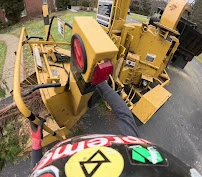
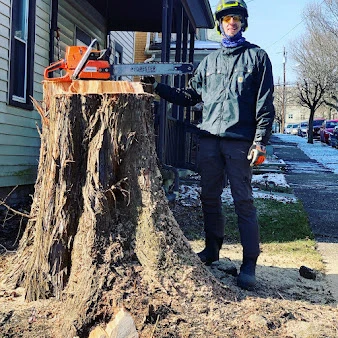
Our crew and our chipper on North Hills properties. Cut fuel rides out, it doesn’t get piled and lit.
Wooded lots north of the city, where this actually matters
The properties that need this are the ones with real trees on them, which up here means the townships. Indiana Township runs to multi-acre parcels with houses set well back behind an oak and hickory stand, so the house sits inside the fuel rather than beside it, and the drive in is often a quarter mile of gravel under a low canopy. Fox Chapel is the borough where the mature trees are the entire point of the address, which means the answer is never clearcutting anything: it’s spacing, dead limb removal, and getting crowns off roofs while the property still looks like Fox Chapel. Over in O’Hara Township the lots are tighter and back onto ravine woods, so a fire on one hillside is a fire behind four houses at once, and the fuel break has to be built at the property line as much as at the foundation.
Our ground helps and it hurts. Ravines and creeks break fuel continuity, and there’s a hydrant on most borough streets. But those same ravines funnel wind uphill, and a fire on a slope moves toward a house sitting above it far faster than it would on flat ground. If your house is at the top of a wooded bank, that bank is the direction to worry about first.
The honest timing advice: get this done in late fall or in the dead of winter. Leaves are down so we can read the property, the ground is firm, and you’re finished before the March window opens instead of scheduling into it. Late February still works. Calling us the week the burn ban makes the news means you’re in line behind everybody else who saw the same headline.
Fuel questions
What homeowners ask once they realize western Pennsylvania has a fire season at all.
Is wildfire really a concern in the Pittsburgh area?
Not the way it is out west, and we won’t pretend otherwise. What we get is a spring brush-fire window, roughly March into mid-May before the trees leaf out, when cured leaf litter and dead grass catch easily. The typical local incident is a yard or hillside fire that reaches a brush pile or a dead tree and then reaches a structure. That chain is what this work breaks.
How far back from the house should the fuel be cleared?
The first thirty feet is where nearly all the benefit sits. Inside that ring you want dead material gone, no continuous run of shrubs feeding into low limbs, and no branches touching the roof, the chimney, or the siding. Past thirty feet you’re into thinning and spacing, which helps but matters far less. If someone tells you to clear an acre, they’re selling machine hours.
What’s a ladder fuel and how do I spot one?
Anything that lets a fire on the ground climb up into a tree crown. The classic version is a shrub or brush pile growing directly under a low limb, so ground flame reaches the branch and the branch carries it up. Look for the vertical gap: if there’s a clear break of several feet between the ground growth and the lowest live branches, you’re fine. If it’s continuous from grass to canopy, that’s a ladder.
Why can’t I just burn the brush I clear?
Often you legally can’t. Pennsylvania runs a statewide burn ban through the spring fire weeks, generally prohibiting open burning between 6 a.m. and 6 p.m., and many boroughs and townships around Allegheny County restrict it further or ban it outright. Beyond the rules, debris burning is the single largest cause of wildfires in this state. We chip everything on site and haul it, so the material leaves as chips or on the truck.
Do the dead ash trees really need to come out?
If they’re near a structure, a drive, or a place people stand, yes. Emerald ash borer left this region full of standing dead ash, and a bare dry snag is both the best fuel on your property and a falling hazard that gets more brittle every year. We handle those under dead tree removal, and the older ones get rigged or craned rather than climbed.
What does a fuel reduction visit cost?
It turns on how much dead wood is standing, how thick the ring around the house is, whether the drive needs opening, and where the chips end up. A phone guess would only mislead you. Chris walks the property, reads it as fuel, and hands you an up-front number in writing. Set up a visit and you’ll usually have it inside a day or two.
Get it cut before the dry weeks in March
One walk-around, one written number, one crew day, and the dead wood and the piles are gone before the burn ban is back in the news. One and done. In sawdust we trust.