
Common ground, common trees
HOA tree work your board can actually vote on
Volunteer boards do not have a facilities department. What they have is a budget, a fiscal year, a stack of resident emails about limbs, and about twenty minutes on a meeting agenda. Triple T shows up with a written scope, photos of every tree in question, and a price you can put to a motion.
Whose tree is it, and who signs the check
Almost every association call starts with the same argument. A tree is dropping limbs, somebody wants it gone, and nobody agrees on whether it belongs to the association or to unit 14. The declaration usually says something about common area and limited common element, and the plat map usually says something slightly different, and by the time a board is calling us the disagreement has already gone three emails deep.
We settle the physical half of that question the same way every time. Where the trunk emerges from the ground is where the tree lives, and we photograph that base with something in frame for reference: a pin, a fence post, a curb, a stake at the lot corner. If the trunk sits astride the line we say so plainly and put it in the write-up, because a shared trunk changes who has authority to remove it and your management company will need that noted before anybody signs anything. We do not read your governing documents for you and we do not pretend to be your attorney. We tell the board exactly where the wood is standing and let them apply their own rules to it.
That one habit has kept more Pittsburgh associations out of arguments than anything else we do. When a homeowner insists the maple is the association’s problem and the photo shows the trunk eight inches inside their own lot, the conversation ends quickly and quietly. When it truly is a common-area tree, the board has documentation that the expense was theirs to carry, which matters at the next annual meeting when somebody asks why the reserve took a hit.
Bids that survive a board meeting
Contractors lose association work by handing over a one-line total. A board cannot vote on a one-line total. Somebody will ask which trees, somebody else will ask whether the stumps are included, and the treasurer will ask whether it can wait until after the pool contract renews. Then the motion tables and everybody loses another month while the tree keeps dropping limbs.
So the packet we hand a board president is built for that room. Each tree is listed and numbered, with a photo, a location description a resident would recognize, what we recommend, and what that line costs. Removals separated from prunings. Stump work broken out so the board can add it or defer it. The whole thing sits on one or two pages, and the up-front number at the bottom is the number, not a range that grows later. If a board wants to compare us against two other bids, that packet makes the comparison honest instead of a guessing game about what each contractor actually included.
We also write it knowing the person reading it is a volunteer who has a full-time job. No jargon that needs decoding, no codes, no line items that only make sense to a tree crew. Chris walks the property, marks it up, and puts it in plain language. A board that understands what it is buying approves it faster, and a board that approves faster gets the work done before storm season instead of after.
The assessment project versus twelve separate emergencies
Here is the arithmetic that changes how associations budget. When every ash in a development is dying at once, and around Allegheny County they are, an association can address them as one mobilized project or it can pay emergency response twelve separate times over four years as each one fails. The second path costs more, disrupts more residents, and generates far more complaints, because emergency work happens on the tree’s schedule and always at the worst moment.
One project means one setup, one traffic plan, one round of resident notices, one week of noise. It also means the association can put a real number in front of the membership if a special assessment is needed, backed by photographs of every tree on the list. Boards find that a much easier vote than showing up empty handed and asking for money because something already fell.
Making the entrance drive look like somebody is in charge
Street trees are the part of a community that people judge from the car. When half the entrance drive was planted in 1998 and the other half got replaced piecemeal after storms, the whole approach reads uneven no matter how good the landscaping is. We prune the row to a consistent clearance height and a consistent crown shape, replace gaps with the same species where that is the right call, and keep the whole line on one pruning cycle so it stays matched instead of drifting apart again.
The same discipline applies to sight lines at the entrance, at the mailbox cluster, and at every blind corner in the development. Overgrown canopy at an intersection is a liability item long before it is an appearance item, and it is one of the few tree issues a board can fix cheaply if they catch it during a scheduled visit instead of after a fender bender. See how the finished work reads in the gallery.
What the board file gets
Tree-by-tree photos, a numbered written scope, and a certificate of insurance sent directly to your management company on request.
Fully insured, twenty five years in the trade, and Chris on the phone rather than a call center.
Related work: commercial tree maintenance for the scheduled-cycle side, and tree planting when a common-area gap needs filling back in.
“Christopher and his crew arrived on time, worked safely and efficiently, and handled the entire process with real professionalism.”
Felicia Provenzano, Google reviewFrom resident complaint to closed work order
Most association tree work starts as somebody’s email. Here is where it goes from there.
The board’s part
Forward the complaints. The shading-my-patio letter, the limbs-over-my-car email, the photo somebody took after a windy Thursday. Tell us the fiscal year end and roughly what is left in the line item. Point out any unit owners we should not surprise.
Then take the written scope to your meeting. Questions between the walk and the vote go straight to Chris, and he will get on a call with your management company if that speeds up the motion.
Our part
Walk the whole property, not only the tree in the complaint, because the one generating email is rarely the one in worst shape. Photograph each trunk base against the line. Write the scope numbered and priced, split into what should happen now and what can wait a budget cycle. Post notices before the work day, stage where we agreed to stage, and hand back after photos that close the resident’s file.
Storm damage in a common area moves to the front of the line. That is emergency response, day or night, and we bill it separately from the planned scope so your accounting stays clean.
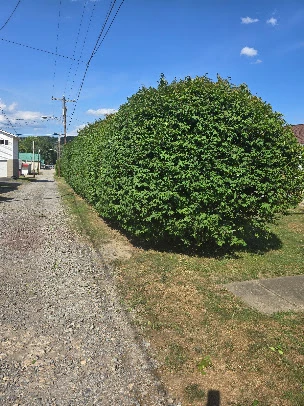

Our crew on North Hills properties. Both photos are jobs we did, not a stock library.
Townhouse courts, shared drives, and nowhere to park a chipper
The developments north of the city were built to fit as many units on the parcel as the ordinance allowed, which means the tree in the back court is often reachable only through somebody’s patio gate. In Wexford and Franklin Park we work a lot of newer townhouse communities where the shared drive is the only way in and blocking it for a morning means eight households cannot leave. We plan those jobs backward from the access problem: which unit’s driveway we borrow, where the chip truck sits without blocking a hydrant, whether the wood comes out by hand through a fence gap instead of by machine.
Older associations in Allison Park have the opposite issue. More room to work, but far more mature canopy, much of it planted at once decades ago and now aging at once too. Those are the properties where a phased plan across two or three fiscal years beats trying to solve everything in one assessment, and where a walk-through every spring catches the failures early enough to stay on the planned budget.
Either way, the common-area trees on a Pittsburgh property sit on clay soil that holds water all spring and then freezes and thaws all winter. Root plates loosen, leaders crack, and the trees that have been quietly declining for years pick a windy night to make it everyone’s problem. A scheduled look every year is how boards stay ahead of that. Get us on the property and we will tell you which trees are actually urgent and which ones can wait, in writing.
What boards ask us
Questions from association presidents, treasurers, and the property managers who work for them.
A homeowner says the tree is the association’s. How do we settle it?
We photograph where the trunk meets the ground with the lot line, pin, or fence marked in frame, and we note it in the written scope. That gives the board a dated record of which side of the line the tree stands on. Applying your declaration to that fact is the board’s call or your attorney’s, but the physical question stops being an argument once there is a photo.
Can you give us something a volunteer board can vote on?
That is exactly what we write. Each tree numbered, photographed, described by a location a resident would recognize, with the recommendation and the price on its own line. Removals, prunings, and stump work are broken out so the board can approve some items and defer others. It fits on a page or two and it is written in plain language, not trade shorthand.
Our budget year ends before we can do all of it. Can the work be split?
Yes, and for most associations that is the smart move. We mark the scope into what is genuinely urgent this year and what can safely hold until the next cycle, then hold the pricing on the deferred portion so the board is not renegotiating in twelve months. Phasing across two or three fiscal years is normal for us.
Will you send a certificate of insurance to our management company?
On request, directly to whoever needs it for the file. We carry full liability and workers comp coverage. If your management company has a vendor packet or an approval process, send it over and we will fill it out rather than making the board chase us.
How do you handle residents during the work?
Notices go on doors before the work day so nobody is surprised by a chipper at seven in the morning, and we tell you honestly how long a shared drive or court will be tied up. If a specific unit owner has been the one complaining, we send the board after photos of that tree so the resident’s message can be answered with something more than a promise.
Our courts are too tight for equipment. Is that a problem?
It is the normal condition in townhouse communities, so we plan around it. Sometimes that means climbing and lowering wood by hand out through a gate, sometimes it means borrowing one driveway for a morning with the owner’s agreement. We work out the staging on the walk-through and it goes in the scope, so the board knows the plan before the crew shows up. In sawdust we trust, and the property gets left the way we found it.
Put the tree list on the agenda with a real price attached
One walk of the property gets your board photos of every tree in question, a numbered written scope, and an up-front number the treasurer can budget against. One and done, and the resident emails stop.