
Name it first
Diagnosing what your tree actually has
Browning leaves have about nine possible causes in Western Pennsylvania, and only three of them are a disease. Chris reads the symptoms against the roster of things that actually show up here, rules out the look-alikes, and gives you a name you can make a decision on.

Symptoms are common. Causes are not.
A homeowner sees brown leaves. Brown leaves are the ending of a dozen different stories, and the whole skill in this work is running the story backwards. Where did the browning start, at the tips or between the veins or along the whole margin? Did it move inward or upward? Which species is it, and what time of year did it begin? Answer those four and the list of suspects usually drops from a dozen to two.
That’s the part a picture search on your phone can’t do. Online, every leaf photo matches everything. In the yard, the pattern is the evidence: an oak that browned from the outer canopy inward in July is telling a completely different story than an oak that browned from the bottom branches up in September. Same color, opposite conclusions, and the conclusions are worth thousands of dollars apart.
The Western PA roster, one suspect at a time
Oak wilt is the one that gets our full attention, because it’s the one that kills fast. On a red oak the leaves brown from the outer edge toward the midrib while still partly green, they drop while they still have color in them, and a tree can shed most of its canopy in a single summer. It moves through beetles drawn to fresh wounds and through root grafts between neighboring oaks, which is exactly why we don’t put a saw in an oak between April and July unless it’s already a hazard. A summer pruning cut on an oak in a neighborhood with wilt nearby is an open door.
Anthracnose is the opposite: ugly and mostly harmless. Sycamores and maples get it in a wet Pittsburgh spring, leaves develop dead blotches that follow the veins, whole shoots die back, and by the Fourth of July people are convinced the tree is finished. Then the tree pushes a second set of leaves and looks nearly normal by August. A sycamore that does this every damp spring has been doing it for forty years.
Verticillium wilt in maples has a signature you can almost see from the driveway: one whole scaffold limb dies while everything around it stays green, then a different limb goes the following year. It’s a soil fungus, it moves up through the vascular system, and cutting into an affected branch often shows an olive or greenish streak in the sapwood. Some maples live with it for years. Some die in two.
Bacterial leaf scorch fools people into thinking they’re watching drought. Leaf margins brown with a yellow band between the dead edge and the green center, it shows up late in the season, it comes back a little worse every year, and it favors pin oaks and red oaks. There’s no cure for it. There is a real difference between a tree in a slow decline you can manage and a tree that needs to come down, and pinning the name on it is what decides which.
Apple scab and cedar-apple rust hit the ornamentals: crabapples, hawthorns, serviceberries. Scab spots the leaves olive-black and strips a crabapple bare by August. Rust prints orange spots on the leaves and needs a juniper somewhere within a few hundred yards to complete its life cycle, which is why the crabapple next to the row of arborvitae is always the worst one on the street. Neither one kills the tree. Both make it look terrible every year, which is its own reason to deal with them.
Needle cast is the Pittsburgh blue spruce story, and every neighborhood has three of them. The fungus infects new needles, browns them out a year later, and works upward while the top of the tree still looks fine. A spruce that’s green up top and bare from the knees down is the most common tree call we get in the North Hills, and by the time it reaches halfway up the tree, the diagnosis and the outcome are the same sentence.
The four things that pretend to be disease
Half of what gets called disease around here isn’t. Drought stress browns leaves from the margins in, usually on the sunny side first, and it shows up on the youngest and the shallowest-rooted trees before anything else in the yard. Salt damage runs along driveways and road edges, kills whatever branches face the pavement, and stops in a straight line where the plow spray stops. Herbicide drift from a lawn treatment or a neighbor’s fence line makes leaves cup, twist, and strap out narrow, and it hits new growth hardest while the older leaves stay untouched. Girdling roots strangle a tree from the flare, produce a slow whole-canopy thinning with no spots and no lesions at all, and are only found by digging at the base until the flare shows itself.
None of those four are treated by anything sold as a disease treatment. Getting them named correctly saves you from paying for the wrong solution twice.
What we look at
Symptom pattern and direction, species, timing in the season, cut-wood staining, root flare and grade, site history, and what the neighbors lost recently.
Insured, 25 years of reading trees, and a military discount for those who served.
Once we have a name, the plan lives on the tree disease treatment page. For a routine walk of the whole property, see tree inspections. Recent work is in the gallery.
“Christopher and his crew arrived on time, worked safely and efficiently, and handled the entire process with real professionalism.”
Felicia Provenzano, Google reviewThree honest endings
Every diagnosis lands in one of these buckets, and we tell you which one before anybody talks about work.
Treatable or manageable
Anthracnose, apple scab, rust, needle cast caught early, verticillium on a tree with plenty of live crown. These respond to sanitation pruning, airflow, cleanup of infected litter, and better root-zone conditions. Some need nothing more than a dry June and patience.
A manageable diagnosis means you buy the tree years, not a cure. We’ll say which it is.
Not worth treating
Bacterial leaf scorch with the canopy already thin. Oak wilt well established in a red oak. A spruce bare past the halfway point. Advanced decay in the trunk under any of it. At that stage the money goes further on a replacement than on years of care that won’t change the ending.
We would rather lose the treatment sale than take it on a tree that’s already decided. Get a straight read and an up-front number for whatever comes next.

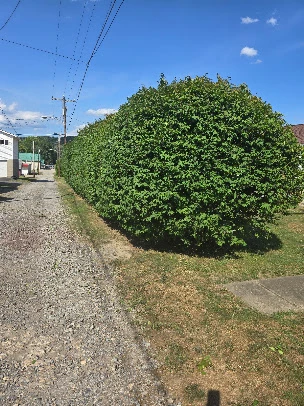
Left: some symptoms only read from inside the crown, which is where we go when the ground view is ambiguous. Right: driveway edges like this one are where salt damage gets mistaken for blight every spring.
What we find, street by street
The older properties in Fox Chapel are heavy with mature red and pin oak, so that’s where wilt questions and scorch questions come up most, and it’s also where the April-to-July no-cutting rule matters the most because the oaks stand close enough for their roots to touch. Along the river flats in O’Hara Township, damp low ground brings anthracnose on sycamore and needle cast on spruce earlier and harder than the hillsides above them. The tight older lots in Oakmont put maples and crabapples right on top of driveways and sidewalks, which is why we start those calls by asking about salt and lawn treatment before we look at a single leaf.
Pittsburgh’s clay makes all of this harder to read than it would be somewhere with real drainage. Roots sit wet in April and bake in August, and a tree stressed by that swing shows symptoms that mimic four different pathogens. That’s the reason the walk-around starts at the base of the trunk instead of at eye level, and the reason we ask what’s been dug, paved, or sprayed near the tree in the last ten years. Half of our diagnoses are settled by the answer to that question.
Before you guess
The questions that come up while we’re still standing under the tree with our heads back.
Can you tell what a tree has without a lab test?
Most of the time, yes. Species plus symptom pattern plus timing narrows nearly everything on our local roster down to one answer. Where it stays genuinely uncertain, usually oak wilt versus scorch on a red oak, a lab sample through Penn State’s plant disease clinic settles it, and we’ll tell you when the answer is worth the wait instead of guessing on your behalf.
How do I know if it’s drought and not a disease?
Drought browns leaf margins evenly, hits the sunniest side and the shallowest-rooted trees first, and shows up across several plants in the yard at once rather than on one tree alone. A disease usually picks a species and stays with it. If your maple is browning while the dogwood next to it is fine after a dry August, it’s more likely something in the maple than something in the weather.
Why won’t you prune my oak in June?
Because oak wilt spreads through beetles that find fresh cuts within minutes on a warm day. From roughly April through July, a pruning wound on an oak is an invitation. We schedule oak work for dormancy instead, late fall through winter, and the only exception is an actual hazard that can’t wait, in which case we seal the cuts immediately.
Can a lawn treatment hurt my tree?
It can, and this one surprises people every year. Broadleaf herbicide drift makes new leaves cup, twist, and come out narrow and strappy while older leaves stay normal. It often affects the side of the tree facing the treated lawn or the neighbor’s fence line. Damage that looks like this gets a question about spray schedules before it gets called a disease.
My neighbor’s oak died. Is mine next?
Worth checking, and quickly. Oaks growing within about fifty feet of each other frequently share root grafts, and oak wilt travels through them. If a red oak nearby died fast during a growing season, tell us. That single fact changes what we look for and can justify severing the root connection between the trees before anything else is done.
What does a diagnosis visit run?
Chris walks the property, reads the tree, and names what it has. If you send clear photos of the whole tree plus a close shot of affected leaves and the trunk base, we’ll usually tell you over the phone whether a visit is even worth your time. Whatever work follows comes with an up-front number in writing. Set up a visit and you’ll have it in a day or two.
Get the name before you get the bill
One walk-around, one honest answer, and you know whether you’re looking at a nuisance, a manageable problem, or a tree that’s already made its decision. No scare talk and no treatment plan for something your tree doesn’t have. In sawdust we trust.