
A corridor is a box
Right-of-way clearing measured in feet, not opinions
A lane, an easement, a farm road, a gravel two-track back to the barn. Every one of them is supposed to be a certain width and a certain height, and every one of them shrinks a foot a year until a box truck loses a mirror. We cut corridors back to a real spec and leave you a passage that a fire engine could use.
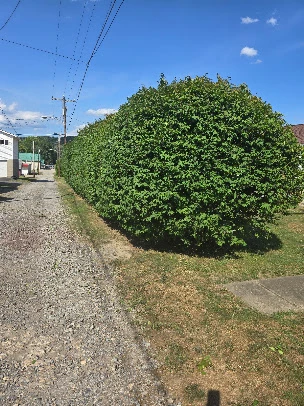
Say the width and the height out loud before anybody starts cutting
Most corridor jobs go sideways because nobody ever put a number on the finished passage. Somebody says “open it up,” a crew cuts what looks about right, and eight months later the delivery truck is still folding branches over the cab. So we start the other direction. We ask what has to fit through, and then we cut the box that fits it.
Typical numbers around here: a residential shared drive wants roughly twelve feet of clear travel width with a couple more feet of shoulder on each side, and about fourteen feet of overhead. A farm road or a logging access lane usually wants sixteen wide because the equipment is wider than a pickup and the turns are tight. If a fire truck or an ambulance has to reach a house at the back of the property, most Allegheny County departments want a wider, taller passage than people expect, closer to twenty feet across and thirteen and a half up, with a turnaround at the end. A school bus stopping at the mouth of a private lane needs sight distance in both directions before it can commit.
Once those numbers exist, the whole job gets simple. We flag the centerline, we mark the offsets, and everything inside the box comes out. Nothing outside the box gets touched unless it is dead or leaning in. That is the difference between a corridor cut and a general clearing job, and it is why people who have been burned once get very specific on the second try.
Sight triangles at rural intersections, where the accident actually happens
The most dangerous vegetation on a lot of properties is not near the house at all. It is the fifteen feet of multiflora rose, sapling maple, and volunteer locust sitting inside the corner where a private drive meets a township road. A driver pulling out has to nose halfway into the travel lane to see anything coming, which is exactly how somebody gets hit on a road posted at forty five.
That corner has a name in the traffic world: the sight triangle. The idea is plain enough. From the point where a driver stops, you need clear vision far enough up the road that a car traveling at posted speed can be seen before it arrives. On a forty five mile per hour road that is a lot of feet, and a hedge row eats it fast. We cut those corners low and keep the canopy above eye level, so a driver sees down the road instead of through a wall of green.
It is a cheap piece of work compared to what it prevents, and it is usually a half day. If your driveway has become a leap of faith, that is the job.
Who is responsible for a lane that four families share
Here is the honest part, and it is the part nobody wants to write down. On a shared private lane, the road is almost never anybody’s in particular. Sometimes the deed spells out a maintenance agreement with percentages. More often there is an easement recorded fifty years ago that grants access and says nothing about who trims what, and the lane has been maintained by whichever neighbor got tired of it first.
What we see work: the households on the lane split the corridor cut by the number of driveways using it, or by frontage, and one person calls it in and collects. We will write the number up for the whole lane and, if it helps, break it out per stretch so the math is easy to hand around at somebody’s kitchen table. We do not chase four separate payments, and we do not take sides in a neighbor argument. One point of contact, one crew day, one bill, and everybody gets a lane that a moving truck can use.
If the lane is genuinely orphaned and one household is paying alone, say so. That changes what we recommend. Sometimes the right call is a narrower corridor cut this year and the overhead work next year rather than one big push nobody can afford. Chris will tell you which sequence gets you the most passable road for the least money, which is a conversation you will not get from a crew being paid by the hour.
What comes down the lane
Saws and climbing gear for the trees worth taking whole, a grapple loader for the wood, a chipper, and a mulching head when the corridor edge is more brush than timber.
Insured, twenty five years in the trade, and a military discount for those who served.
See corridor work in the gallery. Recurring cutbacks on a schedule live on the vegetation management page, and anything close enough to touch conductors belongs on utility line clearance.
“I had a tree damaged by wind and close to falling. Triple T came out within an hour and cut it down.”
Peter Cardone, Google reviewCutting a corridor takes different hands than cutting a yard
Yard work is one tree at a time. Corridor work is a line, and the machine and the saw trade off along it.
Where the machine leads
Along the shoulders, the machine does the volume. Brush, briar, sapling stems under about eight inches, and the wall of growth that has crept in from both sides get taken by a mulching head or a grapple in a steady pass. That is fast, it does not need a landing zone, and it leaves chip on the ground instead of a pile to haul.
On soft ground we work off mats or wait for a dry stretch, because a rutted lane is worse than an overgrown one.
Where the saw takes over
Anything big, anything leaning over the travel lane, and anything with a fence, a gas meter, or a culvert underneath gets cut by hand with rigging. Overhead height is a climb, not a reach: we take limbs back to a proper cut at the collar so the tree closes the wound instead of throwing water sprouts back into the corridor in two years.
Near energized conductors we stop and coordinate. Chris is EHAP certified for line-adjacent work, so we know exactly where our limit is and who has to be called. Storm blowdowns blocking a lane jump the queue.
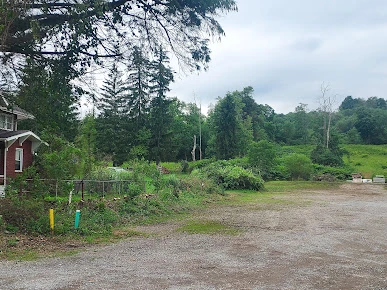

Our crew, our machines, Allegheny County corridors. Nothing here came from a stock library.
Easement letters, pipeline corridors, and the lanes behind the townships
Plenty of properties out past the city carry an easement somebody else holds. A gas gathering line, a transmission corridor, a water main, a right of access recorded before the house existed. Sooner or later the holder mails a letter saying the corridor has to be kept clear of woody growth, usually a fixed width centered on the line, and the landowner is left holding a map and a deadline. We read the letter with you, cut what the letter actually requires, and leave the trees outside that width alone.
The deep lots in Indiana Township hide long private drives that were cut for one car in 1968 and never widened. Out toward the airport, the farm roads and pipeline runs through Findlay Township and Oakdale are the ones we get called on most, usually after a fuel truck or a septic pumper says it will not come back until the lane is opened. Wet clay, fast locust regrowth, and hillside cuts that narrow every spring mean corridors here close in faster than people plan for.
If a letter has a date on it, bring us the date. We schedule corridor work around deadlines regularly, and it is a lot easier to hit one when we know about it in July instead of the week it is due. Send over the map and we will tell you what the cut actually involves.
Corridor and easement questions
The things people ask standing at the mouth of a lane with a letter in their hand.
How wide and how tall should my lane end up?
Tell us the biggest thing that has to get through and we work backward. A shared residential drive usually lands around twelve feet of travel width and fourteen feet of overhead. Farm and equipment access wants sixteen or more across. If emergency apparatus needs to reach a back house, plan on a wider, taller box and a turnaround at the end. We put the finished dimensions in writing so there is no argument later about what “opened up” meant.
Four of us use the lane. Who is supposed to pay for this?
Check your deed first for a maintenance agreement, because some of them spell out shares. When there is nothing recorded, the households on the lane usually split it by driveway count or frontage. We will write one number for the whole corridor and break it into stretches if that makes the split easier to hand around. One person books it, one crew day, one bill. We stay out of the neighbor negotiation.
I got a letter from a pipeline company about clearing my easement. Now what?
Send it to us. Those letters name a width, usually centered on the buried line, and sometimes a species or height restriction inside it. We cut to what the document requires and nothing beyond it, so you keep the trees you want and the holder gets the corridor they are entitled to. If the letter carries a deadline, tell us early and we will build the schedule around it.
Can you clear the corner where my driveway meets the road?
Yes, and it is one of the more worthwhile half days we sell. We cut the sight triangle low on both approaches and lift the canopy so a driver stopped at the end of your drive can see traffic at posted speed without nosing out. On township roads we keep the work inside your property and the road right of way limits, and if the municipality owns the strip we tell you who to call.
Will you cut wires or work next to power lines along the lane?
We work near conductors, not on them. Chris carries EHAP certification for line-adjacent work, which means we know the approach limits and we coordinate with the utility before anything comes down near them. When the job really belongs to a line clearance crew, we say so instead of taking chances. The details are on the utility line clearance page.
How often does a corridor need this done again?
A hard cut to spec buys most lanes three to five years before the edges start reaching back in, less on wet ground where locust and multiflora move fast. Some clients prefer a lighter cutback every year or two instead of one heavy push, which we set up as a recurring program under vegetation management. Either way, walk the lane with Chris and you will get an up-front number before a saw runs. In sawdust we trust.
Point down the lane and tell us what has to fit
One walk of the corridor, one written price, one crew day, and the passage is open to a real dimension instead of a guess. One and done.