
What a Hickory Stump Leaves Behind
Taking a forest-grown hickory down is the loud part. What it leaves at ground level is the part you live with: a stump that sits up off the lawn and a root flare spreading out much wider than the trunk ever looked from the kitchen window.
Here is how we deal with that stump on Franklin Park lots, depending on whether you just want it gone from sight or want to plant or build in that exact spot.
A root flare you can’t mow around
Trees that grew up in a woodlot spread a wide, shallow base. When one comes down, the flare runs out from the trunk in thick ridges that catch a mower deck, trip anybody crossing the yard after dark and hang around for years while the wood slowly breaks down.
Planting over it fails too. A new shrub set into a hickory flare sits on a slab of wood with very little soil under it, and the roots of whatever you plant have nowhere to spread.
The stump also keeps the old tree’s footprint printed on the lawn long after the canopy is gone, which is rarely what the homeowner had in mind when they asked for the tree to come out.
So on most removals up here, the stump gets handled on the same visit the tree comes down. Leaving it for later only means booking a second trip for work that was always going to be needed, and living with the lump in between.
Cutting it low before the real work
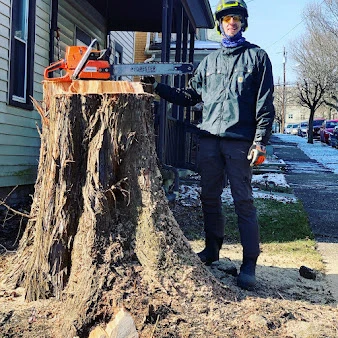
That is the work behind stump removal in Franklin Park, and the photo shows where a lot of big stumps start: waist high, right beside a house, with the saw set down on top. A stump that tall is usually what remains after a tree came down in sections, and nobody grinds one that size from the top down.
First the saw takes it as close to the ground as it can safely go. That shortens the grinding, keeps the machine working on solid wood down near the roots, and lets us read the grain and any rot in the fresh face before going further.
Near a house, that low cut also shows how close the flare runs to the foundation and the walk, which shapes the angle the grinder comes in from.
Stump work does not have to wait for spring, as the snow in this photo makes clear. If the ground will carry the equipment, the job goes ahead.
Grinding below grade, or pulling the whole thing
For most homeowners, grinding is the right call. The grinder chews the stump down below grade, the chips get raked back into the hole, and the spot is ready for topsoil and seed. The deeper roots stay where they are and break down slowly, out of sight.
Full removal is a different job. If you want to plant a new tree in that exact spot, set a patio, or build something there, the stump and the main root mass come out so the ground underneath is clear.
Tell us which you want at the walk-around. The answer changes the equipment, the time on site and what the yard looks like when we leave.
Grinding also throws a lot of chips, more than most people expect from one stump. Some go back in the hole, some get spread thin where they will not smother the grass, and anything left over leaves on the truck. You should be able to mow across that spot without hitting a pile we forgot.
People who want lawn back usually pick grinding. People with plans for that ground usually need the root mass out, and it is better to know that before the machine shows up than after it has gone home.
Before anything digs, find the lines and the tank
A stump grinder goes into the ground, and so does any removal of a root mass. Before either one starts, we want to know what else is buried down there.
Buried utility lines get located and marked before the machine touches the stump. On a deep lot, the septic tank and its drain field get the same treatment, because a big tree near a house often stood closer to them than anyone remembers.
Grinding stays clear of anything marked. If a line runs right through the flare, the plan changes to slower hand work around it or a shallower grind on that side, and you hear about it before the first pass.
Equipment reaches the stump along the same plywood path we would lay for any removal on soft ground, so the trip in does not leave a scar of its own. On a tree far back on the lot, the stump is the last stop of a difficult access removal, and it leaves by the same drag path as the wood.

Chips, topsoil and something new
Once the stump is ground, the chips go back into the hole and get raked level. As they settle over the following weeks, a layer of topsoil on top gives grass seed or a new planting a fair start.
If a replacement tree is going in, plan for the deer before it goes in the ground. Bucks rub the bark off young trunks in the fall, and a rub that circles most of a stem will kill the tree outright.
A trunk guard or a simple cage at planting costs very little and keeps the new tree alive long enough to join the canopy. With nothing growing up under the old woods here, that new tree may be the only one coming.
If the tree itself is still standing and you are weighing whether it should go, start with large tree removal, where the first question is always whether it can stay.
Questions about stumps and what comes next
Is grinding enough if I just want lawn there?
For lawn, yes. Grinding takes the stump below grade, the chips get raked into the hole, and topsoil and seed go on top. The deeper roots stay buried and rot away slowly without causing trouble. You only need the root mass pulled out if you plan to plant a tree, set a patio or build right on that spot.
Can stump work happen in winter?
Yes, and winter is often a good time for it. Firm or frozen ground carries the machine with less damage to the lawn, and the stump is easy to get at with everything around it dormant. Snow just means the area gets cleared and the edges of the beds get marked before the grinder rolls in.
Do I need to protect a new tree I plant there?
On a wooded lot, yes. Deer rub the bark off young trunks every fall, and a rub that wraps most of the way around will kill the tree. A trunk guard or cage at planting time costs very little next to the tree it protects. Ask about it before you plant, because adding it after the first rub is often too late.
Send us a photo of the stump
If a stump is sitting in your yard, or a tree is about to leave one, send a photo through the contact form or call (412) 526-2028. You get an up-front number in writing before the grinder ever shows up. More on stump removal, and the rest of our work around Franklin Park. In sawdust we trust.