
Hedges the Deer Got to First
On a wooded Franklin Park lot, a hedge has two jobs at once. It has to look tidy along the front of the house or down the lane, and it has to hold up against deer that browse anything low and green they can reach.
This post covers how we trim hedges up here, from foundation shrubs under the front windows to a long hedge running beside a gravel lane, and what to do when the deer have already left their mark on one side.
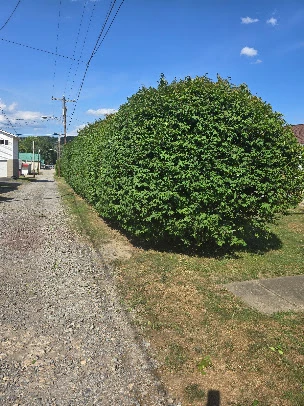
Wider at the bottom than the top
The hedge in the photo runs the length of a gravel lane, rounded and dense from the ground up. The fullness down at the base comes from how it was shaped.
A hedge trimmed straight up and down, or wider on top, shades its own lower branches. The bottom thins out, the leaves drop, and after a few seasons you are looking at bare stems along the ground with all the green perched up top.
Trimming each face so the hedge is a little wider at the bottom than at the top lets light reach all the way down. To the eye it is a slight lean on each side. Over a few years it decides whether the hedge stays green to the gravel.
It is the first thing we set on any hedge trimming in Franklin Park, on the front face and the back face both. A hedge that has already gone top heavy can be pulled back toward that shape over two or three visits, a little more off the top each time.
Hand cuts where shears would make it worse
Shearing the face of a healthy hedge keeps it tight and even, and for a hedge that has been kept in shape, the shears are the right tool.
An overgrown section is a different animal. When a hedge has gone a few years without attention, the outer layer gets thick and the inside fills up with dead wood. Shearing that face only stacks more growth onto the outside of the shell.
Those sections get hand cuts. We reach in and take thick, overgrown stems back to a point inside the hedge, which opens the interior to light and lets new growth fill in from within. The hedge can look thinner for a while afterward, and it comes back greener than a sheared shell ever would.
Foundation shrubs along the front of a house get the same judgment, one shrub at a time. Some need only a light shear. Others have crept toward the windows or the siding and need branches taken back by hand so they stop rubbing.
Now and then a shrub along the foundation is past saving: dead through the middle, split at the base, or planted so close to the wall that every cut fights the siding. That one comes out instead of getting another trim, and if it leaves a thick old base behind, we can grind that out too as part of stump removal, so the bed is clear for whatever goes in next.
Timing the trim around the frost
When a hedge gets trimmed matters nearly as much as how. Every cut tells the plant to push new growth, and that fresh growth is soft for a while.
Trim too late in the season and the soft shoots are still tender when the first hard frost arrives. They get burned back, and the hedge goes into winter with brown, damaged tips across its whole face that stay ugly until spring.
So we plan the work around the calendar. The main shaping happens early enough that new growth has time to harden before cold weather, and any late visit stays light, cleaning up stray shoots without pushing out a fresh flush of leaves.
If your hedge got missed this year, that is fine. Call, and the work gets fitted to wherever the season actually is when we come out, even if that means a light pass now and the real shaping later.
Deer browse and the hollow side
Franklin Park has heavy deer pressure. On wooded lots they have browsed the understory down to bare ground, and hedges and foundation shrubs get hit wherever the deer can reach them.
The damage tends to show as a hedge that is full on one side and hollow on the other, or full up top and stripped along the bottom. Browsing takes the low, tender growth first, which is exactly the growth a hedge needs to stay dense.
A trim cannot put back what was eaten. It can help the plant recover evenly. We go easy on the browsed side, shape the healthy side toward it over time, and leave the base room to fill back in.
If the hedge sits under a big canopy tree that shades it, lifting the low limbs with a crown raising can let light back down to the struggling side. When a whole stretch has gone bare and stays that way after a full season, it is worth a talk about cutting that section back hard or replacing it.
Clippings out of the beds, the lane swept
A trim leaves a lot behind, especially along a long hedge. Clippings fall into the mulch beds, lodge in the base of the shrubs and scatter across the gravel and the grass strip.
Cleanup is part of the job on every visit. Clippings get raked out of the beds and pulled from inside the shrubs, where they would otherwise sit and rot against the stems. The lane gets swept, the walk and driveway get cleared, and every bit of brush leaves on our truck.
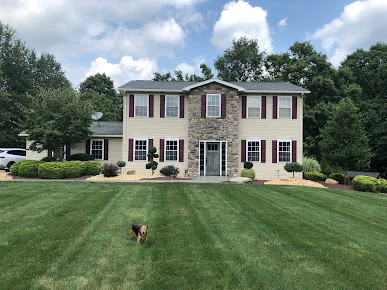
The stone house in the photo above shows what the end of a visit should look like: foundation shrubs clipped neat along the front and nothing on the lawn but the stripes and the dog.
That is one and done for a hedge. You should not be spending your evening raking up after the crew that just left.
Questions about hedges on wooded lots
Should the side facing the woods be trimmed differently?
Often, yes. The side facing the trees gets less light, grows thinner and takes the browsing first. We keep that face a little narrower at the top and lighter overall, so what sun it does get reaches the base, and we leave it fuller than the street side instead of shearing both to match.
Can an overgrown hedge be brought back?
Most can. Instead of shearing the thick outer face, we take overgrown stems back by hand inside the hedge so light reaches the interior and new growth fills in from within. It can look thinner for a season while it recovers. Very hollow sections sometimes need more than one visit to come back without losing too much at once.
When is it too late in the year to trim?
When the new growth a trim pushes out will not harden before the first hard frost. Those fresh shoots are soft, and frost burns them back across the whole face of the hedge. We do the main shaping earlier in the season and keep any late visit light, so the hedge heads into winter without a flush of tender tips.
Let us see the hedge
If a hedge along your lane or across the front of the house has gotten away from you, call (412) 526-2028 or send a photo through the contact form. Chris will take a look, and the up-front number lands in writing before any shears come out. Read more about hedge trimming, or see our Franklin Park page. In sawdust we trust.