
A Tree Two Hundred Feet Behind the House
The deep lots are why plenty of people bought in Franklin Park. They are also why the tree that needs to come out is so often the one farthest from the street: back past the deck, over the fence line, beyond the septic field and somebody’s vegetable garden.
Getting that tree out without leaving a trail of damage behind it is its own kind of job. This post walks through how we take one apart when no truck can get anywhere near it.
Mapping the way in before the way down
The first thing we figure out on a back-of-the-lot job is the route, because every piece that comes off the tree has to leave by it. We walk from the driveway to the trunk and note each gate width, every step down, the soft patches and the edges of the septic field.
Plywood goes down wherever the ground gives under a boot. The drag path gets picked to stay off the tank and the drain lines, away from the garden beds and clear of the deck posts. Brush moves out along that one line trip after trip, so the lawn sees a single narrow track instead of a dozen.
That route is the backbone of any difficult access tree removal in Franklin Park. Nobody photographs it, and it decides how the yard looks when we pull out of the driveway.
If a gate is too narrow for the equipment, we say so at the walk-around and plan around it right then, while there is still time to adjust.
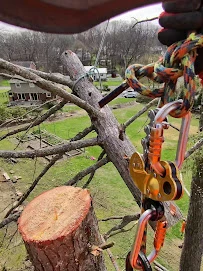
Lowering it on a block and a line
The close-up above shows the hardware that makes back-lot work possible: orange and yellow pulleys and carabiners on a rope, hung beside a freshly cut stem top, with the lawn and the neighbors’ houses well below.
A rigging block works like a pulley anchored in the tree above the cut. The piece gets tied off and cut free, and its weight swings onto the rope rather than falling. A groundworker holds the other end and lets it down slowly, steering it into the one open spot we picked for it.
That is how a heavy limb clears a fence by a few feet and settles between the garden and the deck. It is also how pieces end up on plywood instead of punching holes in the turf.
Setting the rigging takes longer than making the cuts. On a tight back lot, that time is what keeps the fence standing and the garden intact, so we never rush it to save an hour.
On the ground, pieces get cut down to a size one person can carry or drag, then stacked by the path instead of piled under the tree. That keeps the landing spot clear for the next piece coming down, and it keeps the crew from tramping a second trail across the garden to reach the wood.
What is left at the end of the limbing
When nothing with wheels can reach the tree, a climber does. He ties in high, then works down the tree limb by limb, cutting pieces small enough to control the whole way to the ground.
By the end of the limbing the tree looks like the photo below: a bare spar standing straight up with the climber at the very top of it. From there the stem comes down in sections, each one sized to what the rigging and the ground underneath can take.
It is slower than dropping a tree whole in an open field. On a back lot hemmed in by a fence, a deck and a garden, taking it apart from the top is how everything around the tree stays the way you left it.
The last sections near the base are the heaviest. Those get the shortest lengths and the most careful lowering, since they hit hardest if anything goes wrong.

Ravine trees that cannot be allowed to swing
The west side of the borough drops hard toward the runs that feed Big Sewickley Creek. Trees on those slopes have spent their whole lives holding a root plate against gravity, and when one starts to lean after a wet spell or a gusty front, it leans downhill.
That makes the rigging plan stricter. On a ravine tree we dismantle from above with the lines set so no piece ever gets the chance to swing toward the low side. Before the first cut, each section is assigned a landing spot, and that spot sits uphill of the trunk.
We also study the soil above the tree before anybody climbs. Cracks or heaving on the uphill side tell us the root plate is already on the move, which changes how much weight we let the tree carry while we work in it.
These jobs take longer to set up than to cut. A log that gets loose on a slope keeps rolling until something at the bottom stops it.
If no boom can reach it
For a tree this far back, a crane is sometimes the right answer, swinging pieces over the house to the street. Plenty of times it is not. The roads here follow the terrain with no shoulder to stage on, and a deep lot can put the tree past the reach of any boom that fits the street.
When that is the case, you hear it up front, before the job is on the calendar. The tree comes out by climbing and rigging, piece by piece, along the route we already mapped. It takes longer, and the plan says so from day one. A dead oak hanging over the roof is the exception, and that one is covered under large tree removal.
Every piece leaves by the drag path, the plywood comes up, and the back of the lot looks like itself again. A stump left at the far end can be ground out the same visit through stump removal.
Questions about trees nobody can drive to
How do you get equipment to a tree behind the house?
Mostly we leave the big equipment out of the backyard. A climber takes the tree apart from the top and the pieces travel out along a drag path we pick at the walk-around. Plywood goes over soft spots, and the route stays clear of the septic field, the garden beds and the deck posts, so the yard comes through in one piece.
What if my gate is too narrow?
Then the wood comes out in pieces small enough to carry through it, or goes over the fence on a line if that is cleaner. Nothing gets torn out to make room. We measure the gate and the path at the walk-around, so the size of each piece is settled before the climber ever goes up.
Why not just use a crane?
When a crane can reach the tree and get down the road, we use one. On many deep lots it can do neither, because the tree sits past the boom’s reach or the street has nowhere to set up. Then we climb it and rig it down, and you hear that at the walk-around, before anything gets booked.
Show us the back of the lot
If the tree that worries you is the one nobody can drive to, send a few photos of it and the route from the driveway through the contact page, or call (412) 526-2028. Chris will walk it with you and put the up-front number in writing. Read more about difficult access tree removal and our work across Franklin Park. In sawdust we trust.