
This is the call we get more often in Penn Hills than anywhere else we work. Somebody has a large tree leaning toward their house, and it is growing on the property next door, and the property next door has nobody paying attention to it.
The honest answer has three parts, and the middle one is usually better news than people expect.
Ownership follows the trunk
The tree belongs to whoever owns the ground the trunk stands on. Not the roots, not the canopy, not where the leaves land. The trunk at ground level.
So if the trunk is six inches on their side, it is entirely their tree, even if three quarters of the canopy is over your roof and every fall you are the one clearing the gutters. That part is settled and there is no clever argument around it.
Where it gets less clear is a trunk sitting right on the line. Then it is generally treated as jointly owned and neither of you can take it down unilaterally. If you are anywhere near that situation, find out where the boundary actually runs before doing anything, because fences in these plans are frequently a foot or two off the real line.
What you can do without asking anyone
Here is the part people do not know. Pennsylvania follows what is commonly called the self-help rule. You are entitled to cut back branches and roots that cross onto your property, at your own expense, up to the boundary line.
You do not need their permission for that. You do not need to give notice. It is your property that the growth has entered.
There are real limits, and they matter:
- You cut to the line and no further. Not a foot past it because the branch looks better cut there. Reaching over the boundary to make a cut is trespass and you own the consequences.
- You cannot kill the tree. This is the one that catches people. If your cutting is severe enough that the tree dies or becomes unstable, you can be liable for its value, and mature trees are valued higher than most people imagine. Taking every limb off one side of a tree is the usual way this goes wrong.
- You cannot enter their property to do it. Everything has to be done from your side or from above it.
- Roots are the same as branches. You can cut roots at the line, with the same caution, and cutting major roots on one side is a fast way to destabilize a tree that then falls on somebody.
In practice this means there is usually more you can legally do than you assumed. A canopy hanging over your roof can generally be brought back to the line, which removes most of what worries you, without any conversation with the neighbor at all. That is straightforward trimming work and we do it regularly.

When cutting to the line is not enough
Sometimes the problem is the whole tree rather than the part over your side. A dead ash, a trunk with a serious lean and heaved soil at the base, a split union: none of that is fixed by trimming your side, and a tree like that leaning at your house is a genuine hazard regardless of who owns the dirt.
The step that matters is written notice. Talk to them first, because most of the time people simply did not know, and a photograph taken from your yard showing what their tree is doing solves it. But follow it up in writing.
The reason is not to be difficult. It is that an owner who has been formally notified their tree is hazardous and does nothing sits in a very different legal position from one who genuinely had no idea. Keep a copy, include photos, and if you have had someone look at it, include that opinion. If it later comes down on your house, that record is the difference between your carrier absorbing it and your carrier having somewhere to go.
What the law will not do for you
Two expectations come up often and both are wrong, so they are worth stating plainly.
The first is that leaves, seeds, acorns and sap from a neighbor’s tree are a nuisance you can make them fix. They are not. Courts have treated natural droppings as one of the ordinary facts of living near trees, and cleaning your own gutters is your job even when the tree responsible is not yours. The exception is a genuine hazard, which is a different question from a mess.
The second is that you can bill them for work you did on your own side. If you hire a crew to cut the overhang back to the line, that is your expense, even though their tree caused it. You are exercising your right to clear your own property, not doing repairs on their behalf. The cost only shifts if the tree actually causes damage and they were on notice that it was dangerous.
Knowing both of these in advance saves a lot of frustration, and it also shapes the sensible strategy: deal with your side promptly because it is yours to deal with, and use written notice to move the liability where the real hazard is on theirs.
The vacant property version
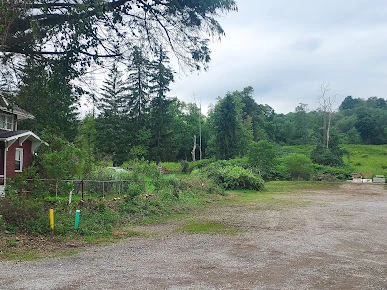
This is the Penn Hills specific case. There are a real number of vacant and aging properties across the township where nobody has touched a canopy in ten or fifteen years, and the tree that grew up unmanaged is now leaning over an occupied house next door.
Start with the county real estate records, which are public and will tell you the owner of record. It is frequently a bank, an estate, or an out-of-state address. Sometimes that is enough, because a bank holding a property does not want a liability sitting on it and will act once told.
If the property is genuinely abandoned and the tree is a hazard, code enforcement is the next call. A hazardous tree on a neglected parcel is exactly the kind of thing the municipality has a process for, and it moves faster when there is documentation showing the risk rather than a phone complaint.
All the while, everything on your side of the line remains yours to deal with, and often that is the practical fix while the ownership question grinds along.
The neighborly version, which works more often than people expect
Everything above is what you are entitled to do. It is worth saying that most of these end without any of it being necessary.
The usual situation is not a hostile neighbor. It is somebody who has not looked at the back of their own property in three years, does not know the ash is dead, and has no idea their tree is leaning at your bedroom. People do not walk their own tree lines. When you knock and show them a photo taken from your yard, the common reaction is genuine surprise.
A couple of things make that conversation go better. Lead with the specific tree and the specific concern rather than a general complaint about their yard. Bring a photo, because it is hard to argue with. And if you have already had someone look at it, say what they said rather than what you think.
The other thing that helps is going in knowing what you are actually asking for. There is a large difference between asking someone to spend money removing a mature tree and asking whether they mind if your crew takes the overhanging limbs back to the line at your cost while they are there. The second is usually an easy yes, and it often solves the whole problem for you.
Where a neighbor is willing but the cost is the sticking point, a single visit covering both properties is meaningfully cheaper than two separate ones, because the setup and haulage happen once. We are happy to quote it that way and let the two of you sort out the split.
How we handle these
Chris will walk it with you and tell you plainly what can come off from your side, where the line appears to be, and whether cutting to it actually solves your problem or just makes the tree lopsided.
If the only real fix is on their ground, he will say that rather than sell you half a job. That is a conversation we have often here, and the useful version of it includes what to put in writing to the neighbor and what a reasonable request from them looks like.
Where a neighbor is willing but worried about cost, a single visit covering both properties is usually cheaper for everyone than two separate ones, and we are happy to quote it that way. If it has already come down, that becomes cleanup work and the documentation matters even more.
Call (412) 526-2028 and describe the situation, or send photos through the contact form including one showing where you believe the line runs. None of this is legal advice and a genuine boundary dispute needs a solicitor, but most of these never get that far.