
Smaller, on purpose
Crown reduction: making a tree shorter without ruining it
The maple outgrew the yard. It is over the roof, past the wires, taller than anything else on the block, and you would rather shrink it than lose it. Reduction does that by cutting back to limbs the tree can hand the job to, so the finished tree looks like a smaller version of itself instead of a pole with stubs on it.
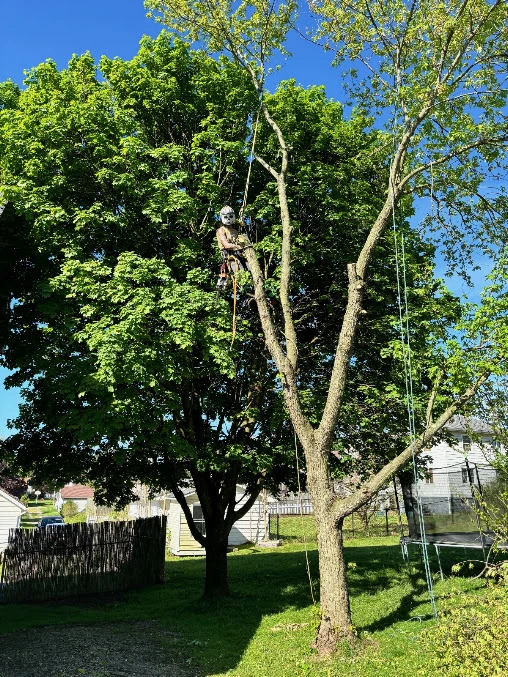
Cut back to something that can take over
Reduction is one idea repeated a few hundred times in a single tree. Instead of sawing a leader off wherever the height looks right, we follow that leader out to a side branch already growing in the direction we want, and we cut there. The side branch has to be big enough to matter, roughly a third the thickness of what we are taking off. That is the drop-crotch cut, and the reason it works is that the tree still has a living, functioning limb at the end of that stem. Sap keeps moving. The wound sits at a union the tree knows how to seal. Nothing is left hanging in the air with no leaves on it.
Do that all the way around, high side to low side, and the outline of the tree comes in. Height comes down. Spread comes in. The silhouette keeps its taper because we shortened the long stems and left the short ones alone, which is the part homeowners notice from the driveway. Six months later the tree is leafed out and looks like it grew that way. That is the whole standard we hold ourselves to on a reduction job: if the neighbors can tell we were there, we cut it wrong.
It is slow work, and honest about it. A reduction takes longer than a takedown of the same tree, because every single cut is a decision made from the saddle instead of a straight line run through the wood. Chris climbs it, reads it, and picks each target limb by hand. Twenty five years in the trade is mostly what that skill is: knowing which lateral is going to be a good leader in eight years and which one is going to sulk and die back. Walk the tree with him and he will point at the ones he is planning to cut to before the ropes come out.
Topping is not the cheap version of this
Somebody is going to knock on your door after the next storm and offer to take ten feet off the top for a fast price. What they are describing is topping: cuts made at whatever height the bucket reaches, straight through the stem, no regard for where the next limb is. It leaves stubs. Stubs have no way to seal, so they crack, hold water, and rot down into the trunk while the tree is still standing there looking fine to you.
Then the tree panics. It loses that much leaf area at once and answers with a burst of sprouts from dormant buds right under the cuts, dozens of them, growing straight up and fast. Those sprouts are anchored in the outermost layer of wood only. They are not attached the way a real limb is attached. In about five years they have put the tree back to the height you paid to lose, they are heavier than they look, and they snap out of a decaying stub in the first serious wind. A topped tree is a bigger problem in five years than it was on the day the truck showed up, and it costs more to deal with then.
We do not do it, at any price, and we will say so on the phone before we drive out. The pruning page covers the same refusal from the health side. If a tree really cannot be made small enough to work, the honest recommendation is a removal and a replant with a species that fits the spot, and we would rather tell you that than take money for something that hurts the tree.
Reduction versus the neighbors
Reduction shrinks the whole outline: shorter, narrower, same shape. Thinning is a different job and leaves the size alone.
Not every tree is a candidate. Species that respond well include maple, linden, and most fruit trees. Older oaks, beeches, and anything already in decline get a much lighter hand, or a different plan entirely.
Insured, military discount for those who served. Finished crowns are in the gallery.
“Absolutely a great worker! Professional and knowledgeable about our trees. Quick response time. 10/10 would recommend!!”
Erin Auvil, Google reviewHow much can actually come off
The honest ceiling, and what happens on the day.
The real limits
Fifteen to twenty percent of the crown is a realistic reduction on a healthy mature tree. In feet, that usually reads as five to ten off an eighty-footer, not thirty. Anyone promising to cut a tree in half and calling it reduction is describing topping with better vocabulary.
The limit exists because the tree feeds itself with leaves. Take too many and the roots starve, dieback starts in the upper crown, and you have traded a tall tree for a sick one. Stressed or older trees get less than fifteen percent, and some get nothing at all.
The work itself
Chris climbs and works the crown from the outside in, picking laterals and making the drop-crotch cuts by hand. Longest stems first so the shape stays readable while we go. Rope down anything over the roof, the fence, or the beds.
Then we back off, walk the property line, and look at it from where you look at it. Small corrections from the ground view, then chip, rake, blow the beds, and walk it with you before the truck moves. Storm-broken tops that cannot wait go through emergency service instead.


Left, working the crown from rope. Right, a finished outline that still reads like the tree it was. Our crew, our photos, our jobs.
Big trees on lots that were platted small
Reduction is a Pittsburgh problem more than most places. Whole neighborhoods here went in with silver maples and Norway maples on narrow lots in the postwar years, planted six feet off a foundation because nobody was thinking about eighty feet of eventual tree. Sixty years later those trees are past the roofline, over the service drop, and shading out everything underneath. Removing them all would strip the street. Reducing them keeps the canopy and buys another twenty or thirty years.
Along the river flats in Sharpsburg, the lots are tight and the houses sit close enough that a leaning crown becomes the neighbor’s problem before it becomes yours, so reduction there is usually about pulling weight back off one side. Up in O’Hara Township we get bigger properties with older specimen trees where the goal is holding the shape of something planted deliberately, which means smaller cuts spread over more visits. Out in Indiana Township the trees have room but the wires do not, and utility-side clearance sets the height before we do.
Season matters here too. We schedule reduction work in dormancy whenever we can, late winter into early spring, because the structure is visible with the leaves off and every lateral is easy to judge. That also gives the tree a full growing season to push new wood over the cuts before the next Pittsburgh winter sits on them. Summer reduction happens when it has to, and we go lighter when it does.
Reduction questions
Asked by people standing in the yard looking straight up.
What is a drop-crotch cut?
It is a cut that ends at a fork instead of in the middle of a stem. We follow a long branch out to a side limb that is at least a third its thickness and cut just outside that union. The side limb becomes the new end of the branch and takes over as leader. The tree seals a union it recognizes, and there is no dead stub left hanging out past the cut.
How much shorter will my tree actually be?
Fifteen to twenty percent of the crown is the honest working range. On a seventy-foot maple that is roughly seven to twelve feet, and the width comes in with it. Cutting half a tree off is topping regardless of what it gets called, and it does long-term damage we are not willing to sign our name to.
Can you reduce a tree that was already topped?
Partly. Once the sprout clusters have grown out we can select the strongest one or two per stub, take the rest off, and slowly build something closer to real structure over two or three visits a few years apart. The old rot inside the stubs stays. It is restoration, not a reset, and we are straight with people about the difference before starting.
Why would I stage a reduction over several years?
Because a big overgrown maple often needs more taken off than it can safely lose in one season. We take the top fifteen percent, let it respond for two or three growing seasons, then come back and take the next round off the new outline. Two or three passes gets you where a single aggressive cut would have gotten you, without the dieback and the panic sprouts.
Will reduction fix a tree that is leaning?
It helps in the right situation. Pulling weight and sail area off the heavy side lowers the leverage the wind gets, which is often enough on a tree that is otherwise sound. It does nothing for a lifting root plate or a cracked union, and those are the ones that actually fail. Chris checks the base and the trunk before he ever quotes crown work.
What does crown reduction cost in Pittsburgh?
It comes down to height, how much has to come off, and whether the crown is climbable or needs bucket support. Nobody can price that from a phone description, so Chris comes out, reads the tree, tells you what it can handle, and hands you a number in writing. Set up a visit and you will usually have it within a day or two.
Keep the tree. Lose the height.
One climb from somebody who knows which limb can take over, an up-front number before the ropes come out, and a crown that looks like it was always that size. In sawdust we trust.